
The Oldsmobile Muscle Car That Matched The LS6 Chevelle For Half The Price
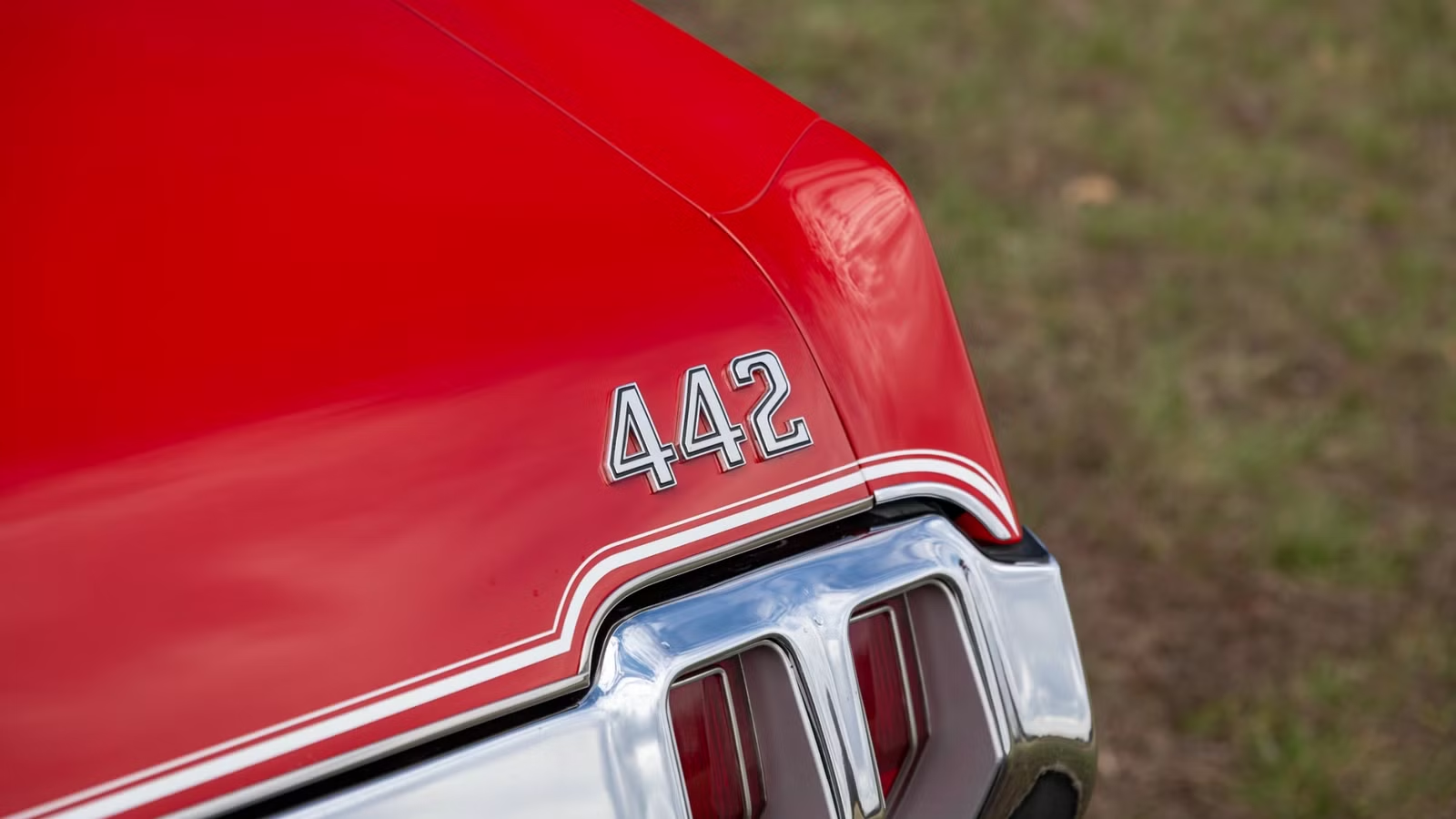
Show a muscle car fan a picture of a 1970 Chevelle SS 454 with the LS6 high-performance package, and parts of their brain light up the same way they do when you see your soul mate. It’s one of those long-standing love affairs that GM muscle car fanatics grow up with from childhood, but that doesn’t mean the LS6 Chevelle was alone in being an extremely potent mid-size muscle car. On the very same platform as the Chevelle, another General Motors nameplate did its own thing with the same formula. In hindsight, both of them were icons, but one is just a bit faster than the other.
The GM A Body: A Bread and Butter Platform for Decades

If business schools across America aren’t writing theses about the GM A platform, they really ought to be. For decades, the A body was the foundation of more great GM cars than you could name in a timely manner. Everything from entry-level commuters to station wagons, luxury cars, and some of the best muscle cars GM ever built called the A platform its foundation. Save for a brief gap between 1959 and 1964, the A body was continuously built all the way until 1981. In that time, the platform downsized from a full-size platform into the intermediate range, just in time for the muscle car wars to start.
By the mid-60s, the A platform was a relative technology juggernaut of the period, complete with a full perimeter frame, a four-link coil spring suspension in the rear, and short/long arm front suspension geometry. It used front disc brakes and supported a wide range of rear differentials depending on which of GM’s brands was being manufactured. To that end, the A body was a modular powerhouse, capable of accepting the full range of GM brands’ design cues and powertrains with an absolute bare minimum of fuss or headaches. At a time when the entire range of GM passenger cars was supported by just a few platforms, the A body was a guiding light for the whole company.
Buick led the way with the Skylark and the Special; Pontiac arguably started the muscle car age in earnest with the LeMans, Tempest, and the much beloved GTO. However, as far as Oldsmobile was concerned, things were a bit less straightforward. You see, the brand had no less than three cars on the A platform in the late 1960s, but the strategy they’d use to differentiate ’Olds from the rest of the GM lineup truly was unique for the period. In short, they were stylish, refined, AND powerful, without sacrificing in any one area to better serve the other.

Engineering an Executive Street Beast: The Anti LS6 Chevelle

Oldsmobile was the GM brand that arguably squeezed more out of the A platform than any of its sisters. The Cutlass and F-85, the two most mainstream famous A body Olds cars, melded sportiness and comfort in a way Chevrolet simply didn’t. Even if it wasn’t quite on the same level of luxury as a Buick, the Cutlass’ potent range of Rocket V8 engines and bold styling made ‘Olds arguably the more desirable brand of the two.
From the rib of the Cutlass, the mighty 4-4-2 was born in 1964, complete with a four-barrel carburetor, a mandatory four-on-the-floor manual transmission, and dual exhausts. The first-generation 4-4-2 was a marvelous muscle car, one with a 330-cubic-inch Rocket V8 (upgraded to a 400 in 1965) and an optional drop-top. Even so, it’d take just a bit longer for the 4-4-2 line to come into its own as a standalone model separate from the F-85 or Cutlass. That change came in 1968, with the introduction of the second-generation 4-4-2. Bigger, heavier, and bolder-styled than the model before it, the Gen-2 4-4-2 remained a plush gentleman’s runabout. Still, it wasn’t one that sacrificed performance to preserve the luxury experience.

The base engine for 1968 and 1969 was a 400-cubic-inch Rocket V8, but when GM lifted its 400-ci displacement cap for 1970, Olds made a massive 455-cubic-inch Rocket motor standard—the largest engine Oldsmobile ever fitted to an intermediate car. It was loud, it was mean, and it looked distinct against a sea of similar muscle cars from other brands. The 4-4-2 body could be had as a ragtop convertible or a two-door coupe, with or without a hardtop B-pillar. Still, one particular performance options package set a handful of 4-4-2s apart from the rest: a group so rare and special, they’re still talked about today.
The 4-4-2 W-30: Chevelle Who?

Not every 4-4-2 that left an American factory came from GM’s plant in Lansing, Michigan, but each one ordered with the legendary W-30 performance package sure was. The easiest way to tell if what you’re looking at is a real Gen-II 4-4-2 W-30 is the letter M stamped into the seventh digit on the VIN code in 1970 and ‘71. If it’s missing that letter M, what you’re looking at is almost certainly a fake. The brainchild of ’Olds’ Chief Engineer John Beltz, the W-30 package was the brand’s ticket into the street-legal drag racing scene that also birthed the LS6-powered Chevelle SS 454.
The package included a slew of hand-selected components that easily identified the W-30 package as unique. A fiberglass W25 forced-air hood kept the 455 Rocket V8 fed with cool air, while high-flow “F” cast-iron cylinder heads and an aluminum intake manifold improved breathing and cut weight. A special Rochester Quadrajet four-barrel carburetor put the four in 4-4-2, and mandatory JL2 front disc brakes ensured the 3,700-pound car could actually stop after a hard pull. That’s a notable advantage, because with 370 advertised horsepower and a healthy 500 lb-ft of torque, a 4-4-2 W-30 could sprint to 60 in under six seconds and hit the quarter mile in under 14 seconds.

Paired with a Type O axle with an Anti-Spin limited-slip differential exclusive to 1970, you could legitimately launch a 4-4-2 W-30 all day long and maintain consistent performance data. Compared to a Chevelle SS with the LS6 package, a 4-4-2 W-30 matched the Chevy’s 500 lb-ft torque figure at a low 3,600 rpm, while giving up an estimated 80 advertised horsepower on the high end. Of course, it is now well understood that American OEMs routinely understated power figures during this era. In reality, the 4-4-2 W-30 and Chevelle SS LS6 were within the same performance margins.
All Downhill After the Second Generation

One thing was certain: the ‘Olds was far more refined and, arguably, offered a far better driving experience anywhere other than a racetrack. With a base MSRP of roughly $3,370 for a standard 1970 4-4-2 Holiday Coupe, adding the $420 W-30 package yielded a total that works out to around $29,000 in modern money. Considering what kind of power you were working with, that was a tremendous deal. For reference, the legendary 1970 Chevelle LS6 sold for roughly $3,800.
The W-30 options package was a mainstay of the second-gen 4-4-2 for all three years of production (1970–1972). Still, when the time came to replace the model in 1973, a lingering global oil crisis and strict EPA regulations meant subsequent models were far less potent. More to the point, later 4-4-2s are commonly seen as far heavier and less cohesive in styling. The badge was neutered heavily over the next four generations, until the final sixth generation was little more than a tuned front-wheel-drive Cutlass Calais.
That means the second generation will always hold a place in the hearts of muscle car enthusiasts, and with fewer than 5,000 W-30s built between 1970 and ’72, even the more common Holiday coupes are worth as much as six figures at auction today. Rarer Sports Coupes and ragtop convertibles can easily run past $200,000 at auction, meaning the dollar-per-horsepower bargain is truly gone. Even so, the wow factor is still there, and in full force.
Source: Classics.com, General Motors

Related posts



Latest Post



No Comments