
Why the New 2027 BMW X5 Can Be Gas, Diesel, Hybrid, Electric, or Hydrogen

Article Summary
- The G65 X5 is the first BMW built from day one to share one body across five powertrains, including a future hydrogen fuel cell version.
- BMW’s chief engineer confirms the iX5 gets a 144 kWh battery, the largest the brand has built, on an 800-volt architecture.
- A new in-house computer called Heart of Joy merges chassis and drivetrain control, running roughly ten times faster than before.
BMW will sell the next-generation X5 with five different powertrains in the same body, and according to the Head of Project Michael Ahlers, that was the entire point of the project from day one. We sat down with Ahlers at an early prototype event for the fifth-generation X5, internally coded G65, to go through what’s actually changed underneath the next generation of BMW’s best-selling SUV.
Five Powertrains, One Set Of Mounting Points
Ahlers confirmed this is the first BMW model built to house five separate powertrains in a single body: petrol, diesel, plug-in hybrid, battery-electric, and eventually a hydrogen fuel cell variant. That is not a case of BMW bolting a battery into an existing combustion platform after the fact. Ahlers said the engineering for every variant started and finished on the same timeline, by design.

The proof is in the hardware. Front and rear axle carrier mounting points are identical across the ICE, PHEV, and BEV versions, even though what bolts onto those points is completely different in each case. A combustion car needs room for a driveshaft and a differential. An EV needs a housing big enough for a rear electric motor. The body-side mounting geometry stays fixed; only the hardware bolted to it changes.
That consistency extends to the rear cargo area. Ahlers said matching the trunk volume across all three driveline types in the same body, on a first-of-its-kind project, was one of the harder packaging problems the team solved.
A New Rear Axle, With The Damper Moved Outside The Spring

The previous X5 used a combined air spring and damper unit at the rear. The G65 splits the two apart, moving the damper outside the air spring on every powertrain variant. Ahlers said the reasoning is straightforward: a damper sitting inside the spring eats into the spring’s usable air volume. Pulling it out frees up more air volume for the spring itself, which lets BMW reduce damper force and improve rear-axle comfort, all while using the same mounting points regardless of which engine sits up front.
Active Roll Stabilization, On Both Axles
The G65 gets active roll stabilization at both the front and rear axle, not just the rear, which Ahlers described as new for this car. The system can disconnect each side of the axle for comfort on straight roads, letting each front wheel move independently over bumps, then link both sides together under cornering load to resist body roll. The front suspension components themselves are mounted elastically rather than rigidly, which Ahlers said is intentional: a fully rigid mount would sharpen steering feel but transmit more harshness over rough pavement, so BMW tuned the mount stiffness to balance the two.
Rear-Wheel Steering At 3.2 Degrees

Rear-axle steering returns as an option, turning the rear wheels up to 3.2 degrees. Ahlers said BMW settled on that figure after testing higher angles and finding they felt unnatural at speed. At low speed, the rear wheels turn opposite to the front, tightening the turning radius and making the X5 feel smaller in tight maneuvers like a U-turn. At higher speed, the rear wheels turn the same direction as the front, which stabilizes the car during quicker direction changes.
Staggered Tires Across The Entire Lineup, Sized Like The X7
Every G65 X5, regardless of powertrain, rides on staggered tires; wider in the rear than the front. Ahlers said the wider rear tire allows more cornering force to be put down at the rear axle, which in turn lets BMW raise the front axle’s performance ceiling as well. The wheel sizing across the lineup now matches what the current X7 uses. Ahlers was direct that bigger wheels are not simply a styling upgrade: a larger diameter and a wider rear tire both increase the air volume inside the tire, and more air volume improves ride comfort in addition to grip. The rear tire on at least one configuration measures 315 millimeters wide, close to what BMW fits to some M cars.
Chasing 50/50 Weight Distribution Across Every Variant

BMW targeted even front-to-rear weight distribution on every version of the G65, and the strategy for getting there differs by powertrain. On the BEV, the battery sits low between the axles, which lowers the car’s center of gravity even though the car is heavier overall. On the PHEV, Ahlers said the battery also sits between the axles rather than in the second-row footwell, and the fuel tank moves to a compartment above the rear axle. On the combustion version, BMW pushed the inline-six and the transmission as far back and as low as possible against the firewall, continuing a packaging approach the brand has used for years.
The iX5: An 800-volt System And BMW’s Largest Battery
The electric iX5 will use a 144 kWh battery in the US market, which Ahlers confirmed is the largest battery pack BMW has built for a production vehicle. The car runs an 800-volt electrical architecture across the front and rear motors, which Ahlers said supports high charging power (we expect at least 400 kW), though BMW has not released specific charging time or range figures while the car is still in the final phase of homologation.
“Heart of Joy”: One Computer For Chassis And Drivetrain

The G65 introduces what BMW calls the Heart of Joy, a control unit developed entirely in-house that, for the first time, merges drivetrain control and chassis control into a single processor. Ahlers said the project began as two separate teams; chassis engineers and drivetrain engineers, working independently before the two efforts were combined. The resulting unit is roughly ten times faster than its predecessor, and Ahlers said that speed is what lets the system coordinate the front motor, rear motor, and brakes in real time to stabilize the car.
Towing Capacity Holds Across All Five Powertrains
BMW has not released towing figures yet, but Ahlers confirmed that high towing capacity will be available on every variant, including the hydrogen fuel cell version, not just the combustion and PHEV models that traditionally handle towing duty on this segment.
Exterior Details: Rear Hip Design And New Door Handles
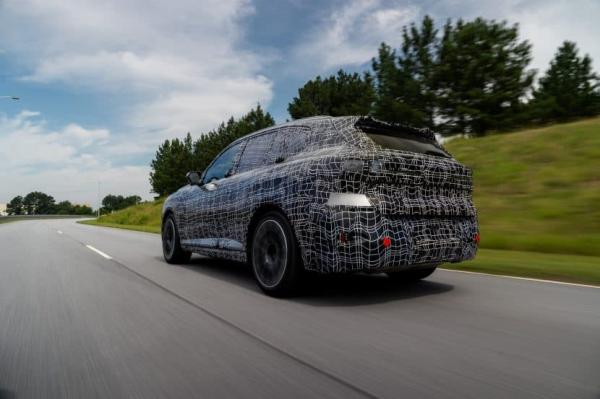
The prototype’s bodywork includes a distinct lowered character line at the rear hips, which Ahlers said exists for aerodynamic reasons as much as styling: lowering that area reduces drag, which improves both fuel economy on combustion variants and electric range on the BEV and PHEV. The G65 also carries over BMW’s flush, touch-activated door handles, which Ahlers said trade a small efficiency penalty from a conventional handle for a one-handed, no-mechanical-movement opening action.
BMW is expected to fully reveal the production G65 X5 at the end of this month.

Related posts




Latest Post


No Comments