
Ford’s 427 Side-Oiler Street Car Almost Nobody Saw Race
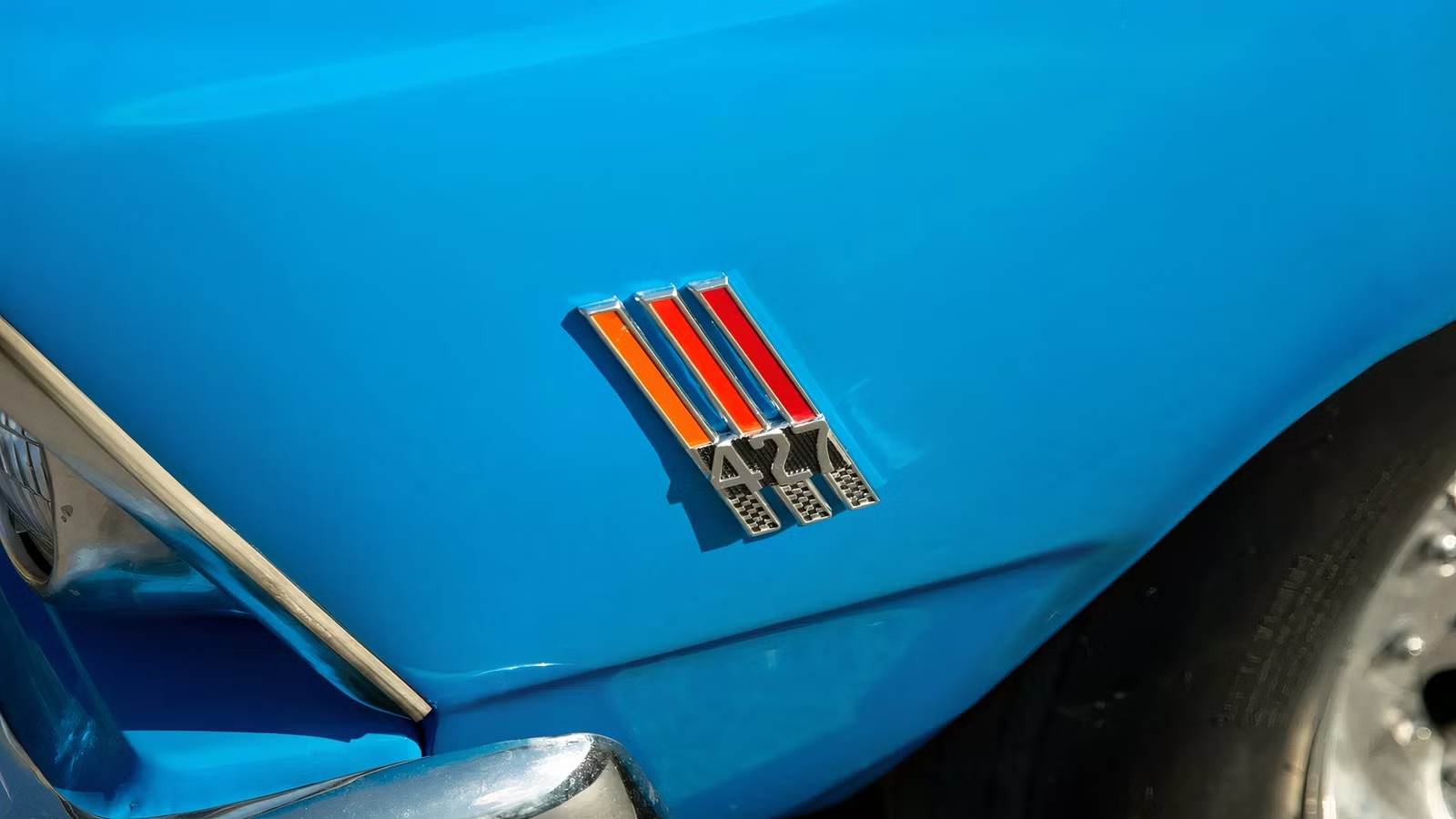
There’s no dearth of Ford’s 427 stories that end at Le Mans, Daytona, or the drag strip under cars that already became legends. But, for those wanting in on the action, Ford sold a handful of brutal big-block cars that looked almost too plain for the job.

The engine everyone remembers for GT40 heroics, NASCAR stockers, Shelby Cobras, and lightweight drag weapons also slipped into a few street cars regular buyers could technically order. “Technically” is doing some heavy lifting there, because these were expensive, kind of awkward, low-volume cars built around racing rules.
Ford’s Loudest Racing Engine Had A Street Car Problem
Ford’s Total Performance era was a company-wide flex. It stretched from NASCAR to sports car racing to drag strips and anything else with a checkered flag nearby. The 427 FE big-block became one of the main weapons in that campaign because it had the displacement, breathing, strength, and intimidation Ford needed in the early ’60s.

The engine’s 4.232-inch bore and 3.784-inch stroke gave it a short-stroke, oversquare layout, which helped it rev harder than a big-block had any right to. This was a serious competition engine that happened to fit under the hood of certain production Fords. But racing fame only went so far when the rulebook got involved. Stock-class racing needed showroom credibility, and Ford couldn’t simply point at Le Mans or the Thunderbolt program and call it done. Some version of the hardware had to be available to the public.
That’s where the street 427 cars enter the story. The reason behind them wasn’t a clamoring for expensive, high-strung, dual-carb big-block family cars. Rather, Ford built them because racing rules, brand image, and factory pride all pointed in the same loud direction.
Homologation Turned Ordinary Fords Into Factory Weapons

The Ford Galaxie helped set the tone. In the early ’60s, Ford’s full-size family car became one of the strangest carriers of serious performance hardware, especially when the 427 arrived. The R-code version used dual four-barrel carburetors and made 425 horsepower, while the single four-barrel Q-code was rated at 410 hp.
Built To A Sizeable Cost

That’s what makes these cars substantially cooler than a simple ‘big engine in normal car’ story. Ford was using showroom-available big-block cars to legitimize its racing program. A Galaxie with a 427 could sit in a dealer’s window and quietly say that the stuff tearing around tracks had at least some bloodline connection to what buyers could order. That said, the 1963 R-code Galaxie wasn’t cheap. With the R-code 427 and mandatory four-speed, its sticker climbed to $3,488 (or about $36,000 today), which was stupid money for a full-size Ford. Ford built 3,857 R-code 427 cars for that shortened model year, making it rare but not invisible.
The Galaxie also showed the compromise baked into this whole idea. Buyers got enormous power, but they also got old-school chassis hardware, heavy controls, and full-size mass. A 427 Galaxie was less like a modern performance sedan and more like a barbell with a VIN.
The 1966 Fairlane R-Code Was The One Nobody Could Get

|
Engine |
Power |
Torque |
Transmission |
|
FE 427 Side-Oiler V8 |
425 hp |
480 lb-ft |
4-speed manual |
If the Galaxie proved Ford could sell the 427 to the public, the 1966 Fairlane R-code made the idea sharper and meaner. This was the midsize street-legal 427 car that almost nobody actually bought, partly because Ford built only 57 of them. That was barely over the 50-car threshold needed for NHRA certification.
Every 1966 Fairlane 500 R-code came with a black all-vinyl interior and a four-speed manual transmission. The engine was the 427 side-oiler, rated at 425 hp at 6,000 rpm and 480 lb-ft of torque at 3,700 rpm. It used dual Holley four-barrel carburetors, a medium-riser aluminum intake, solid lifters, and 10.5:1 compression.
Ford stripped the car down in the right places. The R-code package brought a mandatory Toploader four-speed, manual steering, 11.375-inch front disc brakes, a 9-inch rear axle with 3.89 gears, and a freer-flowing 2.25-inch dual exhaust system. Body sealer and unnecessary caulking were left out, which tells you exactly how little Ford cared about making this thing feel plush.
The money was crazy. A base Fairlane cost $2,378.40, but the 427-8V engine race-car package alone added $1,725.20. One documented car carried a $4,529.37 price (roughly $50,000 today), which meant people were paying big money for a Ford Fairlane with steel wheels, dog-dish caps, and the personality of a lit firecracker.
Don’t Confuse The Side-Oiler For Just A Big-Block Party Trick

The side-oiler name was crucial because it wasn’t fluff. Traditional FE oiling sent oil through a path that fed the top end before prioritizing the crankshaft’s main bearings. The side-oiler block changed that with a cast-in oil gallery running along the side of the block, drilled to feed the main bearings first before sending oil upward.
At racing speeds, that showed the difference. The 427 could spin hard, and keeping the crank properly lubricated was the difference between durability and a very expensive noise. The side-oiler also used a forged crankshaft, reinforced main-bearing webs, cross-bolted main caps, and solid lifters.
Sizeable Differences

The street Fairlane version still used a more livable 10.5:1 compression ratio compared with more aggressive competition setups, but ‘livable’ is doing a lot of work here. We’re still talking about a dual-quad, solid-lifter, priority-main-oiled 427 in a midsize Ford with manual steering and a four-speed.
It’s worthwhile bringing up again that the Fairlane R-code wasn’t a Thunderbolt, and it definitely wasn’t a GT40 with plates. The Thunderbolt was a lightweight drag special with a much more extreme mission, while the GT40 took the 427 to international sports-car glory. The street Fairlane and Galaxie 427 cars sat in the weird middle ground: factory-built, publicly available, rulebook-relevant, and still close enough to normal cars to make the whole thing feel slightly weird.
Other Icons That Carried Ford’s Legendary 427 Side-Oiler

The Side-Oiler was a highly specialized, expensive racing engine that was never intended for mass production. It was strictly reserved for legendary track cars, ultra-exclusive sports cars, and a handful of rare, race-homologated street muscle cars built in the mid-to-late 1960s. The most iconic Ford powered by this remarkable powerplant is the Ferrari-crushing Ford GT40 Mk II, which used the engine’s reliability and straight-line speed to clinch a historic 1-2-3 victory at the 1966 24 Hours of Le Mans.
Carroll Shelby, who created the GT40, also used the engine to turn the little-known British AC Ace into one of the most feared American sports cars of the day – the Shelby Cobra 427. Cobras equipped with the Side-Oiler are far more expensive than earlier models, mostly thanks to the engine.
In the muscle car world, the Fairlane and Galaxie weren’t the only Blue Oval products that received the engine. The Mercury division also installed it in the 1968 Cougar GT-E to dominate the street performance wars and models like the Comet Cyclone to terrorize drag strips across America. Few engines of the era found success in as many different forms of motorsport as the 427 Side-Oiler, from superspeedways to quarter-mile tracks.
How To Tell If A Ford 427 Side-Oiler Car Is The Real Thing

The popularity and sheer scarcity of Ford’s 427-powered muscle cars has inevitably led to countless clones, tribute builds, and engine swaps over the decades. Because so few factory side-oiler cars were built, serious collectors typically rely on organizations such as the Ford Performance Club, Shelby registries, Marti Reports, and marque-specific historians to verify authenticity. These organizations typically check build sheets, specific engine codes, and other pieces of documentation that identify them as factory-installed performance cars.
There are also visual differences that can give you a clue as to whether or not you’re looking at the real deal. A genuine 427 side-oiler can usually be identified by the external oil gallery cast into the left side of the block, cross-bolted main bearing caps, and correct FE-series casting prefixes such as C5AE-H, C6AE-B, or C8AX on the side of the block. The factory 427 cars also usually included unique supporting hardware that is difficult and expensive to duplicate accurately, including Toploader four-speed transmissions, heavy-duty suspension components, factory front disc brakes, and specific exhaust systems.
Solid Bang For Your (Considerable) Buck

The 1966 Fairlane R-code was expensive when new, obscure when built, and scarce enough today that finding one feels more like spotting a vintage race transporter than shopping for a normal muscle car. One 1966 Fairlane 500 ‘427’ R-code sold for $265,000 in 2019, after earlier auction appearances showed high bids of $225,000 and $250,000.
A lot? Probably, but remember that only 57 were built, and they carried one of Ford’s most serious engines, with a direct connection to NHRA homologation. They also avoided the obviousness of more famous halo cars. Everyone knows a Shelby Cobra is special. A plain white Ford Fairlane with dog-dish caps asks you to know the password first.
Ford’s Secret

The Galaxie R-code market looks a lot more approachable in comparison. A ’64 Galaxie R-code 427 showed recent asking prices of $76,995 and $87,000. That puts it in a different collector lane from the tiny-production Fairlane, though condition, year, body style, and authenticity can swing values.
That’s why the Fairlane still feels like the one with the better story to tell. It feels like Ford accidentally sold a secret: a 425-hp 427 side-oiler street car built in tiny numbers because the rulebook demanded proof. The Galaxie gave Ford‘s big-block racing push a showroom footprint, whereas the Fairlane left 11s on that footprint.
The Side-Oiler Was The Best FE, But It Wasn’t The Only Icon

The 427 Side-Oiler is undoubtedly the ultimate evolution of Ford’s FE big-block family, and it played a central role in Ford’s historic 1966 Le Mans victory, but it wasn’t the only FE engine to leave a lasting mark on automotive history. Long before the Side-Oiler arrived in 1965, earlier “Top-Oiler” FE engines — which earned their name by routing oil to the valvetrain before feeding the crankshaft’s main bearings — had already powered some of Ford’s most important racing victories and performance icons.
While the Top-Oiler design worked well in lower-stress racing environments, especially drag strips, Ford engineers discovered that sustained high-rpm racing could leave the bottom end vulnerable, which is why they created the Side-Oiler.
Legendary Top-Oiler Variants
- 427 “Low-Riser” V8 Q-Code
- 427 “Low-Riser” V8 R-Code
- 427 “High-Riser” V8
One of the earliest FE Top-Oiler legends was the 406 V8, introduced in 1962. It helped put Ford’s big Galaxies in NASCAR contention and paved the way for the larger 427 that followed. The “Low-Riser” debuted in 1963 and was the initial production format of the 427. It was built in two configurations: a single four-barrel (Q-Code) version rated at 410 hp and a higher-compression dual four-barrel variant (R-Code) with 425 hp on tap. The Low-Riser powered cult legends like the Galaxie Lightweights that painted drag strips with rubber in 1963 and some of the earliest Shelby Cobra 427 development cars.

The Top-Oiler’s greatest triumph came with the original 427 High-Riser engines that preceded the Side-Oiler. Introduced midway through the 1964 season to counter Chrysler’s 426 Hemi, the High-Riser was one of Ford’s most aggressive factory FE race engines. It featured dramatically raised intake ports, a larger intake manifold, and a taller cylinder-head design that allowed the engine to breathe far better at high rpm than the earlier Low-Riser. The High-Riser powered the 1964 Galaxie Lightweights that helped Ford stay competitive in NASCAR’s escalating horsepower wars, but its most famous home was in the 1964 Ford Fairlane Thunderbolt, a purpose-built drag racer created to dominate NHRA Super Stock competition.
What About The 428 FE?

The 428 was introduced in 1966 as a larger-displacement, lower-cost alternative to the 427. While both engines belong to the same Ford FE engine family and share external dimensions, Ford gave the 428 a narrower bore and longer stroke for massive low-end torque, making it better suited to heavy street cars. It also lacked cross-bolted mains, making it much cheaper to mass-produce.
The 428 FE became Ford’s ultimate street-performance engine towards the end of the ’60s, reaching legendary status with the 428 Cobra Jet and the even more potent 428 Super Cobra Jet. Powering icons such as the Mustang Cobra Jet, Mach 1, Torino Cobra, Fairlane Cobra, Cougar Eliminator, and Cyclone Cobra Jet, it traded some of the 427’s race-bred sophistication for immense low-end torque and became one of the most feared drag-racing engines of the muscle car era.
Sources: Hemmings, Classic.com, Ford

Related posts

Latest Post


No Comments