
SLP’s 1997 Firehawk Is A Rare Pontiac Muscle Car Built For Just 29 Buyers
Muscle car royalty is usually measured in cubic inches and calendar years — specifically, the years between 1964 and 1972. But every so often, a car slips through a later decade that carries the same raw, uncompromising spirit as those golden-era machines. The 1997 Pontiac Firebird Firehawk is exactly that car. Built in almost absurdly small numbers, fitted with an engine borrowed from one of America’s most iconic sports cars, and sold quietly through regular Pontiac dealers, it’s the kind of vehicle that rewards those who know what they’re looking at. Most people drove right past it. That was their loss.

By the ’90s, the muscle car landscape had shifted dramatically. Incredible JDM performance cars had given enthusiasts a compelling alternative, and the Dodge Viper, with its bonkers V10, was pushing American muscle in a whole new direction. It would be easy to assume the decade was slim pickings for low-production, collectible models — but one stands out above the rest. This is the rarest Firebird of the era, packing a proper thumping V8 sourced from a no-nonsense sports car. If the spirit of ’60s muscle could be distilled into a single ’90s machine, this was probably it.
HotCars used experts Classic.com and Hagerty for prices of the model featured in this article. This article is not designed as buying or investment advice.
The 1997 Firebird Firehawk Is One Of The Rawest ’90s Muscle Cars

The Firebird was born in 1967 into a world of legendary muscle cars. It was Pontiac’s pony car answer to the Mustang, sharing some components with the Chevrolet Camaro while projecting a slightly more free-spirited personality. Interestingly, it wasn’t the ’60s that defined the Firebird — it was the decade that followed, a period most remember as the hangover from the muscle car party, when models shed power along with buyers.
The late ’70s Firebird managed to capture the zeitgeist of the disco era, with the Screaming Chicken on the hood and gold and black everywhere. If a car could be John Travolta strutting into the club, it was the Firebird Trans Am. After that high point, the Firebird made do with four-cylinder motors and traded off its rich history rather than offering much to get excited about, aside from the likes of the 20th Anniversary Trans Am.
The Fourth-Generation Firebird Had A More Pebble-Like Appearance

The fourth-gen Firebird arrived in 1993, swapping the squared-off, macho looks for a more rounded, aerodynamic aesthetic. This generation received a Corvette LT1 V8 under the hood from the outset, which gave it genuine potential — though it was also the beginning of the end, with the model being the last of the line before Pontiac phased it out in 2002. But it wasn’t all doom and gloom. This Firebird was the one that went back to its roots with ever-increasing performance, which culminated in the glorious WS6. But there was another ultra-rare Firebird that a lot of people might not remember — one with a special engine and all the right ingredients to make it a legitimate muscle car. Was this the true return of the golden era?
There Was A Very Special Firehawk For 1997

Pontiac dabbled with a few special-edition versions of the fourth-gen Firebird, such as the Trans Am GT, but it was the Firehawk that showed the company was serious about reviving the muscle car. These cars were built by SLP Engineering and sold through Pontiac’s official dealer network — and they were genuinely refreshing.
SLP took Firebird Formulas and fitted them with a range of upgrades. Earlier LT1 cars received a lightweight composite hood with functional ram air scoops, plus Corvette cold-air induction, which reportedly lifted output by 25 horsepower. Later additions included a Level II Bilstein Sport Suspension Package and a Torsen limited-slip differential, along with visual touches to help the Firehawks stand apart. These cars were never big sellers — according to Newgmparts.com, Pontiac moved no more than around 100 in any given year. The company pressed on regardless, and by 1997 decided to offer a radically upgraded Firehawk.
SLP’s 1997 Firehawk Borrowed The V8 Out Of The Corvette Grand Sport
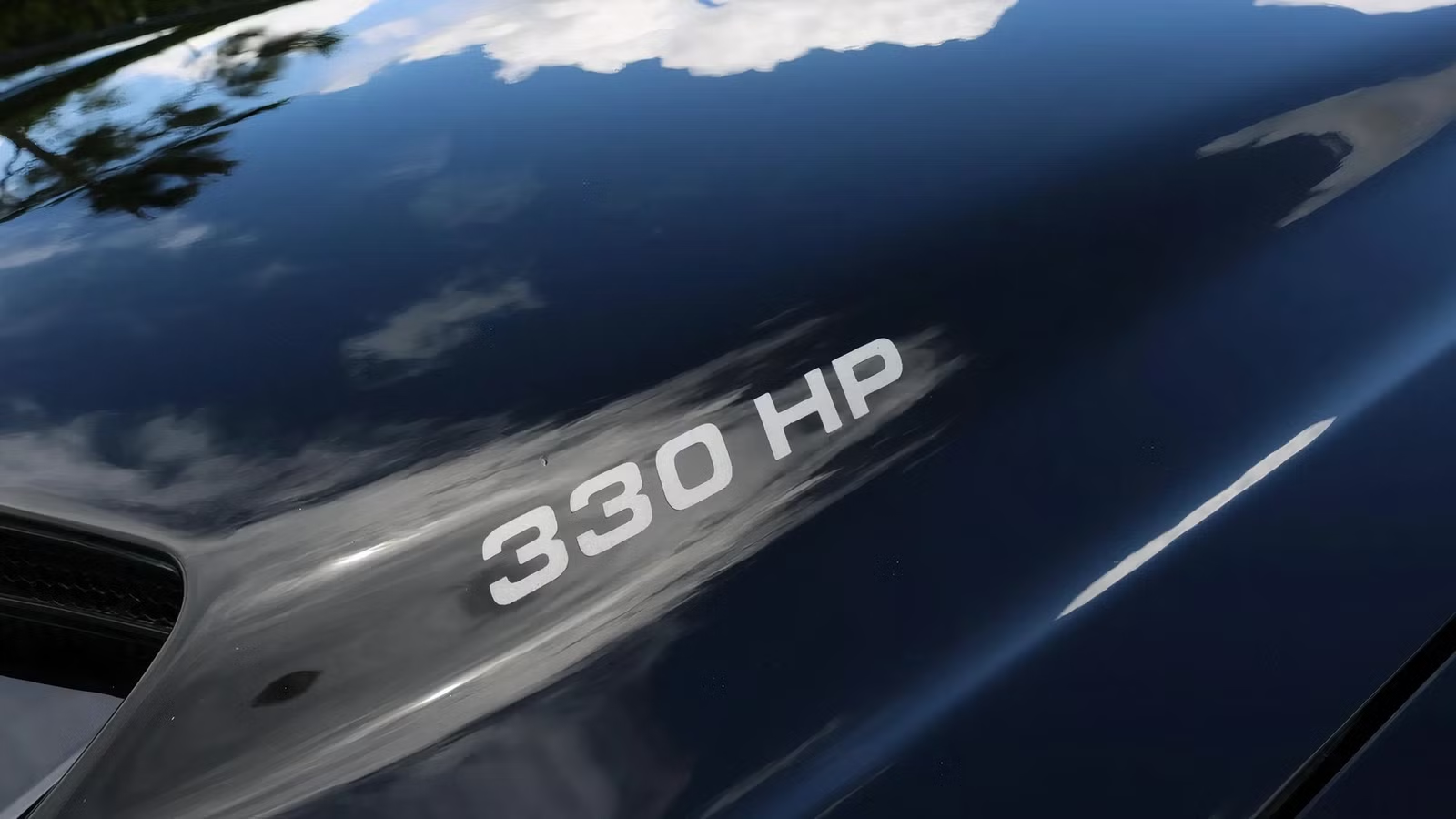
The 1997 models came fitted with the LT4 V8 sourced from the Corvette Grand Sport, which makes them extra special. The free-revving LT4 in the Firehawk produces 330 horsepower, courtesy of reworked ports, higher-flow-rate injectors, a high-lift camshaft, larger valves, and higher-compression pistons. SLP Engineering managed to secure the last 150 of these blueprint units — Motor Trend reports the company used some to power a handful of 30th-anniversary Camaros, reserving the rest for Firehawks. A Borg-Warner six-speed manual transmission is the cherry on top for this ’90s modern classic.
It’s worth noting that all 29 LT4 Firebird Firehawks were equipped with the six-speed manual. The same holds true for all 100-plus Camaros rolling with the LT4 engine that year. This is a notable detail because SLP was never exclusive to stick-shift cars, building plenty of automatics over the years. While automatics certainly have their place, this factor makes these special-edition cars feel even more like muscle car royalty.
The LT4 Firehawk Is Ultra Rare

|
Engine |
Power |
Torque |
0-60 MPH |
|---|---|---|---|
|
5.7-liter LT4 V-8 |
330 HP |
340 LB-FT |
5.3 seconds |
In the end, just 29 Firehawks were built in 1997 with the LT4 engine, otherwise known as the ‘Alteration Package’. These cars also came with grippy low-profile tires and a revised suspension tune. The following year saw no Firehawks at all, and when the model returned in 1999 it was fitted with an LS1 — meaning the LT4 Firehawk may well be the rarest Firebird ever sold through Pontiac dealers.
Motor Trend tested one of the LT4 Firehawks at launch and came away impressed. The car hit 60 mph in 5.2 seconds and covered the quarter mile in 13.4 seconds — genuinely quick numbers for the era. For context, Ford’s top-end Mustang SVT Cobra of the late ’90s made 320 horsepower and 317 lb-ft of torque, reaching 60 mph in 5.5 seconds.
What About The Other Ultra-Rare Firehawk?

The LT4 Firehawk is an extremely rare car, but some experts may point out that there is another that’s just barely more scarce. SLP built just 25 Firebird Firehawks for the 1992 model year, which technically makes it rarer than the star of this article. However, it was powered by the L98 engine, the L98 engine, which was commonplace for the third-gen Firebird. The only Firebirds to ever feature the LT4 engine were the Firehawk models produced in 1997, which is why we consider it to be the rarer of the two.
Another Rare SLP Firehawk

SLP wasn’t a massive automaker, and naturally, many of the cars it worked on were exceedingly rare. Some years it produced just a few hundred Firehawks. Even then, a handful of those cars were often turned into special editions that collectors would be wise to snap up when the opportunity arises.
Another SLP Firehawk based on the fourth-generation Firebird is the 10th Anniversary Edition. For the 2001 model year, SLP released a limited-run variant to celebrate the milestone. While it carried the ubiquitous LS1 under the hood — not that there’s anything wrong with that — a distinctive black-and-gold theme set it apart from standard cars. Of the 540 units produced that year, just 139 were 10th Anniversary SLP Firehawks, making it one of the rarest examples out there. If nothing else, it’s easily among the most visually striking variants, with throwback styling that any gearhead could appreciate.
The WS6 Is A Close Second

A common question among collectors and enthusiasts is whether to pursue a Firehawk or WS6 Firebird Trans Am. The two are comparable in that they’re both performance-oriented variants of the Firebird, but they aren’t exactly the same, and the right answer depends on what you’re after.
The WS6 was a factory-available package for the Trans Am or Formula models, featuring handling upgrades and a Ram Air hood. While factory-backed, SLP did incorporate a number of aftermarket upgrades for the Firehawk that Pontiac didn’t have access to. Performance-wise, that gives the Firehawk a slight edge — though its exclusivity also makes it better suited for collectors who want to preserve it, while the WS6 is the smarter choice if you want a car you can drive and enjoy without guilt. A 1997 WS6 can’t be had with an LT4, but it remains a thoroughly rewarding machine.
Buying A 1997 Pontiac Firehawk In 2025
Hagerty notes that despite the Firebird continuing in production until 2002, the 1997 Firehawk remains the most desirable and valuable for collectors, thanks largely to its exotic and rare engine designation. These cars very rarely come up for sale, and when they do, they attract significant interest. It’s worth noting that early fourth-generation Firehawks, which featured fewer modifications, are relatively affordable. According to Classic.com, a 1994 model averages around $22,575, while 1995 examples tend to command a little more. The 1996 cars can be found for as little as $12,500.
The Super Rare LT4 Firehawks Sell For Almost Double What Standard Cars Go For
For the 1997 model year, standard Firehawks trade for roughly the same money as earlier cars, but LT4 models frequently sell for double that figure — one example reached $43,900 in 2024. Hagerty values good-condition examples of the hottest Firehawks at around $42,700, while cars in excellent condition carry an average value of approximately $59,600. By contrast, a desirable 2001 Pontiac Firebird Trans Am WS6 with 325 horsepower has a good-condition value of $28,500, and a 2002 coupe goes for around $19,000. For such a rare machine, an LT4 Firehawk in the low-to-mid $40,000 range seems like a compelling proposition — though where the collector market heads from here is anyone’s guess. Could this be a great classic Pontiac muscle car investment for the future? Only time will tell.
Sources: Classic.com; Hagerty.com.

Related posts



Latest Post


No Comments