
The Road Car Bruce McLaren Never Finished Gets A 500-Unit Manual V8 Successor
There are plenty of stories throughout automotive history of projects that never got finished. McLaren’s had its fair share of those. That includes a project started by founder Bruce McLaren that could have made it a road car manufacturer much earlier. While this car never got fully realized, a brand-new model is finally finishing what Bruce started.
McLaren Is Now Known For Its Brilliant Road Cars, As Well As Its Racing Machines

If you’re a younger enthusiast, you’ll know McLaren for its brilliantly-engineered road cars as well as for its racing prowess. That wasn’t always the case. McLaren was purely a race car manufacturer for a long time, until the legendary F1 came along. After the end of the F1, there was a long gap (with the McLaren-Mercedes SLR in the middle of that) before McLaren finally committed to a regular road car lineup.
McLaren Was Originally Going To Build A Road Car Decades Before The F1
Most people will view the start of McLaren’s road car journey as the F1. That’s actually not the case. Back in the 1960s, Bruce McLaren had already made concrete plans to produce a road-going version of one of his race car designs. It even got as far as two prototypes being built, with Bruce picking out one for himself. This car is known as the M6GT, and it was designed for FIA Group 4 racing. The road-going version was powered by a 5.7-liter Chevrolet small-block V8, which was tuned by Bartz. This gave it 370 hp and 370 lb-ft of torque, running to the rear wheels through a 4-speed ZF manual transmission.
The reason the M6GT didn’t survive beyond the prototype stage wasn’t because it was a bad car. It was mainly because of Bruce McLaren’s sudden death in 1970.

The McLaren McL 6GT Is A Retro-Styled Supercar Designed For The Most Hardcore Driving Enthusiasts

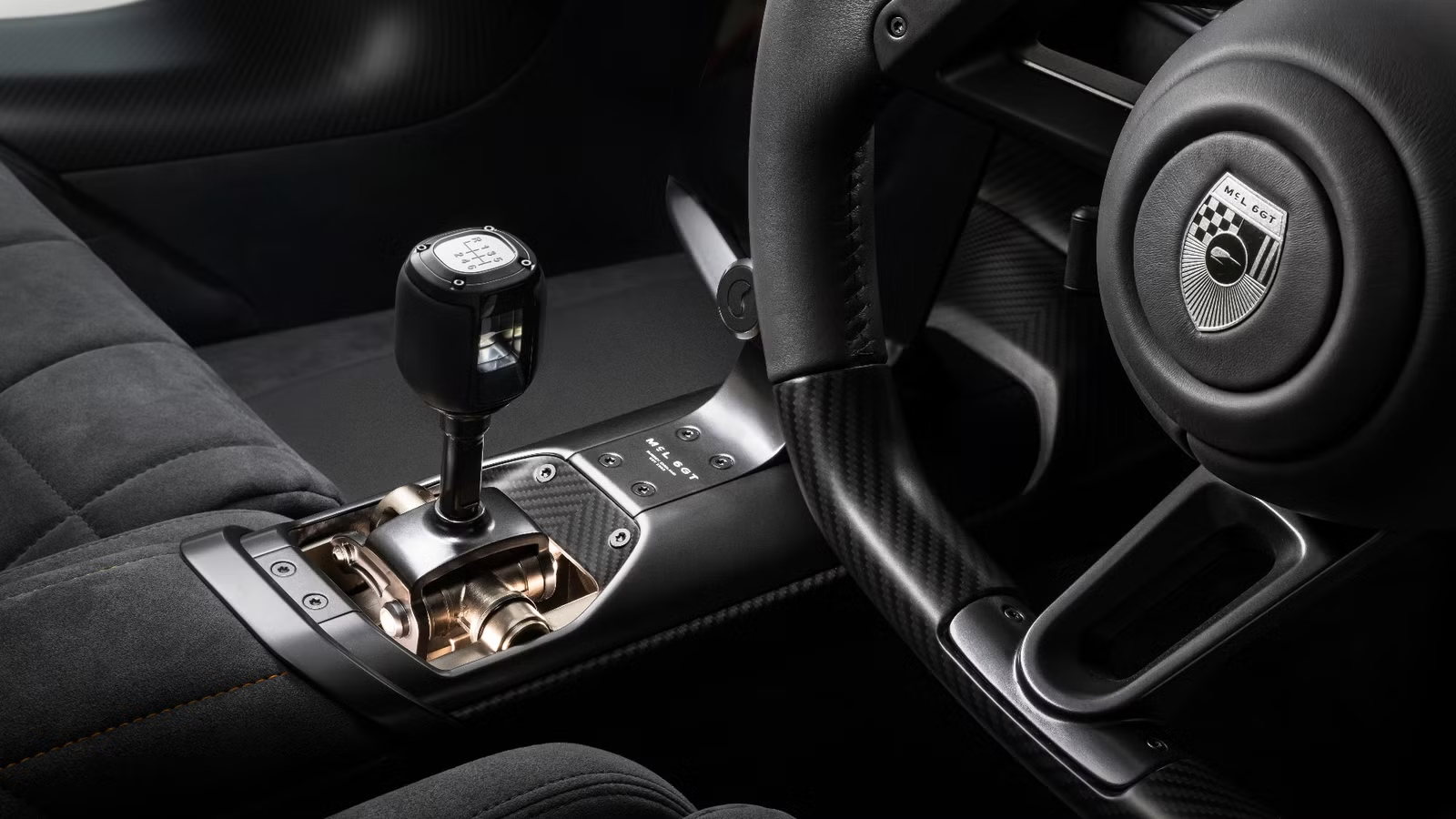
While the M6GT may have never entered production, its legacy and influence has survived to this day. That’s nowhere more apparent than in McLaren’s latest road car offering. The McL 6GT is intended to be a return to McLaren’s roots, aimed at the most hardcore driving enthusiasts who have the means and are devoted fans of the brand. The car’s design pays deliberate homage to the M6GT’s looks—compare them side by side and you can see the similarities right away. It’s also dripping with nostalgia, including touches like the original McLaren “speedy kiwi” logo on the steering wheel and the exposed titanium gear shift linkage.
The McLaren McL 6GT’s engine is very much up to date—a 4-liter twin-turbocharged V8 that’s expected to produce anywhere between 777–800+ hp and 590 lb-ft of torque. But the way that power is delivered is very old-school. It’s rear-wheel drive, and it’ll only be available with a 6-speed manual transmission. That makes the McL 6GT the first McLaren since the F1 to have a manual transmission from the factory.
Only A Small Number Will Be Made

As you’ll have guessed by now, the McL 6GT is a pretty niche vehicle. So, it’s not surprising that only a small number of them will be made. McLaren states that 500 McL 6GTs will ever be produced, and customer deliveries are planned to start in 2028.
The McL 6GT Finally Fulfills Bruce McLaren’s Dream From The 1960s
The McLaren McL 6GT may be important as a very analog car in a digital age. But that’s not the real reason why this car is historic for McLaren. Where it’s truly important is that it has finally fulfilled Bruce McLaren’s dream. Both its looks and its engineering philosophy are as close as you can get in today’s world to Bruce’s original M6GT. Both those aspects of the McL 6GT are simple and purist—clean lines influenced by classic sports cars, paired with a powertrain that shuns complex modern systems in favor of giving the driver the purest experience possible. Even the limited production run is similar to Bruce’s original philosophy for the M6GT. The M6GT was a homologation special, so only a small number needed to be made to make it legal for FIA Group 4 racing.
While Bruce McLaren never lived to see a road car made under his original direction, McLaren’s new owner CYVN Holdings has realized how important his original vision is to the brand and made sure to respect it. That was especially evident in how much time chief designer Kemal Curic spent getting tiny details, like the feel of the gear shifter, right. “We went through so many iterations of it. Not just how it looks, but how it feels in your hand, and the craftsmanship behind it,” Curic said. “In general, we were obsessed with the interior. Around the steering wheel, everything at your fingertips. We spent a great deal of time on things like that, so the car doesn’t just look great from the outside, but feels great on the inside as well. So that as a driver, you really feel engaged.”
The McL 6GT Isn’t The Only Raw, Analog, Modern Supercar Waiting To Be Unleashed

The McLaren McL 6GT is getting a lot of attention at the moment for its raw, analog interpretation of what a modern supercar can be. But, it’s far from the only one waiting to be unleashed on the world. McLaren F1 designer Gordon Murray has been hard at work on the Gordon Murray Automotive (GMA) T.33, a V12-powered supercar that prioritizes old-school driving enjoyment over advanced technology. While customer cars were originally supposed to be delivered in 2024, delays have meant that customers won’t receive them until as late as 2027.
Former Koenigsegg designer Sasha Selipanov has also been hard at work on his Nilu27 supercar. Powered by a hand-built V12 made by Hartley Engines in New Zealand, this supercar promises a raw experience with no turbochargers or hybrid assist and a proper manual transmission.
Source: Chapter, Gordon Murray Automotive, McLaren, Nilu

Related posts




Latest Post



No Comments