
The Motorcycle Engine That Can Make 100,000 Miles Look Routine
On a motorcycle, a six-figure odometer reading usually makes owners nervous. Most riders start budgeting for an engine rebuild the moment they see it, and that fear isn’t baseless for high-strung, high-revving machines. Cruisers, however, do things a little differently. Their owners tend to hold on for a decade or more, and the engines are built to match.

Big displacement, relaxed tuning, and old-school hardware allow a few V-twins to clock six-figure mileage with little drama. Among them, one American powerplant has earned a reputation for treating 100,000 miles as a little more than a milestone on the way to somewhere further.
What Helps A Motorcycle Engine Reach Six-Digit Odometers
Longevity in a motorcycle engine rarely comes from a single clever feature. It is about how hard the engine has to work to generate power. A high-revving engine from a sports bike packs more heat and more power strokes, all of which result in wear on internal engine components like pistons, bearings, and the valve train.

By contrast, an engine that makes its power at lower revs causes less wear on engine components. An engine that has been tuned sensibly with simple valvetrains and regular oil changes ensures better longevity. That is why the engines with the best reputations for six-figure mileage are usually conservatively tuned.
Big Air-Cooled V-Twins Have Been Known For This Particularly Well

On paper, the big air-cooled V-twin engines appear to be the weaker option. A modern liquid-cooled engine, on paper, runs cooler, makes more power for its displacement, and breathes through multiple valves per cylinder with overhead cams. An air-cooled engine, in comparison, does run hotter, especially in traffic, relies on pushrods, and produces less power. However, the old-school engine wins the race when it comes to long-term ownership.
Big displacement engines produce lots of torque at a lower crank speed, resulting in less stress on engine components. Air and oil cooling mean fewer complicated parts like hoses, pumps, and seals, which eventually start to leak in the long run. The result is an engine that requires fewer components and very few consumables to replenish or replace over many years of riding. Less fuss results in a better ownership experience that is easier on the wallet, and six figures on the odometer do not seem extraordinary.
The Indian Thunderstroke 116 Makes Six-Figure Mileage Look Ordinary

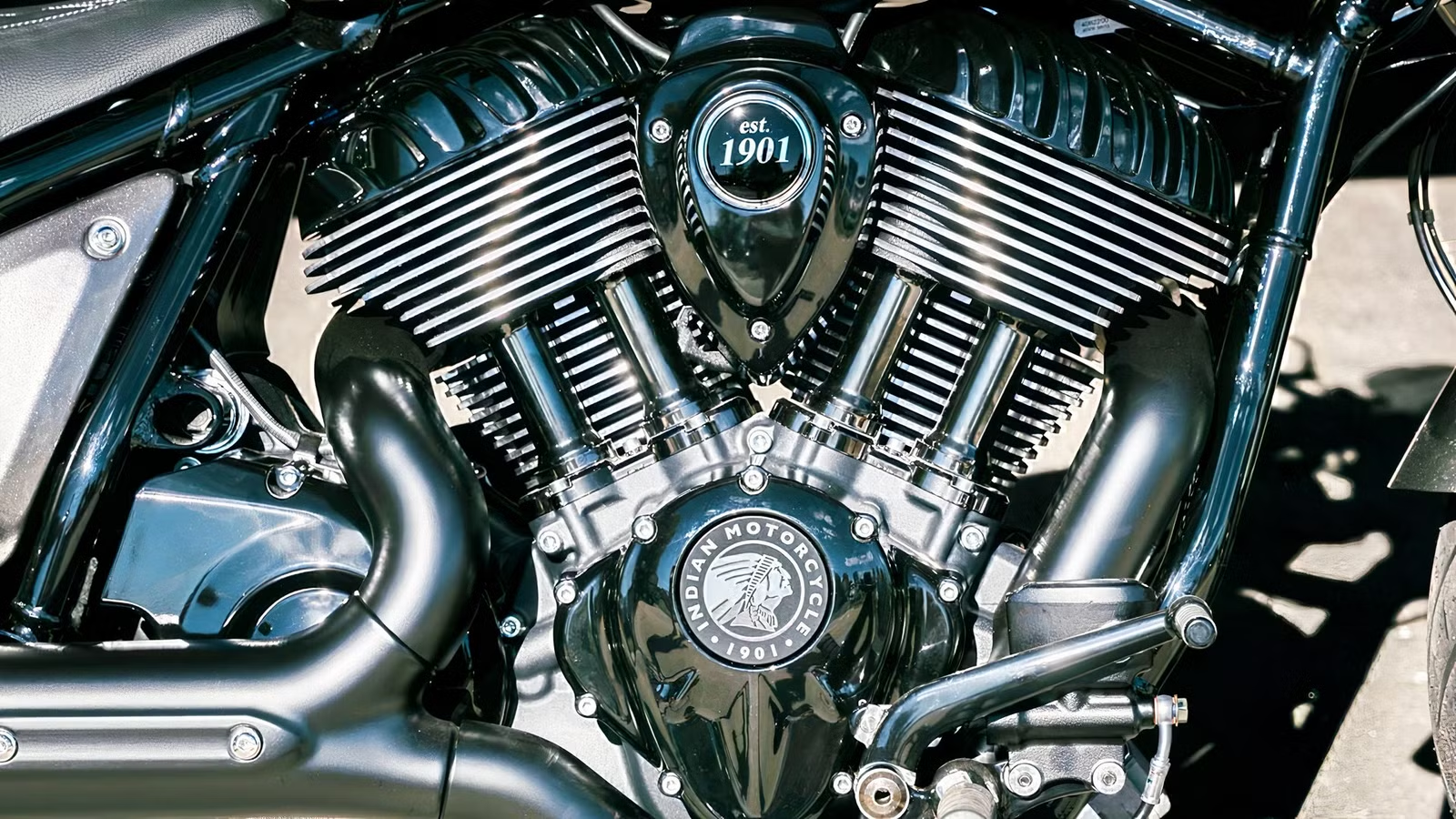
Indian’s Thunderstroke 116 follows this formula. This is the largest engine that Indian fits into a production motorcycle—a 1,890cc air-cooled V-twin. Instead of modern liquid-cooled technology, the manufacturer has chosen to stick to proven hardware. Two valves per cylinder, pushrod actuation, and a long stroke that makes its torque low in the rev range.
Depending on the model, Indian rates it for up to 126 pound-feet, delivered through a six-speed gearbox. Nothing in this powertrain is fragile or highly strung, and that is the point. The robust Thunderstroke 116 was designed to run hard for years, not to win a spec-sheet contest.
The Evolution Of Indian’s Thunderstroke Engine

Indian revealed the Thunderstroke 111 at Daytona Bike Week in March 2013 to power the brand’s 2014 models. It was the company’s first clean-sheet engine in decades – an air-cooled 49-degree 1,811cc V-twin. This engine drew inspiration from the 1948 Chief and accumulated a million miles of testing before launch. Indian introduced the bigger Thunderstroke 116—the successor to the 111. With a higher compression ratio of 11:1 compared to the 111′s 9.5:1, high-flow cylinder heads, a larger bore, and 20 percent more power, the Thunderstroke 116 took over the job. The brand, however, kept the long-stroke geometry for low-end grunt and durability.
Old-School Hardware Is The Secret To Longevity

The Thunderstroke 116 features old-school hardware, built with durability in mind. With a compression ratio of 11:1, a 4.449-inch stroke, and just two valves per cylinder operated by pushrods, this engine proves that simplicity is the key to longevity. With a claimed peak torque at a relaxed 2,900 rpm, the engine performs quite well at lazy speeds.
Every internal component spins slower, with less stress and wear, when compared to a high-revving motor. None of this makes the engine primitive, but it does explain why it can survive tens of thousands of miles with absolute ease.
A V-Twin For Owners Who Never Plan On Trading Up

For buyers who plan to keep a motorcycle indefinitely, this Indian V-twin is worth serious consideration. On the highway, the low-end torque gets the bike moving effortlessly regardless of gear. Maintaining highway speeds does not strain the engine—it remains composed rather than working hard to keep up.
In town, it can crawl along in traffic in first or second gear without excessive clutch work. Thanks to the simple design, fewer moving parts turning slowly under light loads add up to less wear per mile. This helps the engine with longevity, and with fewer parts, maintenance isn’t much of a hassle.
Its Ownership Experience Stays Simple, Too

Living with the Thunderstroke 116 stays refreshingly uncomplicated. Self-adjusting hydraulic lifters mean fewer service visits compared to a more complex valvetrain. Oil and filter changes are required at 5,000-mile intervals. Being a simple air-cooled engine with high displacement, it tends to run hot, and even hotter in stop-and-go traffic.
However, Indian offers rear-cylinder deactivation, which shuts off the cylinder closest to the rider’s leg once temperatures rise past 59 degrees Fahrenheit. As soon as the throttle is opened, the cylinder comes back to life. Running costs are notably low, with owners reporting around 40 MPG thanks to the engine’s low-revving nature. All these aspects ensure an ownership experience that will keep owners happy in the long run.
High-Mileage Owners Make The Strongest Case

The Indian Motorcycle Forum backs the engineering with real-world owner accounts. One owner has ridden a Roadmaster past 100,000 miles without the engine or transmission ever being opened up. Another example is an Indian motorcycle that has covered around 446,000 miles with no engine work—an exceptional demonstration of longevity.
A member of the forum owns three Thunderstroke-powered bikes, including a 2014 model that has clocked 95,000 miles and a 2017 example with 60,000 miles on the odometer. A used motorcycle with 80,000 miles is something potential buyers may shy away from. However, a used Roadmaster with 80,000 miles attracts buyers like a moth to a flame. This tells a story that no brochures and spec sheets can explain.
The Thunderstroke 116 Powers A Variety Of Motorcycles Today

Even though this is the biggest engine that Indian offers, the Thunderstroke 116 is available in a slew of motorcycles. This engine is available across Indian’s big-cruiser lineup. For a vintage look, the Chief Vintage and the Super Chief Limited are available. For a stealthier aesthetic, the Chief Dark Horse, Chief Bobber Dark Horse, or Super Chief Dark Horse are strong options. Those who prefer a sportier stance have the Sport Chief and Sport Chief RT to choose from. The Springfield, Chieftain, and Roadmaster are the touring-oriented Indians with the Thunderstroke 116 engine. Whatever the style, every model shares the same unhurried, long-lived engine underneath.
Source: Indian Motorcycles

Related posts

Latest Post


No Comments