The Most Reliable Hybrid SUV: Toyota, Honda, Or Lexus?
9 minutes reading
Saturday, 25 Jul 2026 12:00 0 80 autotech
You will likely face long daily commutes that drain your household budget. Driving tens of thousands of miles each year forces you to spend thousands of dollars on fuel and routine vehicle maintenance. High automotive operational expenses compress your finances even more, making cost-cutting a priority.
These escalating ownership costs force you to consider a hybrid vehicle. Transitioning to a hybrid lowers your per-mile expenses significantly. However, long-term reliability determines your actual savings. Deciding between a Toyota, Honda, or Lexus hybrid SUV is critical to ensuring maximum value, lower maintenance bills, and dependable everyday performance.
Three Japanese Brands That Dominate The Hybrid Industry
Toyota
When it comes to reliability and efficiency, American consumers typically gravitate towards Toyota and Honda. These two brands have consistently been the leaders in hybrid SUV and sedan sales by noteworthy margins. They are veterans in the industry, having introduced gasoline-electric hybrid models to the U.S. almost three decades ago, via the original Toyota Prius and Honda Insight. This level of experience gives these brands the edge in the hybrid automotive sphere.
Lexus is the only luxury car brand that gets to leverage hybrid technologies from a mass-market parent brand, making it the leader in hybridization in the premium segment. Honda doesn’t do the same for its Acura brand, so we can’t include this sub-brand in a match-up that highlights who makes the most reliable SUV. Reliability scores are usually the best signifier to discover which brand gets reliability right, especially when consulting the iSeeCars 200,000-mile reliability estimate.
Lexus Aces Hybrid Reliability With The RX 350h
Front 3/4 shot of a blue 2026 Lexus RXLexus
The 2026 Lexus RX 350h earns top marks when it comes to reliability. iSeeCars indicates that you can expect it to have an average lifespan of 5.1 years or 176,939 miles, with a 35.8 percent chance of reaching 200,000 miles. J.D. Power gives the model an 85/100 overall score, including 85/100 for quality and reliability, 82/100 for the driving experience, 84/100 for resale, and 87/100 for the dealership experience.
iSeeCars backs this with an 8.3/10 overall score, including 8.6/10 for reliability, 8.2/10 for retained value, and 8.0/10 for safety.The publicationalso highlights that the RX 350h will lose $22,409 or 43.8 percent of its value after five years, which is more than 10 percent better than what its main rivals struggle with.
Copper-Colored 2026 Lexus RX Rear 3/4 poseLexus
According to the Edmunds True Cost To Own tool, we see that you can expect to spend $63,119 on the Lexus RX SUV over the course of five years and 60,000 miles. This includes $22,120 on depreciation, $9,377 on maintenance, and $1,127 on repairs.
According to CarEdge, the Lexus RX Hybrid will cost you $57,867 over five years and 60,000 miles. This includes $25,704 on depreciation, $12,910 on insurance, $6,415 on fuel, $10,246 on financing, and $2,592 on maintenance. Over ten years, this maintenance cost goes up to $7,842, which beats the industry average for a luxury SUV by $4,611. So, while the battery replacement may be expensive, overall ownership costs remain on the lower end compared to other premium SUVs.
How Lexus Makes The Most Out Of Toyota’s Technology
2025 Lexus RX 500h F SPORT Performance engine bay showing 2.4-liter hybrid engineLexus
The NX Hybrid features the brand’s naturally aspirated 2.5-liter four-cylinder engine connected to a pair of permanent-magnet synchronous motors. This system directly drives all four wheels via an eCVT system. This is the same drivetrain found in the 2026 Toyota RAV4 and Camry ranges, which explains its impressive reliability ratings.
Lexus claims that this produces a combined 240 horsepower, but does not declare a combined torque figure. The engine alone produces 163 pound-feet of torque, which helps it achieve a 2,000-pound towing capacity. The brand keeps things modest when it comes to performance, as the NX 350h only achieves a 7.2-second 0-60 MPH acceleration claim time and a limited 112 MPH top speed.
Efficiency Figures Add Appeal To Luxury Car Ownership
Low-angle front 3/4 action shot of 2025 Lexus RX in orange driving on city roadLexus
The Lexus RX 350h doesn’t benefit from the best EPA-estimated figures, with the agency indicating that it will return 37/34/36 MPG on the city/highway/combined cycle and cover 619 miles on a single tank of gas. You won’t benefit from any fuel cost savings over five years, as you’ll spend $1,700 on gas every year and $2.81 to drive 25 miles.
The RX 500h will achieve 27/28/27 MPG and cover 465 miles from a single tank. You’ll find yourself spending $2,750 more on gasoline every five years compared to the average car, $2,250 on gas every year, and $3.75 to drive 25 miles. Both models feature a 17.2-gallon tank, which costs about $70 to fill.
Honda Masters Hybrid Reliability In The Mass Market
Front 3/4 action shot of 2026 Honda CR-V Sport Touring Hybrid driving on roadHonda
iSeeCars indicates that the 2026 Honda CR-V Hybrid will last for 13.9 years or 169,626 miles, with a 30.4 percent probability of covering 200,000 miles. J.D. Power gives the same model an 85/100 score for resale. The SUV also scores 83/100 for driving experience, 84/100 for quality and reliability, and 81/100 for dealership experience, bringing its overall consumer-verified rating up to 83/100.
Overall, Edmunds predicts that the front-wheel-drive Sport Hybrid will carry a True Cost to Own of roughly $35,368 over the first five years of ownership, which factors in insurance, maintenance, taxes, financing, depreciation, and fuel. The base Honda CR-V Sport Hybrid depreciates by $10,310 over the course of five years, which is an impressive value retention rate by compact SUV standards. Additional five-year operating expenses include spending $5,580 on maintenance, $601 on repairs, and $6,032 on fuel. iSeeCars holds a similar sentiment with the CR-V Hybrid, highlighting that it will lose 33.7 percent or $12,001 of its value after five years, resulting in the Japanese HEV SUV earning an 8.0/10 retained value score.
Rear 3/4 action shot of 2026 Honda CR-V Sport Touring Hybrid driving on roadHonda
Using its own distinct tracking metrics, CarEdge indicates that a typical Honda CR-V loses 30 percent of its value after five years, resulting in a strong residual value profile. The site estimates five-year insurance premiums to total around $9,795, alongside a highly competitive long-term maintenance cost of $2,425, which sits well below the average for a compact crossover.
Sacrificing Power To Conserve Fuel Consumption
2025 Honda CR-V Hybrid Engine BayHonda
Honda offers the CR-V Hybrid with a choice of front-wheel or all-wheel drivetrains, both of which produce a combined 204 horsepower and 247 pound-feet of torque. This power is managed by an advanced two-motor hybrid system with a direct-drive eCVT. Honda limits both configurations to a 115 MPH top speed. In terms of utility, the hybrid variant is rated for light-duty tasks, with a maximum towing capacity limited to 1,000 pounds.
The CR-V Hybrid’s Cost-Effective Fuel Consumption Metrics
Front 3/4 action shot of 2026 Honda CR-V Sport Touring Hybrid driving on roadHonda
The 2026 Honda CR-V’s hybrid system employs a supplementary compact lithium-ion battery pack, resulting in an impressive and financially appealing 43/36/40 MPG EPA consumption estimate on the city/highway/combined cycle for the front-wheel drive option. The all-wheel drive model returns a slightly worse 40/34/37 MPG result. While these are not segment-leading results, they are still impressive figures for a fully functional family SUV.
The 14-gallon gasoline tank gets you 560 miles of range in front-wheel drive guise, which the all-wheel drive system lowers to 518 miles. Honda’s hybrid system is a series-parallel variation, which means it allows the operation of the electric motor independently. The front-wheel-drive model is likely to save you $3,250 in fuel costs over five years, compared to the average new vehicle currently being sold in the U.S. This will cost an estimated $1,550 to refuel over a year and $2.59 to drive 25 miles. A full tank of gas will cost around $58.
Toyota Finds The Reliability Middle Ground With The RAV4
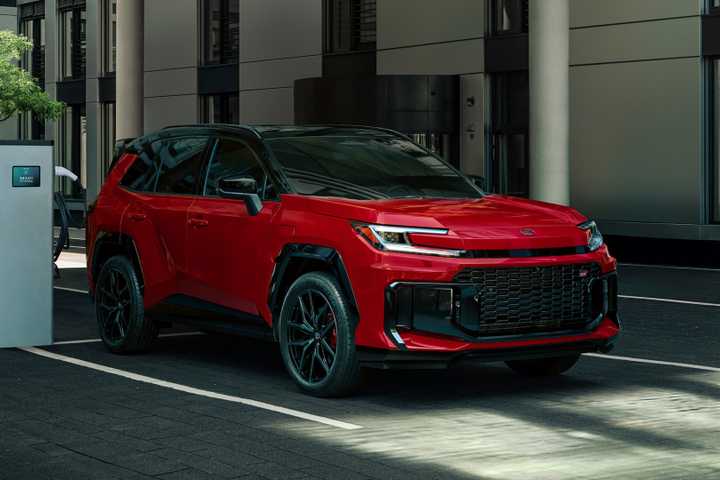
Front 3/4 shot of red 2026 Toyota RAV4 PHEV parked in parking lotToyota
iSeeCars backs the 2026 Toyota RAV4 with an 8.7/10 reliability score, citing that it will benefit from a 13.8-year lifespan and cover 169,545 miles without any reliability issues. A 29.1 percent probability of reaching 200,000 miles means that it just about loses to the CR-V in this comparison. J.D. Power‘s latest valuation of the RAV4 consists of a reasonably positive assessment, resulting in a 79/100 overall score. Joining this is a 78/100 score for the driving experience and 82/100 for resale, with a 77/100 grade for the dealership experience.
2026 Toyota RAV4 PHEV GR Sport rear 3/4 shot parkedToyota
According to CarEdge, the Toyota RAV4 will cost you $6,005 for maintenance and repairs during its first 10 years of service, which is to be expected considering its strong brand reputation, high consumer demand, and proven long-term reliability. Edmunds indicates that you can expect to spend $36,219 over the course of five years and 60,000 miles on the base Toyota RAV4 LE. $4,427 accounts for maintenance, $601 for repairs, $11,554 for depreciation, and $7,831 for fuel.
Toyota Strengthens Its Hybrid Tech With Subtle Updates
2026 Toyota RAV4 engineToyota
The 2026 Toyota RAV4 is only available with hybrid powertrains. The HEV lineup introduces Toyota’s fifth-generation hybrid system, which features an improved transaxle, battery, and power control components to refine performance. The all-wheel-drive model produces a combined 236 horsepower, while the front-wheel-drive model churns out 226 horsepower. Toyota also improves the towing capacity of some of the all-wheel-drive models, including the XLE, Woodland, SE, XSE, and Limited grades to 3,500 pounds. All front-wheel-drive and LE all-wheel-drive models can pull up to 1,750 pounds.
The RAV4 Remains An Efficiency Leader In The Hybrid SUV Segment
2026 Toyota RAV4 Limited towingToyota
According to the EPA, the front-wheel-drive model is the most efficient, achieving 49/42/45 MPG on the city/highway/combined cycle. Installing the optional all-wheel drive system worsens this result to 46/39/42 MPG, which is not too much of a sacrifice. The Woodland’s larger tires and all-wheel-drive-only configuration achieve a 41/35/38 MPG result. The XSE’s sporty wheel configuration changes the RAV4’s consumption to 43/37/41 MPG.
Base Trim Engine
2.5L Inline 4 Hybrid
Base Trim Transmission
CVT
Base Trim Drivetrain
Front-Wheel Drive
Base Trim Horsepower
183 HP @6000 RPM
Base Trim Torque
163 lb.-ft. @ 3600 RPM
Make
Toyota
Model
RAV4
Segment
Compact SUV
Sources: OEMs, J.D. Power, iSeeCars, Edmunds, CarEdge, and the EPA.












No Comments