
The Most Powerful Sleeper Ever Sold By General Motors
The best sleeper cars share a simple trick: they hide serious speed inside a body that nobody looks at twice. General Motors has built plenty of loud performance flagships over the decades, from winged muscle cars to modern super sedans covered in carbon fiber. Its greatest stealth weapon, however, wore no wings, no stripes, and a badge most people associate with country clubs and retirement communities.

Under its hood sat a supercharged, hand-assembled engine that almost nothing in GM’s lineup could match, and fewer than 3,000 people ever bought one. It might be the best-kept secret in GM’s performance history.
The Two Rules Every True Sleeper Must Follow
A true sleeper has to pass a strict two-part test. It needs maximum output from the factory, and it needs zero visual signals that give the game away, which means no scoops, no badges, and no exhaust tips that hint at what lives underneath. Plenty of GM cars nail one half of that equation, but very few nail both.

The classic era produced legends like the Chevrolet Biscayne with the L72 427 and Buick’s Stage cars, and both hid enormous engines inside plain bodies. Their old gross horsepower ratings flatter them, though, because real-world net output lands well below what our subject delivered decades later.
The modern era has the opposite problem. The CTS-V and Blackwing lines announce themselves with quad exhausts, splitters, and wide rubber, while the Hellcat-rivaling Escalade-V is a $150,000 flex rather than a disguise. The Chevrolet SS sedan came closest to true anonymity with 415 hp, but it still falls short of the crown.
That leaves a forgotten luxury sedan from the mid-2000s, a car that out-powered every anonymous performance machine GM ever built while looking like something waiting outside an airport arrivals gate.
The Cadillac STS-V Hid 469 Horsepower In Plain Sight

The Cadillac STS-V is a car so understated that it is usually overlooked by most enthusiasts. Cadillac introduced it at the 2005 Detroit Auto Show and put it on sale late that year for the 2006 model year, giving its STS flagship sedan the full V-Series treatment. Power went to the rear wheels only, which was already unusual for a big American luxury car of the era.
The numbers were anything but understated. The STS-V produced 469 hp and 439 lb-ft of torque, making it the most powerful production Cadillac ever built at the time, a title it held until the 2008 CTS-V arrived. Pricing landed at $77,090, which included a $2,100 gas-guzzler tax on top, and the car came fully loaded with a sunroof delete as its only option.

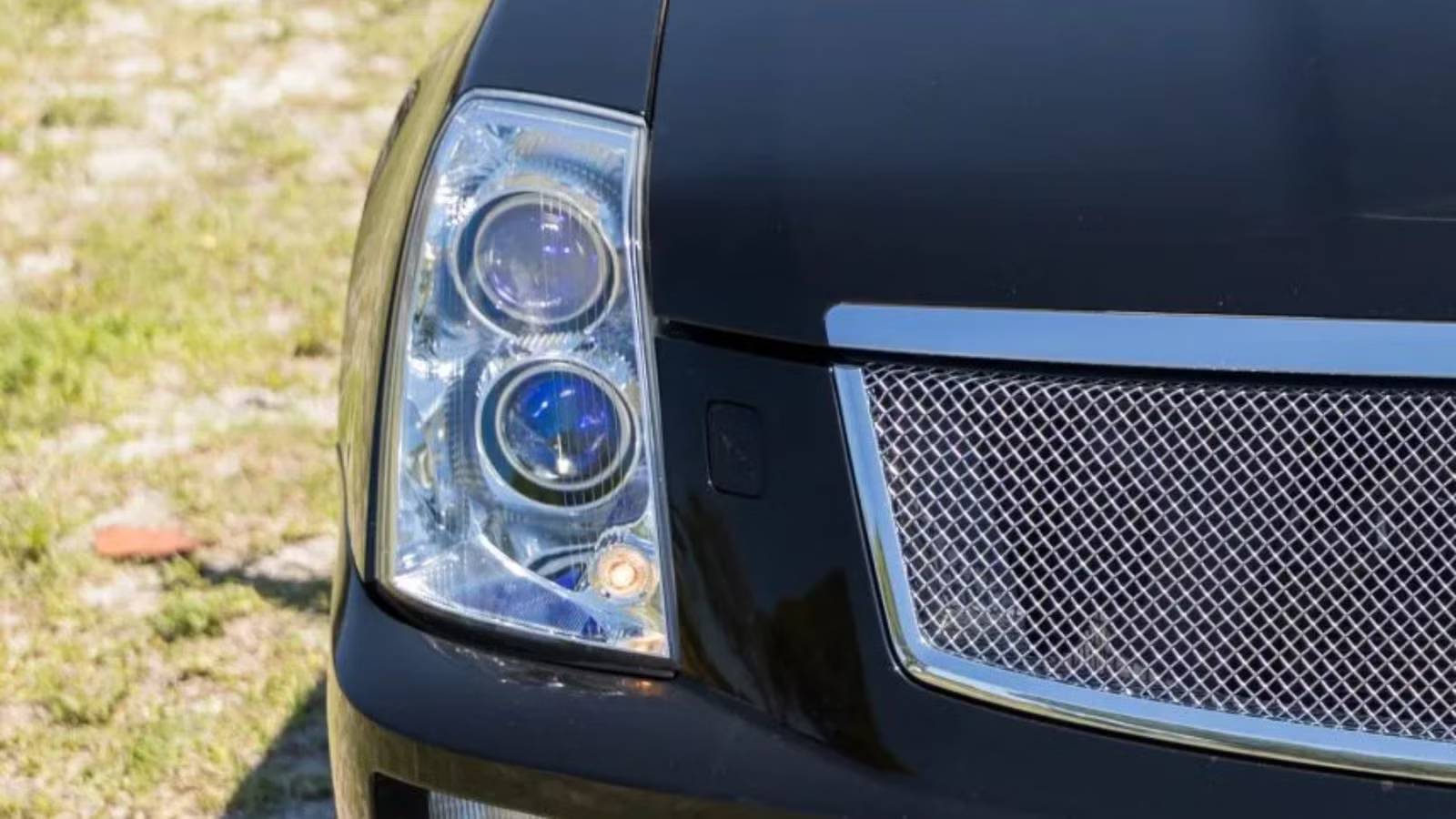
What makes the STS-V a true sleeper is how little of that showed on the outside. The visual changes over a standard STS amounted to a wire mesh grille, a subtly domed hood to clear the supercharger, six-lug wheels, revised bumpers, and a slightly larger spoiler. A period Cars.com review called the Black Raven example about as close to a stealth sport sedan as the class offered.
That class was serious company, too. Cadillac aimed the STS-V directly at the E60 BMW M5 and the Mercedes-Benz E55 and CLS55 AMG, the reigning European super sedans of the day, and priced it thousands below the BMW.
Inside The Hand-Built 4.4-Liter Heart Of The STS-V

|
Engine |
Transmission |
Power |
Torque |
|
Supercharged 4.4-liter LC3 Northstar V8 |
Six-speed automatic (6L80) |
469 hp |
439 lb-ft |
The engine that earned the STS-V its crown was the LC3, a supercharged 4.4-liter evolution of Cadillac’s Northstar DOHC V8. It produced 469 hp at 6,400 rpm and 439 lb-ft of torque at 3,900 rpm, and every one was hand-assembled. In an era when Cadillac was fighting for credibility against Germany’s best, this was the brand’s statement piece.
The LC3 was far more than a standard Northstar with a blower bolted on. Engineers reduced the bore from 93 mm to 91 mm for stronger head-gasket sealing, dropped compression to 9.0:1 for boost, and changed roughly 40 percent of the internals in the process. The result kept variable valve timing on all four camshafts, a rarity for a supercharged V8 of the period.

Sitting between the heads was an intercooled 2.0-liter Eaton M122 supercharger, a Roots-type unit that delivered the low-end shove the standard Northstar never had. The supporting hardware matched the ambition, with a forged steel crankshaft, aluminum block and heads, multi-layer steel head gaskets, and oil jets that cooled the underside of each piston.
The STS-V was also the first GM vehicle to use the new 6L80 six-speed automatic with Driver Shift Control, a transmission that went on to serve across the company’s lineup. Cadillac backed the drivetrain with genuine chassis hardware rather than badges.
Brembo brakes handled stopping duties, staggered 18-inch front and 19-inch rear wheels wore Pirelli run-flat tires, and a faster ZF steering rack sharpened the front end. There was even a dedicated cooler for the rear differential, a detail usually reserved for track-focused machinery.
The Cadillac That Ran With The BMW M5 And E55 AMG

The numbers proved the STS-V belonged in the conversation. Car and Driver’s instrumented testing recorded a 0-60 mph run of 4.6 seconds and a quarter mile of 13.2 seconds at 107 mph.
Those figures came from a car weighing 4,233 lbs, which made the STS-V genuinely quick for a full-luxury sedan of its size. Its 469 hp exactly matched the output of the W211 Mercedes-Benz E55 AMG and its CLS55 sibling, the supercharged benchmarks of the class.
The E60 BMW M5 held the outright power advantage, with its 5.0-liter V10 producing 500 hp. The BMW also cost more, starting at $81,895 against the Cadillac’s $77,090, and period reviewers noted the STS-V matched the M5’s cornering grip while undercutting it by thousands.

The honest verdict from the era cut both ways. Reviewers praised the STS-V’s chassis as world-class, yet the same judges concluded it wasn’t the M5’s equal as a pure driver’s car, and that assessment holds up. What the Cadillac offered instead was serious pace wrapped in genuine comfort.
There was one unavoidable cost of all that supercharged thrust. EPA ratings of 14 mpg city and 20 mpg highway saddled every STS-V with a gas-guzzler tax straight from the factory.
Rarer Than A Ferrari F430 And Cheaper Than A Civic Type R

Enthusiast-tabulated production records list just 2,503 STS-Vs across four model years. The breakdown ran 1,306 cars in 2006, 642 in 2007, 459 in 2008, and only 96 in the final 2009 model year. For perspective, Ferrari built roughly 15,000 examples of the F430 over a similar span, making the Cadillac several times rarer than Maranello’s contemporary supercar.
The end came quietly. Cadillac discontinued the STS-V after 2009, when the second-generation CTS-V arrived with 556 hp and made its bigger brother redundant within the brand’s own showroom.

That obscurity now works in a buyer’s favor. Classic.com data puts average selling prices around $11,583, which is roughly a fifth of the original MSRP and thousands less than a new Honda Civic Type R.
The ownership story holds up better than the Northstar name suggests. The LC3 escaped the head-gasket reputation that haunted early Northstar engines, and owner reports indicate running costs sit well below those of the German rivals it once chased.
That leaves the STS-V exactly where it started, hiding in plain sight. It remains the most powerful car GM ever sold that nobody recognized, and nearly two decades later, nobody still does.
Sources: Car and Driver, Robb Report, MotoGallery, Classic

Related posts
Latest Post


No Comments