
The Most Analog Sports Cars You Can Still Buy New In America In 2026
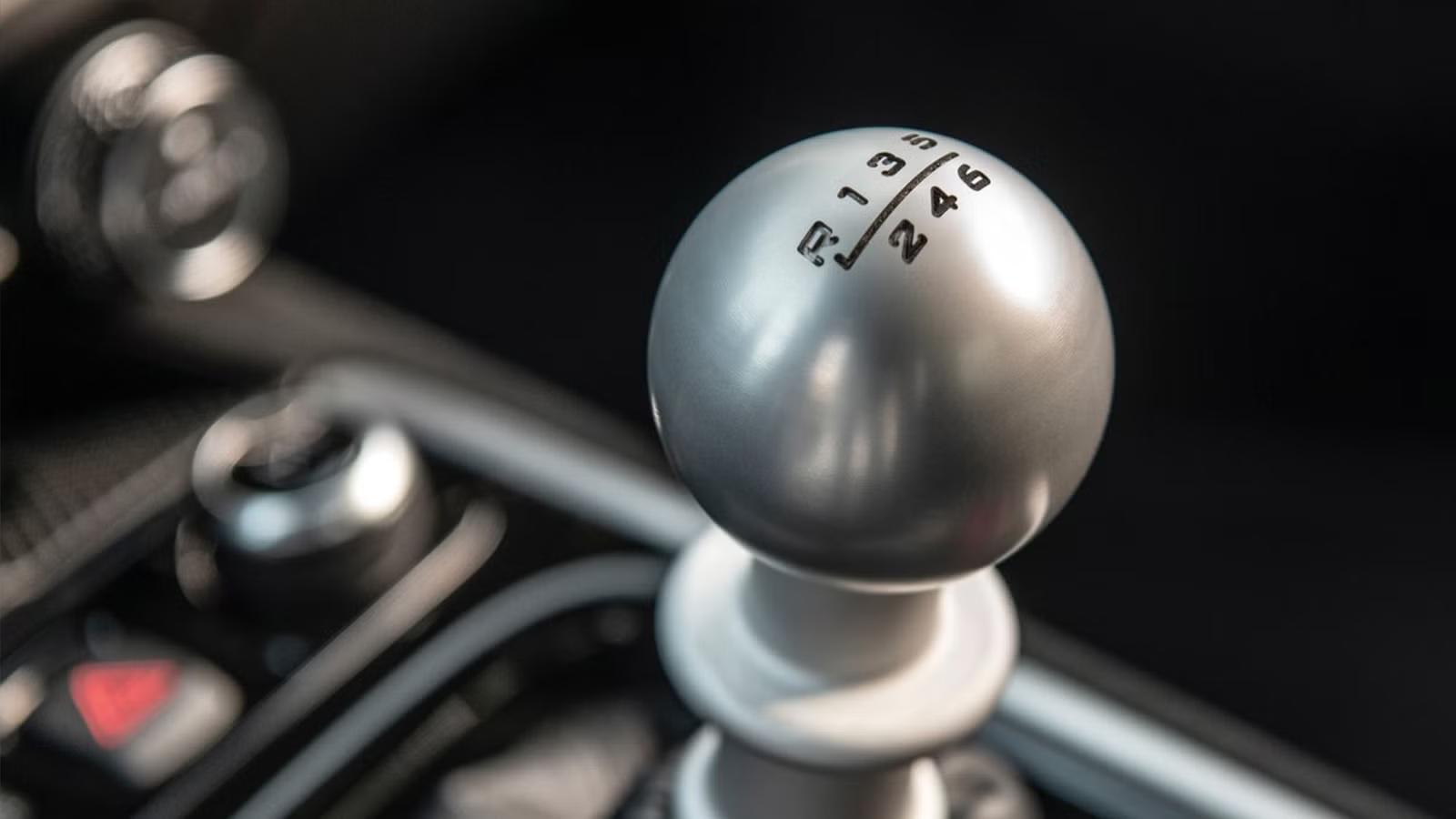
For those of us looking for old-school Sports Cars we can buy brand new, we really don’t have a lot of choice anymore. Sports cars are becoming very tech-heavy, and they’re losing the manual transmission as part of that. Many current sports cars also no longer have rear-wheel drive. That’s a real shame for future generations of enthusiasts. Many of them will never get to experience a raw driving experience from a brand new car. They’ll have to go to the used market to get it instead. This isn’t the worst thing in the world, but it does open up the lottery of how used cars can be.

Thankfully, there are at least still a few options out there that let you have a more old-school, more analog experience. While there are a couple of more expensive cars here, the vast majority of them are actually affordable enough for an average enthusiast to buy. One of them is even a generation of the most successful sports car ever! Another is also part of the lineage of one of the world’s best Muscle Cars, holding down the fort for muscle car purists while other manufacturers are abandoning that tradition.
These cars are all ones that are available to order or buy in dealerships in the USA in 2026. They all have a manual transmission option and rear-wheel drive, either in certain variants or across the entire model range.
6
Mazda MX-5 Miata (ND)
Base MSRP: $30,430

The Mazda MX-5 Miata is the world’s best-selling sports car ever for a reason. It’s one of the few still on the market that honors the old-school, Colin Chapman-style philosophy of “simplify and add lightness”. It’s also proven itself to have great reliability and low running costs, thanks to its bulletproof Japanese mechanicals that it shares with other models in the Mazda range.

The latest ND generation is absolutely no exception. While it may only have 181 horsepower, it doesn’t need any more than that as it only weighs from 2,300–2,366 pounds. Crucially, it still comes with the option of a manual transmission—a reliable and proven 6-speed unit. Combine all of that with its almost ludicrously cheap MSRP of $30,430, and even as a brand-new car it’s a proper performance bargain.
5
Toyota GR86/Subaru BRZ
Base MSRP: $31,500 (Toyota GR86), $36,140 (Subaru BRZ)

Mazda isn’t the only Japanese automaker to realize that there’s still a market for fun, simple, analog sports cars that won’t break the bank to buy and run. Toyota and Subaru knew there was a place for it as well, and have had a joint venture together for years to make that happen. The latest versions of this jointly-developed sports car are the Toyota GR86 and the Subaru BRZ. They both have a 2-liter 4-cylinder boxer engine producing 228-232 horsepower and 184 lb-ft of torque, and they’re both rear-wheel drive. They’re also both a great platform for modding. Many owners and tuning companies have made these cars much faster by adding forced induction, and beefing up the suspension and brakes.

This jointly built car is now getting a bit long in the tooth. But it’s hard to argue with that base MSRP of $31,500 for the Toyota and $36,140 for the Subaru. If you’re looking for a great sports car bargain with all the analog driving fun you could want, it’s difficult not to pass either of them up. Plus, as we’ve already mentioned, they’re a fantastic platform if you want to tune them and turn them into a cut-price performance beast.
4
Nissan Z
Base MSRP: $44,480

The Nissan Z is the latest evolution of the Z car tradition that Nissan brought back in the 2000s with the 350Z. Thankfully, Nissan seems to have kept its roots in mind while it’s improved and updated the Z car formula. The Nissan Z is still available with a 6-speed manual transmission, as well as the 9-speed automatic. It’s actually got a smaller engine than the 370Z it replaced—3 liters, as opposed to 3.7. But Nissan added twin turbochargers to make up for that downsizing. The result of that was an increase in power from the old V6. Standard Zs produce 400 horsepower, while the top-of-the-range Nismo version produces 420 horsepower.

With the change to that smaller twin-turbocharged V6 engine as part of its development, the Nissan Z is now the cheapest twin-turbo sports car you can buy in America. While its base MSRP of $44,480 is starting to get into the kind of territory that not every enthusiast can afford, it’s still a bit of a bargain for the kind of power it has.
3
Ford Mustang
Base MSRP: $49,000 (GT), $67,000 (Dark Horse)

Many manufacturers have given up on the traditional muscle car. Ford hasn’t, though. Ford is not only committed to keeping the V8 alive in several of the Mustang’s variants, but it’s also kept the manual transmission alive too. The V8-powered GT and Dark Horse variants can still be ordered with a 6-speed manual transmission, as well as Ford’s standard-issue 10-speed automatic. American-spec versions of the GT use Ford’s venerable 5-liter Coyote V8, producing 480 horsepower (486 horsepower with the active exhaust fitted) and 418 lb-ft of torque. The Dark Horse version boosts the Coyote’s output to 500 horsepower, with the torque staying the same as it is in the GT.

Ford has more powerful V8-powered Mustangs in its model lineup—the ludicrously powerful Dark Horse SC and the road-legal racecar that is the GTD. But neither of them has a proper manual transmission. They’re both only available with a racecar-style 8-speed dual-clutch automatic. While it’s a great transmission for those cars, it just doesn’t fulfill the purist driving experience as well as the conventional 6-speed manual in the GT and Dark Horse does.
2
Lotus Emira V6 SE
Base MSRP: $112,900

The Lotus Emira is the descendant of many of the cars that inspired the aforementioned Mazda MX-5 Miata. The “simplify and add lightness” philosophy is something that Lotus hasn’t forgotten either. While it may make some distinctly heavier and more bloated electric sedans and SUVs now, Lotus is still very much committed to old-school drivers’ cars. The Emira V6 SE proves that in spades. While the turbocharged 4-cylinder Emira only has an 8-speed dual-clutch automatic transmission, the V6 model still sticks with a good old-fashioned 6-speed manual. That V6 is a supercharged version of Toyota’s 3.5-liter 2GR-FE V6, producing 400 horsepower and 310 lb-ft of torque.

The Emira will still have a V6 going into the future. It’ll get a new 3-liter twin-turbocharged unit developed through Geely’s (Geely is the current parent company of Lotus) working relationship with Renault. But once this engine is dropped into the Emira in 2030, the manual transmission will no longer be offered. If you want a brand-new Lotus with an old-school manual transmission, this could very well be your last chance! That’s especially considering how expensive the Emira V6 SE is. At a base MSRP of $112,900, it’s absolutely out of the budget of any regular enthusiast.
1
Porsche 911
Base MSRP: $135,500

The Porsche 911 is one of the most iconic cars ever made, let alone sports cars. You could recognise that 911 shape from miles away. Porsche has also made sure to stick very much with 911 tradition as the years have gone by. That includes still letting you have a manual transmission and rear-wheel drive on at least some variants. There are 7 911 variants in the US market that have the manual transmission as standard, or as a choice alongside the dual-clutch PDK. These include the Carrera S (with the MT package), the Carrera T, the GT3, and the GT3 Touring. The two GT3 variants are among the best of the bunch when it comes to the 911’s range, with a 4-liter flat-6 that produces 503 horsepower and 332 lb-ft of torque.

The Porsche 911 is easily the most expensive car here. That base MSRP of $135,500 means that only the wealthy among us can afford to buy a brand-new one. But, if you can, and you get one of the variants that’s available with a manual transmission, you’re getting what is still one of the best pure driver’s cars in 2026.
Sources: Ford, Lotus, Mazda, Nissan, Porsche, Subaru, Toyota

Related posts



Latest Post


No Comments