
The Mile-Munching Motorcycle That Makes Premium Tourers Look Financially Unhinged
Crossing the United States on a motorcycle is a classic road trip goal, but modern touring bikes have become remarkably expensive. Walk into any dealership today, and new long-distance baggers equipped with hard luggage, wind protection, and rider aids routinely carry price tags from $25,000 up. Monthly finance payments can easily rival a house payment. Even on the pre-owned market, popular domestic touring models hold high resale values, often asking over $15,000 despite heavy mileage. For riders who want a comfortable highway tourer without taking on massive debt, finding an affordable option is tough.
Open Plains And Big V-Twins: The Barrier Facing Foreign Touring Heavyweights

Breaking into the American touring market has always been an uphill battle for foreign motorcycle manufacturers. The United States places distinct demands on long-distance machines that few other regions duplicate. Endless interstate highways, vast open plains swept by heavy crosswinds, and hundreds of miles between fuel stops require immense high-speed stability, generous luggage capacity, and all-day ergonomic comfort.
Add in a deeply entrenched domestic culture built around traditional tourers from Milwaukee and Spirit Lake, and most overseas contenders have struggled to gain meaningful traction. Japanese and European brands have tried for decades to challenge this stronghold with cruisers of their own, but only one foreign machine has truly cracked the American touring formula with lasting success: the Honda Gold Wing. For everyone else, building a touring heavyweight that resonates with American riders while standing out from the crowd has proven nearly impossible.
How Italian Police Bikes Laid The Blueprint For A Modern Bagger

That did not stop Italy’s oldest continuous motorcycle manufacturer from taking a shot. Based in Mandello del Lario since 1921, Moto Guzzi possesses a surprising connection to American highway culture. Decades ago, the Italian marque developed the iconic California cruiser in close cooperation with the Los Angeles Police Department, proving its air-cooled transverse V-twin layout could endure grueling daily shifts and long highway patrols.

Capitalizing on this transatlantic heritage, the historic Italian firm set out to build an ambitious, modern bagger tailored specifically for American highways, combining its traditional powertrain with futuristic bodywork and high-end chassis components.
The 2017 Moto Guzzi MGX-21 Delivers Pure Touring Exotica For $10,500 Used
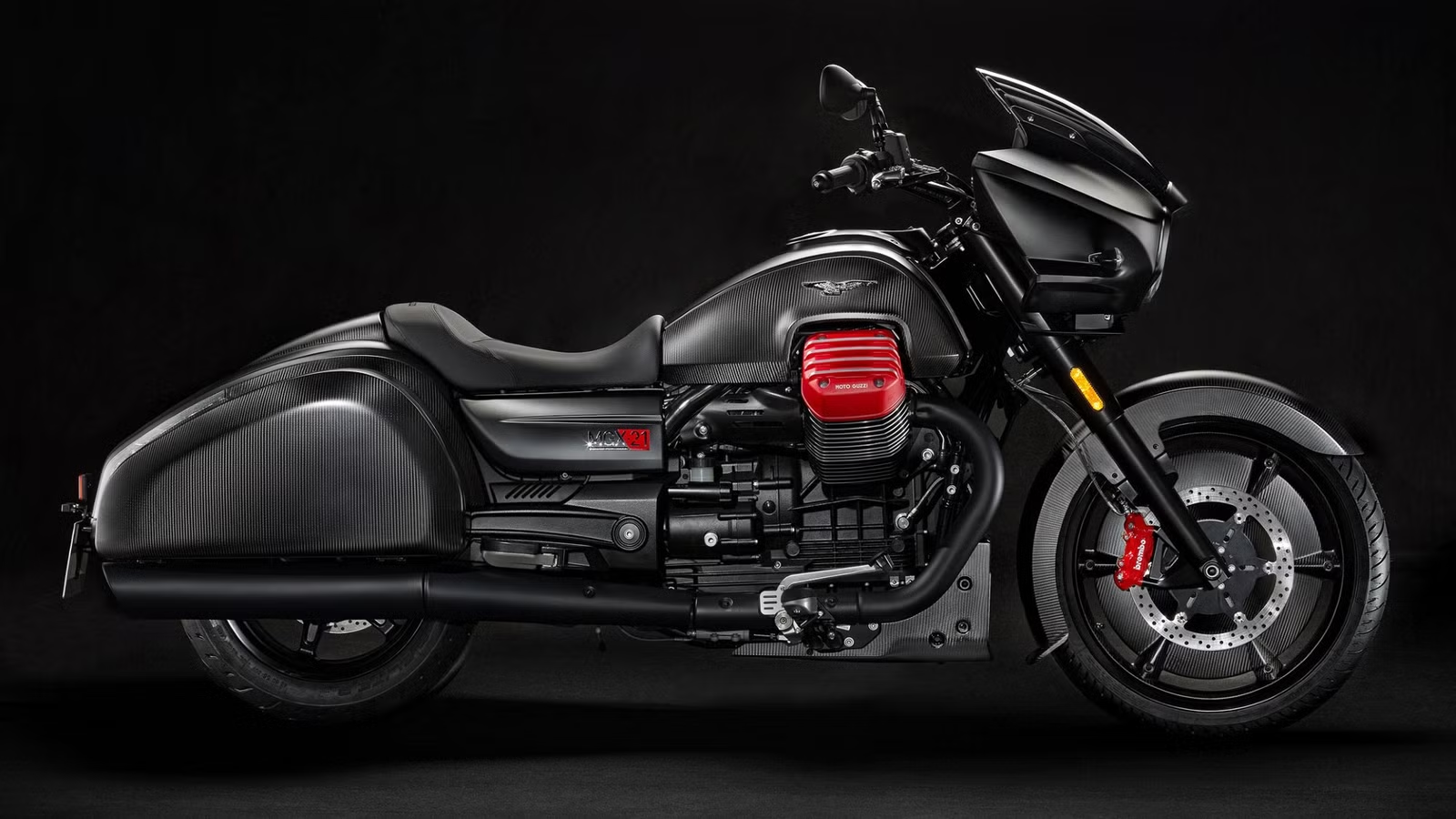
That motorcycle is the Moto Guzzi MGX-21, often referred to as the Flying Fortress. When Moto Guzzi introduced the bike for the 2017 model year, it carried a base price of $21,990, placing it directly against top-tier American touring cruisers. Fast-forward to today, and depreciation has made it one of the strongest values on the pre-owned market.
According to Kelley Blue Book, the typical listing retail price for a 2017 Moto Guzzi MGX-21 in good condition sits right around $10,500. For roughly ten grand, buyers can step into a full-sized touring bagger featuring genuine carbon fiber, designed by legend Miguel Angel Galluzzi, modern rider electronics, and cross-country capability at less than half of its original showroom cost!
Low-End Shove At 3,000 RPM And Tall Overdrives Define The 1,380cc Italian Twin

The heart of the MGX-21 is Moto Guzzi’s 1,380cc, 90-degree longitudinal V-twin engine that is familiar from the California, another touring motorcycle that still feels great after a decade. Unlike transverse V-twins that line up along the frame, Guzzi places the cylinder heads out into the open airflow for better cooling and easy maintenance access – both positives, since this is an air- and oil-cooled engine.
The oil radiator even has a cooling fan linked to a thermostat. It produces 96 horsepower at 6,500 RPM and 89 pound-feet of torque at just 3,000 RPM. This is paired with a six-speed gearbox with a dry clutch and a tall sixth speed for relaxed highway cruising. An enclosed driveshaft transmits the power to the wheel.
Radial Brembos And A Carbon-Shrouded 21-Inch Front Wheel Distinguish The MGX

The MGX-21 has a tubular steel double-cradle frame, with a subframe designed to handle long highway miles with full luggage. 45 mm conventional forks up front provide 4.7 inches of travel, paired with twin rear shock absorbers offering 4.3 inches of travel and a convenient remote hydraulic preload adjuster. Braking is handled by sportbike-spec dual 320 mm front discs with radial four-piston fixed Brembo calipers, and a 282 mm rear disc with a two-piston floating Brembo caliper — little wonder that it is one of the fastest European cruiser motorcycles.
With a 66.7-inch wheelbase and a curb weight of 752 pounds, the MGX-21 is a substantial machine, but it has an accessible seat height of 29.1 inches. It can feel a little top-heavy at low speeds compared to the alternatives, but it is manageable.
Real Carbonfiber Bodywork, Twin-Pod Dials, And 15-Gallon Bags Arm The Fortress

The MGX-21’s age can be seen in its twin-pod instrument cluster. These are circular dials with an analog speedo and tach with floating needles on the circumference, and LCD screens on the inside that display a great deal of information, including the fuel level, gear selected, ride mode, ambient temperature, radio station, distance to empty, and, oddly, speed a second time.
There is an AM/FM radio, Bluetooth streaming capability, and an audio system that could use some more loudness. There is also a USB-A charging port, and real carbonfiber on the front fender, fuel tank, belly pan, saddlebags, and front wheel covers. The saddlebags offer 15.3 gallons of storage space, neither exceptional nor lacking for the time.
The MGX-21 might not have made our list of the best Moto Guzzis ever made, but it has decent tech: it includes a by-wire throttle with three ride modes, three levels of traction control, cruise control, and ABS. Special mention must be made of the high exhausts that refuse to scrape against curbs, something all touring riders have experienced at some point.
At $10,500, The MGX-21 Undercuts Used Street Glides And Chieftains By Thousands

The equivalent of the MGX-21 today would be the segment leader, the Harley-Davidson Street Glide. Even though it is worth every penny, it still costs a whopping $24,999. The Indian Chieftain PowerPlus is even dearer, at $27,999. The only new equivalent at that price would be the $11,599 Honda Rebel 1100T DCT. Even looking at used alternatives, a 2017 Street Glide asks $15,750, while the same-year Indian Chieftain carries a value of $14,600, thus proving that this unique sporty bagger has depreciated into a bargain.
Sources: Moto Guzzi USA, KBB

Related posts



Latest Post


No Comments