
10 German Sedans You Should Buy Used
Finding a driver’s car that also happens to be a bargain is rarer than it sounds — but the used market for German sedans is one of the few places where that combination genuinely exists. Depreciation has done the heavy lifting, and today you can slide into some of the most rewarding machines ever to come out of Bavaria, Stuttgart, or Ingolstadt for a fraction of their original sticker prices. These aren’t just well-engineered vehicles; they’re cars packed with character and genuine driver engagement, offering a thrilling experience every time you turn the key.

The best part? Time has been kind to their prices, making them all secondhand bargains. These German saloons prove that you don’t need to break the bank to own something that blends performance and comfort in one reliable package.
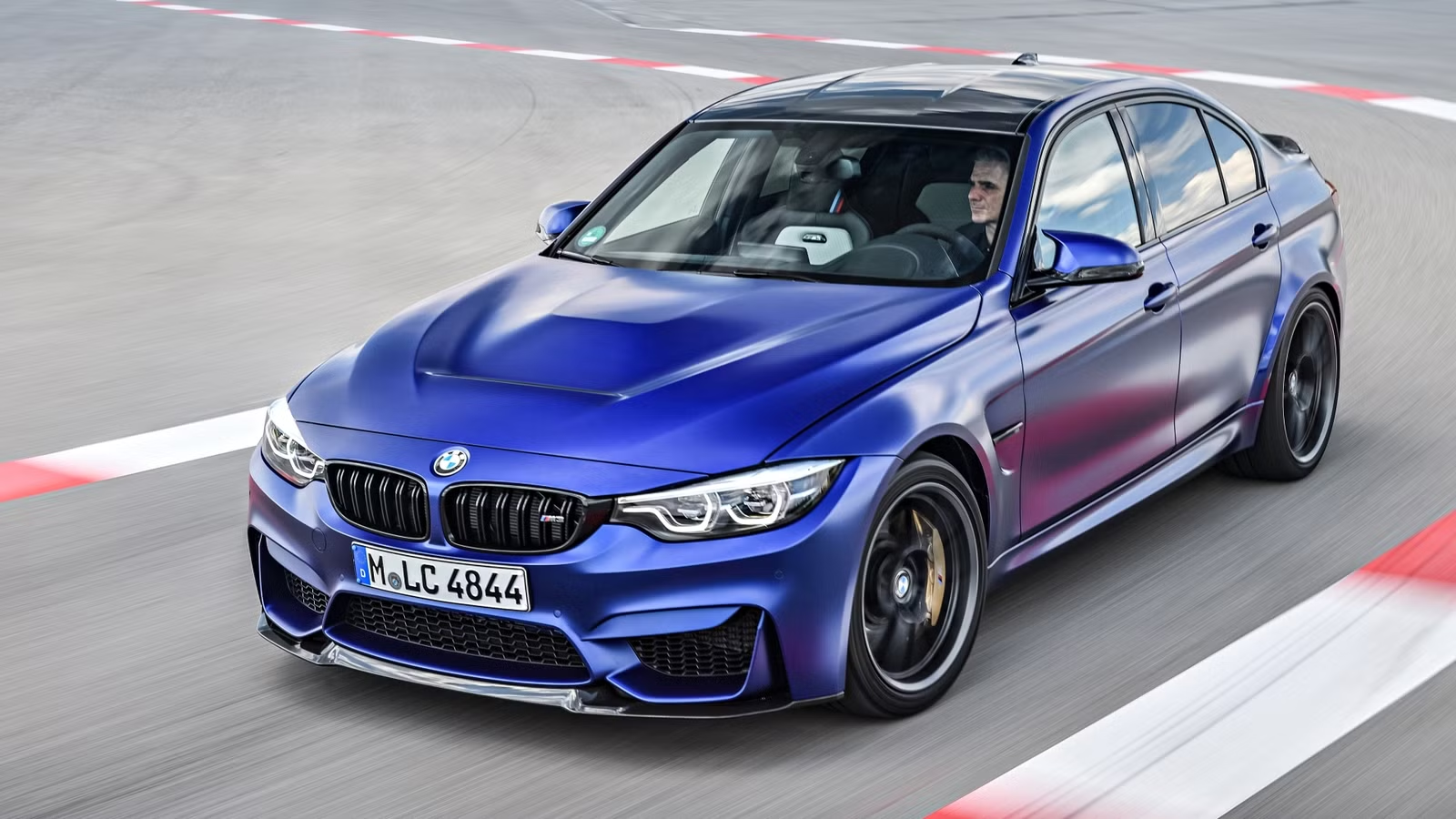
BMW M3 (F80 Generation, 2014-2018)
KBB Fair Purchase Price (2018): $49,390
When BMW launched the current G-series M3, it arrived with controversial styling and a hefty price tag that left many enthusiasts looking over their shoulders at the previous generation. The F80 M3 — and its coupe sibling, the M4 — now represents one of the most compelling used buys in the performance sedan segment.
Performance Specifications
 48 autotech Engine |
3.0-liter Twin-Turbo Inline-Six |
|
Transmission |
Six-speed manual, seven-speed dual-clutch |
|
Horsepower |
425 hp |
|
Torque |
406 lb-ft |
|
Driveline |
Rear-Wheel Drive |
|
0-60 MPH |
3.9-4.1 seconds |
|
Top Speed |
155 mph |
The F80 M3 also offers a far more direct driving experience than its successor. The newer G-series comes loaded with a greater degree of electronic intervention, which can make the car feel somewhat disconnected from the road. It’s worth noting that this M3, like many other BMWs, has a reputation for reliability issues that prospective buyers should research carefully.
BMW M550i (G30 Generation, 2018-2023)
KBB Fair Purchase Price (2023): $48,700

When BMW introduced the G30 generation M550i, it prompted many to question the necessity of the full-fledged M5. While the M5 undoubtedly offers superior performance and handling, the M550i delivers a significant portion of that experience at a much lower price point. And yes, it still has a V8 under the hood.
Performance Specifications
|
Engine |
4.4-liter Twin-Turbo V8 |
|
Transmission |
Eight-speed automatic |
|
Horsepower |
456 hp |
|
Torque |
480 lb-ft |
|
Driveline |
All-Wheel Drive |
|
0-60 MPH |
4.0 seconds |
|
Top Speed |
155 mph |
The M550i often presents a more understated aesthetic, which can be both an advantage and a disadvantage depending on a driver’s preferences — making it the ultimate “sleeper.” Its V8 engine produces less than 500 horsepower, which is considerably shy of the full-fat M5, but it’s still quick enough to keep pace with a sports car while delivering a high level of everyday comfort.
BMW M340i (G20 Generation, 2019-Present)
KBB Fair Purchase Price (2023): $47,370

As one of the more recent vehicles on this list, the BMW M340i has quickly established itself as a compelling used buy. It offers a well-rounded package of ample power, modern technology, and appealing design. Despite their relatively recent retail prices, used examples are fast becoming excellent bargains.
Performance Specifications
|
Engine |
3.0-liter Turbocharged Inline-Six |
|
Transmission |
Eight-speed automatic |
|
Horsepower |
382 hp |
|
Torque |
369 lb-ft |
|
Driveline |
Rear-Wheel Drive (All-Wheel Drive optional) |
|
0-60 MPH |
4.4 seconds |
|
Top Speed |
155 mph |
This B58-powered BMW delivers a driving experience that puts a smile on your face without the eye-watering price tag of an M3. Coupled with its attractive styling — which many enthusiasts prefer to the more outlandish design of the M3 — the M340i is one of the best German saloons available on the used market today, with used models starting around $35,000.
Alpina B7 (F01 Generation, 2011-2015)
KBB Fair Purchase Price (2015): $24,200

While most people won’t recognize the name “Alpina,” it commands tremendous respect within the automotive community. Alpina operates as a performance and luxury specialist that takes BMWs to the next level — think of it as the sophisticated, suit-wearing counterpart to BMW’s M division.
Performance Specifications
|
Engine |
4.4-liter Twin-Turbo V8 |
|
Transmission |
Eight-speed automatic |
|
Horsepower |
500 hp |
|
Torque |
516 lb-ft |
|
Driveline |
Rear-Wheel Drive |
|
0-60 MPH |
4.6 seconds |
|
Top Speed |
174 mph |
The Alpina B7, based on the 7 Series, is the ultimate expression of what Alpina stands for. It delivers meaningful performance upgrades alongside unique styling elements and a host of luxurious interior additions. For those seeking a high-performance luxury saloon with a touch of exclusivity and a more refined sporting character than a comparable M car, the Alpina B7 is a compelling and often overlooked option — and its relative obscurity makes it a genuine secondhand bargain.
Mercedes-Benz CLS (W218 Generation, 2012-2018)
KBB Fair Purchase Price (2018): $23,900 – $25,500

While the current Mercedes-Benz CLS often flies under the radar, the W218 generation — produced between 2012 and 2018 — was a celebrated design that captured significant attention. Its distinctive, flowing silhouette sets it apart from anything else in the German saloon landscape.
Performance Specifications (CLS 550 Example)
|
Engine |
4.7-liter Twin-Turbo V8 |
|
Transmission |
Seven-speed automatic |
|
Horsepower |
402 hp |
|
Torque |
443 lb-ft |
|
Driveline |
Rear-Wheel Drive (All-Wheel Drive optional) |
|
0-60 MPH |
4.6 seconds |
|
Top Speed |
155 mph |
Within the Mercedes-Benz lineup, the CLS occupies a unique position, serving as a more aesthetically driven and often more affordable alternative to the S-Class, though older S-Classes are often brilliant bargains in their own right. It appeals to buyers who prioritize style and a sleeker profile without necessarily requiring the absolute top-tier luxury and space of the larger flagship.
Porsche Panamera (First Generation, 2009-2016)
KBB Fair Purchase Price (2016): $22,000 – $64,000

Upon its arrival, the first-generation Porsche Panamera, much like the Cayenne before it, faced skepticism from purists who questioned Porsche’s move into segments beyond sports cars. However, the Panamera quickly proved its performance credentials, with even the earliest examples delivering more than enough power for everyday driving.
Performance Specifications
|
Engine |
4.8-liter V8 |
|
Transmission |
Seven-speed dual-clutch |
|
Horsepower |
400 hp |
|
Torque |
369 lb-ft |
|
Driveline |
Rear-Wheel Drive (All-Wheel Drive optional) |
|
0-60 MPH |
5.0 seconds |
|
Top Speed |
175 mph |
What makes these early Panameras particularly appealing now is their relatively accessible price point — a stark contrast to the current Panamera lineup, where top-tier models can easily exceed six figures. The first generation offered a range of engines, from a V6 to potent V8 options. For enthusiasts seeking the best value, models equipped with a V8 engine are highly recommended, offering a compelling blend of performance and relative affordability in the used market.
Audi S4 (B8 Generation, 2010-2016)
KBB Fair Purchase Price (2016): $20,300 – $22,300

The B8-generation Audi S4, produced from 2010 to 2016, stands out against newer S4s thanks to its supercharged 3.0-liter V6 engine. Beyond its strong performance, that supercharged unit produces an engine note that the current turbocharged S4 simply can’t match — and it represented a significant step up from the standard A4’s four-cylinder.
Performance Specifications
|
Engine |
3.0-liter Supercharged V6 |
|
Transmission |
Six-speed manual, seven-speed dual-clutch |
|
Horsepower |
333 hp |
|
Torque |
325 lb-ft |
|
Driveline |
All-Wheel Drive |
|
0-60 MPH |
5.1 seconds |
|
Top Speed |
155 mph |
Drivers who are drawn to the M340i mentioned earlier in this list but don’t want to spend as much as $50,000 will find this V6-powered S4 a natural alternative. While the same era also produced the impressive B8 RS4 with its high-revving V8, the S4 is often a far more accessible and usable performance saloon for daily driving.
Audi A8 (D4 Generation, 2010-2018)
KBB Fair Purchase Price (2018): $18,000 – $25,200

The D4-generation Audi A8 was the king of luxury saloons when it launched. Often described as a “boat” due to its sheer size, it wrapped a high degree of technology in an impressively understated package. While both the Mercedes-Benz S-Class and BMW 7 Series of the same era were formidable competitors, the A8 arguably boasted a cleaner, more timeless exterior design that has aged gracefully. Movie fans will also recognize this generation of A8 from its appearances alongside stars such as Jason Statham.
Performance Specifications (A8 4.2 FSI V8 Example)
|
Engine |
4.2-liter V8 |
|
Transmission |
Eight-speed automatic |
|
Horsepower |
372 hp |
|
Torque |
328 lb-ft |
|
Driveline |
All-Wheel Drive |
|
0-60 MPH |
5.5 seconds |
|
Top Speed |
155 mph |
The restrained exterior styling of the D4 A8 has allowed it to maintain a contemporary appearance, perhaps more so than its rivals with busier design elements. The design language of the S-Class — and especially the 7 Series — has evolved significantly since this era, meaning the A8 looks considerably fresher than its contemporaries from the same period.
Mercedes-Benz E350 (W212 Generation, 2010-2016)
KBB Fair Purchase Price (2016): $12,710

The W212-generation Mercedes-Benz E350 often goes unmentioned in performance discussions, mostly due to its lack of an AMG badge, but it represents a solid and capable used saloon that deserves serious consideration. Think of it as the M340i of the mid-2010s — the perfect blend of Mercedes-Benz comfort and performance.
Performance Specifications
|
Engine |
3.5-liter V6 |
|
Transmission |
Seven-speed automatic |
|
Horsepower |
302 hp |
|
Torque |
273 lb-ft |
|
Driveline |
Rear-Wheel Drive (All-Wheel Drive optional) |
|
0-60 MPH |
6.3 seconds |
|
Top Speed |
155 mph |
Sure, it’s not a fire-breathing performance model, but the E350 provides more than adequate power for long-distance cruising with the occasional burst of spirited driving. It’s also available in multiple body styles — saloon, coupe, and estate — meaning there’s an E350 to suit most enthusiasts. Thanks to the relative lack of attention it receives, and the overwhelming popularity of its AMG counterparts, drivers can pick up an E350 for as little as $15,000.
Volkswagen Phaeton (2002-2016)
KBB Fair Purchase Price (2006): $5,175
Ferdinand Piëch, the former chairman of the Volkswagen Group, harbored an ambition to create a Volkswagen that could rival the established luxury giants, Mercedes-Benz and BMW. The result was the Phaeton, a technologically sophisticated luxury saloon that defied typical expectations associated with the VW badge, commanding a price near $70,000 when new.
Performance Specifications
|
Engine |
6.0-liter W12 |
|
Transmission |
Six-speed automatic |
|
Horsepower |
444 hp |
|
Torque |
420 lb-ft |
|
Driveline |
All-Wheel Drive |
|
0-60 MPH |
5.9 seconds |
|
Top Speed |
155 mph |
One of Piëch’s most audacious objectives was to ensure the car could sustain 186 mph for extended periods in 122-degree heat while keeping the cabin at a comfortable 71.6 degrees Fahrenheit. This oddly specific and near-impossible benchmark, along with other undisclosed requirements, reportedly led several engineers to declare the project unachievable.
Despite those challenges, the Phaeton emerged as a remarkable feat of engineering. Under the bonnet, it offered a range of potent engines, including a W12 variant capable of exceeding 200 mph when unrestricted — placing its performance on par with, or even ahead of, some contemporary luxury rivals. In short, it’s the VW that should be wearing a Bentley badge.
Sources: OEMs, Kelley Blue Book

Related posts



Latest Post


No Comments