
The Lexus Coupe With German Grand-Touring Feel And Toyota Reliability
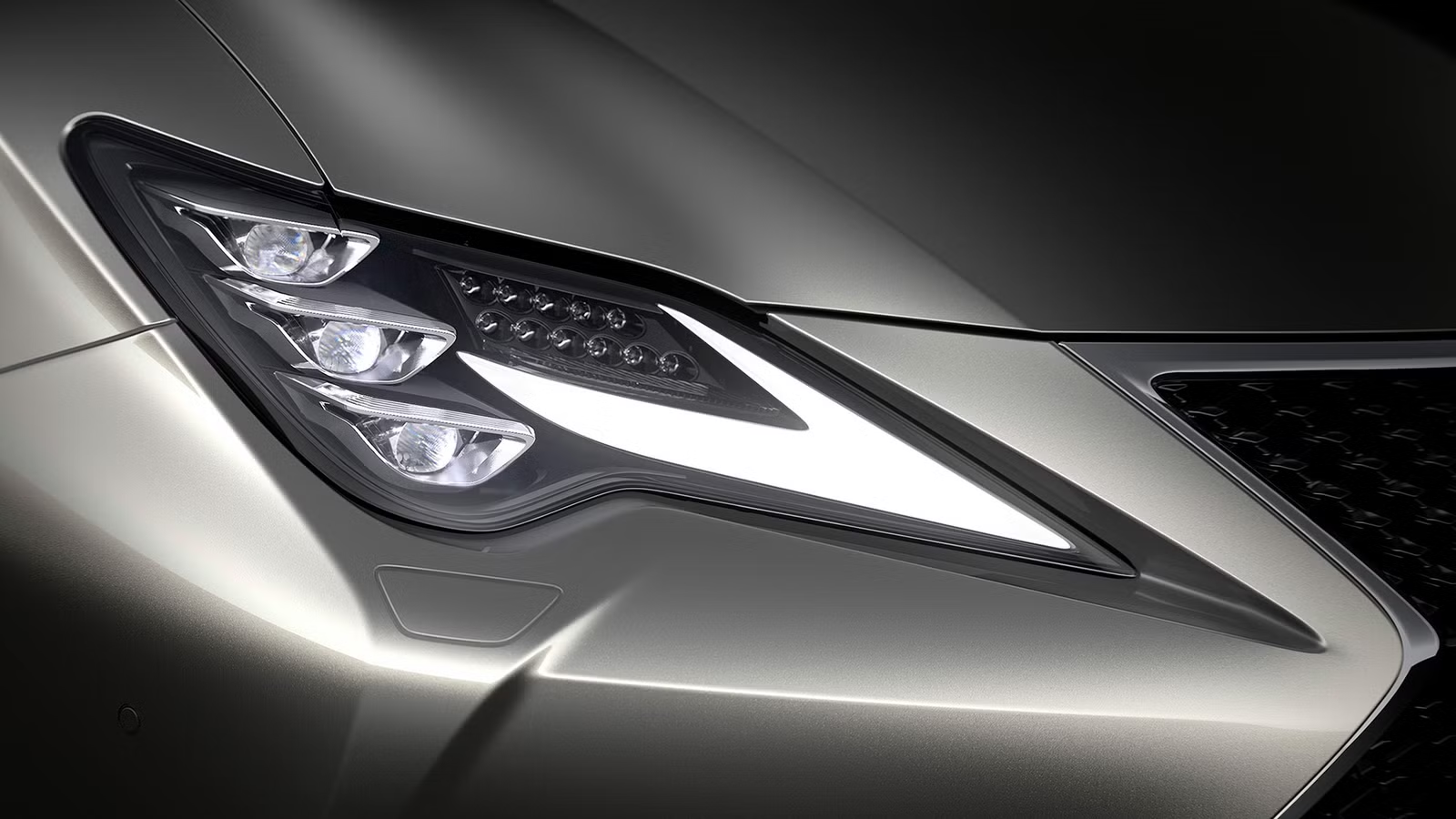
SUVs do everything these days, from dropping off the kids to lapping the Nürburgring. But a few years ago, cars had more definite USPs, whether it was a hot hatch or a supercar. The ’90s and early 2000s belonged to the coupe. The hot hatch had ruled the cheap performance car market for a few years, and when the owners grew up, they migrated to sleek two doors.

This is when BMW started to distinguish the two-door 3-Series from the sedan, calling the E36 a coupe, and the Mercedes CLK started to look like its own model, rather than the previous chopped E-Class coupe. People loved them for a while, but coupes are a bit of a dying breed these days. But that doesn’t make them irrelevant; they are often the best way to get style, comfort, luxury, and sporting intent, all wrapped into a package that even mere mortals might one day attain.
Times Are Changing Quickly In The World Of Upmarket Cars
Back in the ’90s heyday of the Coupe, natural aspiration was seen as aspirational. OK, so a lot of cars coming out of Japan featured turbos and superchargers, and they are truly iconic, but there was still a place for good, honest six- and eight-cylinder units. Just look at the E36, E46, and E90 M3s: the first two had straight sixes, and the third had a V8. But while the 2000s became the wild west of engine development, with cars like the E60 M5 and the Audi RS6 both getting V10s—one F1-inspired, the other essentially a Lambo unit—emissions regulations forced manufacturers to scale it back.

Nowadays, turbocharging is not the preserve of the exciting, top-tier Skyline GT-R; it’s in your grandmother’s VW Polo, the M3, and every other model up to a supercar. Ironically, it is now naturally aspirated units that are as rare as hen’s teeth in a world where manufacturers are always coming up with new ways to keep ICE engines in operation. But there is one carmaker, usually better known for high-tech hybrids, that still offers a slice of the past — and it’s no bad thing.
The Lexus IS 350 And RC 350 Are A Vision Of The Past

Lexus is a company that has made its name by shaking up the establishment and trying something new. Even the company’s first model, the LS400, was an attempt to disrupt the mainstream stuffy luxury brands, with parent company Toyota aiming to “build the world’s finest luxury performance sedan.” Toyota threw everything it had learned over five decades in the business at the LS400, with 24 teams encompassing some 1,400 engineers, 2,300 technicians, and 220 support workers assigned to the Lexus project.
It was mission accomplished, with the LS400 becoming an instant classic, and the company then going on to pioneer hybrid tech in everything from SUVs to upmarket hatchbacks. Strange, then, that Lexus is one of the few companies on earth to offer a naturally aspirated six-cylinder sedan and coupe sibling, in the form of the IS 350 and RC 350.
These Lexus Models Have A Naturally Aspirated V6 Under The Hood

Offered in either rear-wheel drive or all-wheel drive, the 2026 Lexus IS is a sedan powered by a 2GR-FKS 3.5-liter V6 that produces 311 horsepower and 280 lb-ft of torque. In RWD format, you get an eight-speed Sport Direct Shift automatic transmission, with the AWD version sending power through a six-speed automatic. As you would expect from Lexus, there is a host of tech, from Full-Speed Dynamic Radar Cruise Control to Road Sign Assist, but the reality is that the powertrain is a fairly traditional set-up. That’s not surprising, as the XE30 IS has actually been around, albeit slowly evolving, for 12 years.
There are a couple of trim levels to choose from and a Handling package, which adds drive modes, adaptive dampers, and a Torsen limited-slip differential for RWD. The IS 350 hits 60 mph in 5.6 seconds, which would have been more than adequate when Barack Obama was still president, but seems a little pedestrian now. The RC 350 has now been discontinued, but served as the coupe version, also with a 311-hp, 3.5-liter V6 in the nose. You can expect pretty much the same performance from the two-door. The IS and RC are essentially Lexus’ answer to the BMW 3-Series and 4-Series.
Why Lexus Gets It Right With The IS 350 and RC 350

But before we get too down on the RC and IS, it’s important to realize that they actually do a lot of things right. Reviews have pointed out that the Lexus IS doesn’t have the grip of an Audi S3, and it is nowhere near as fast as a BMW M235. In both the sedan and coupe, it has been noted that the V6 needs to be wrung out to deliver its best, unlike the turbocharged rivals, which offer a broad swell of torque. But at the same time, it’s hard to argue with the sound and linearity of a naturally aspirated six. The Lexus is a car that does its own thing, tempting buyers into a well-made cabin and futuristic styling, almost as if driving something away from the norm is a statement in itself. But both Lexus models have another trick up their sleeves.
These Lexus Models Have Bulletproof Reliability As Standard

In 2024, it was announced that Lexus ranked highest overall in vehicle dependability for a second consecutive year, with a score of 135 PP100 at JD Power. Porsche (175 PP100) ranked second and BMW (190 PP100) ranked third. The Lexus IS 350 also has an average lifespan of 184,283 miles or about 17.8 years, according to iSeeCars.
Lexus dependability is built in, says MotorGPA. “What it offers in exchange is genuinely rare: the quietest cabin and best ride in the compact luxury coupe class, Lexus dependability (the brand is #1 in J.D. Power’s Vehicle Dependability Study three years running), about $3,800 in five-year maintenance versus $7,000-plus for a German rival, and roughly 68% resale retention — the best in this dataset.”
The IS 350 and RC 350 Are Old School Cool

The Lexus IS 350 and RC 350 are often seen as comfortable, reliable grand tourers rather than razor-sharp sports sedans and coupes, prioritizing cabin isolation and longevity over raw track performance. Yes, you do get 2014 tech for 2026 money, say some critics, and neither is particularly fast, but neither car is the type of model you will see drifting out of a car meet in a TikTok video. And that’s probably not a bad thing.
The IS and RC need to be celebrated for both their comfort and dependability, and a driving experience that is almost impossible to find new or nearly new these days. You get great seats and a beautifully functional interior too. When you consider the IS starts at $46,895 new in 2026, and adding AWD and a better trim won’t put it much above the $50,000 mark, you realize this is a car that you can buy with your head and a little bit of your heart. When all the naturally aspirated coupes and sedans are gone, we’ll probably miss them.
Sources: Iseecars, MotorGPA, JD Power

Related posts

Latest Post


No Comments