
The Legendary Japanese Engine Still Going Strong Today
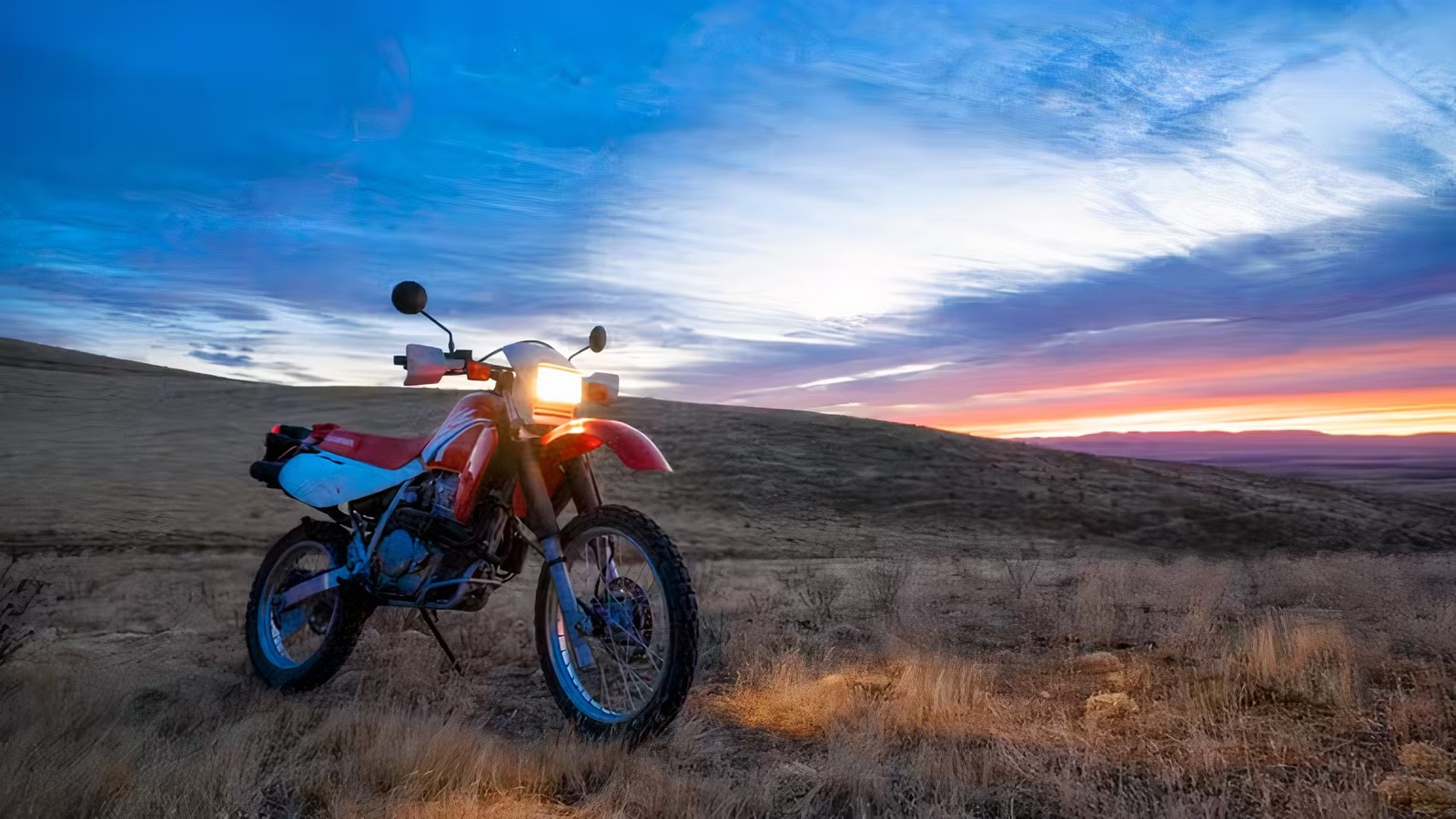
Electronics have transformed motorcycles over the past two decades — ride-by-wire throttles, six-axis IMUs, cornering ABS — and there is no question these systems make powerful bikes more manageable and safer when grip is scarce. But they come with a trade-off that rarely gets discussed until something goes wrong: complexity. Every additional sensor is a potential failure point, and when you are deep in the backcountry with no dealer for a hundred miles, a fault code can end your ride. For riders who plan to keep a motorcycle for the long haul — and who want the freedom to maintain it themselves — there is a compelling case for simplicity.

Electronics add complexity, and that complexity shows up not just in reliability risk but in purchase price, ownership costs, and depreciation. A simpler motorcycle is easier to diagnose, cheaper to fix, and far more forgiving of DIY maintenance. The machines explored here make that case better than almost anything else on the market.
The Japanese Prefer Simplicity In Design
It might not always seem like it, but the Japanese motorcycle manufacturers actually prefer simplicity over everything else. It is a logical decision. The simpler the product, the easier it is to engineer it to last for a very long time. Small wonder, then, if you look at the longest-running engines and motorcycle models in history, you will most probably come up with Japanese names and products. Of course, when they really need to, they can go in the opposite direction, but the underlying philosophy of over-engineering so that it never fails, even under abuse, is always prevalent.


As a result, there are quite a few Japanese motorcycles that have been doing the rounds for a very long time. They don’t particularly care about horsepower figures or features, but they have dedicated followings of their own precisely because they are simple products that focus on the experience of riding the motorcycle in the real world rather than chasing that final two percent of performance at the risk of failure.
Two Mighty Contenders With Unkillable Engines

Yamaha has a number of engines that have been in production for a very long time. But it is worth acknowledging one of its smallest: the air-cooled, single-cylinder, carbureted unit in the TW200. This engine embodies the Trail Way philosophy — a simple bike that can withstand virtually anything, including a trip to the North Pole. It doesn’t offer much other than reliability, but you can count on it absolutely, even if you are a first-time rider who prefers to do maintenance at home.
The Unkillable Single

The KLR650 is legendary for its reliability. It started out in life as a large dual-sport, but over the decades it has grown slowly but surely into a low-cost adventure motorcycle. Kawasaki has added features like fuel injection and ABS without losing its core identity as a reliable, go-anywhere bike. It has become heavier over the years, and the full fairing will be a liability if you drop it. It is also quite unrefined, but all these characteristics pale when it comes to its reliability. There is a reason it is so popular that you can find virtually any aftermarket part imaginable for the KLR — though it could stand to lose a few pounds.
Two (Cylinder) Heads Are Better Than One

Finally, we have to give props to Suzuki’s 650 cc V-twin engine. To this day, it powers both a naked bike and an adventure bike, performing exceedingly well in both roles. It has also proven durable enough for Suzuki to update it to meet the latest emissions standards in Europe — clear evidence that it still has untapped potential, and a strong reason it belongs in this conversation.
The Honda XR650L Has The Legendary Japanese Engine Still Going Strong Today

As good as all of the above are, Honda’s engine in the XR650L deserves recognition as one of the greatest. It not only powers a dual-sport bike — meaning it must cope with an enormous variety of conditions — but it is engineered in a way that makes it a benchmark in its class. Despite being a unique design that Honda has not shared with any other model in its lineup for many years, its reliability is unimpeachable.
The Pricing Is Still Old School

The XR650L carries a price that hovers just under $7,000 at time of writing. At first glance that may not seem like standout value, given that rivals such as the KTM 390 Enduro R and the Kawasaki KLR650 have been priced at close to $1,000 less than the XR. But compare it to its most direct competitor — the Suzuki DR650S — and the picture sharpens considerably. The XR delivers value in ways that go beyond a low sticker price, and if it still doesn’t suit your budget, a clean used example is never hard to find.
Some Very Interesting Engineering In This Engine

The XR650L engine is a study in deliberate contradictions. It is a single-cylinder, air-cooled unit with an SOHC head fed by a constant-velocity carburetor — yet that head carries four valves arranged in a radial layout, not unlike the approach MV Agusta chose for the F4 or Dodge’s famous Hemi cylinder heads. It also uses dry-sump lubrication, which keeps the engine remarkably compact in terms of overall height. Honda has exploited that dry-sump layout to deliver impressive ground clearance — a genuine advantage in the dirt.
Power Figures Are Humble

The engine displaces 644 cc and runs a relaxed compression ratio of 8.3:1, producing 43.6 horsepower at 6,000 RPM and 38.2 pound-feet of torque at 5,000 RPM. A five-speed gearbox and chain drive complete the driveline. Worth noting: the XR650L ships with a spark arrestor in its exhaust, meaning it is ready in stock form to venture further off-road than most dual-sport bikes on the market.
Built Around A Double-Cradle Chassis

The XR rides on a semi-double cradle steel frame that makes it very capable off-road. This chassis has a clever trick up its sleeve: it doubles as the oil reservoir for the dry-sump engine, with the main spine storing the oil and acting as a passive radiator to keep temperatures in check. Suspension consists of 43 mm Showa cartridge forks up front with 11.6 inches of travel and adjustable compression damping, paired with a Pro-Link Showa single shock at the rear offering 11 inches of travel on a progressive spring rate. Spoked wheels in 21- and 18-inch sizes wear tube-type tires. Braking is handled by a 256 mm front disc with a two-piston floating caliper and a 220 mm rear disc with a single-piston caliper.
This Is A Large Dual-Sport Bike

Honda does not officially publish the length, width, and height of the XR, but its 57.3-inch wheelbase tells part of the story. The seat height is a commanding 37 inches — this is not a bike for riders with a short inseam. On the flip side, the dry-sump engine contributes to a generous 13 inches of ground clearance. Curb weight comes in at 346 pounds with a full tank of fuel, which helps offset the challenge of managing such a tall machine.
Features Aren’t The XR’s Forte

This section will be brief, because the XR does not have features in the sense that we understand them today. It has seen no significant updates beyond colors and graphics over the years. The instrument cluster is fully analog, offering a speedometer, odometer, and a single tripmeter — housed, in a charmingly retro touch, in a rectangular pod.
If you want anything more from the XR, the aftermarket is your friend. Its enduring popularity means that virtually whatever you need is available at a reasonable price. And despite the carburetor, the XR650L remains street-legal in all 50 states.
Only One True Legendary Competitor

If the XR isn’t for you, there is really only one true alternative: the Suzuki DR650S. It shares much of the same DNA as the Honda, with identical displacement and nearly matching power and torque figures. It tips the scales at about 11 pounds heavier and uses a conventional wet sump. Suzuki also offers a dealer-installed suspension-lowering kit for riders who find the seat height of either bike too daunting. Honestly, you wouldn’t go wrong with either one.
Source: Honda PowerSports

Related posts
Latest Post


No Comments