
The Kawasaki Motorcycle That Ages Better Than Riders Expect
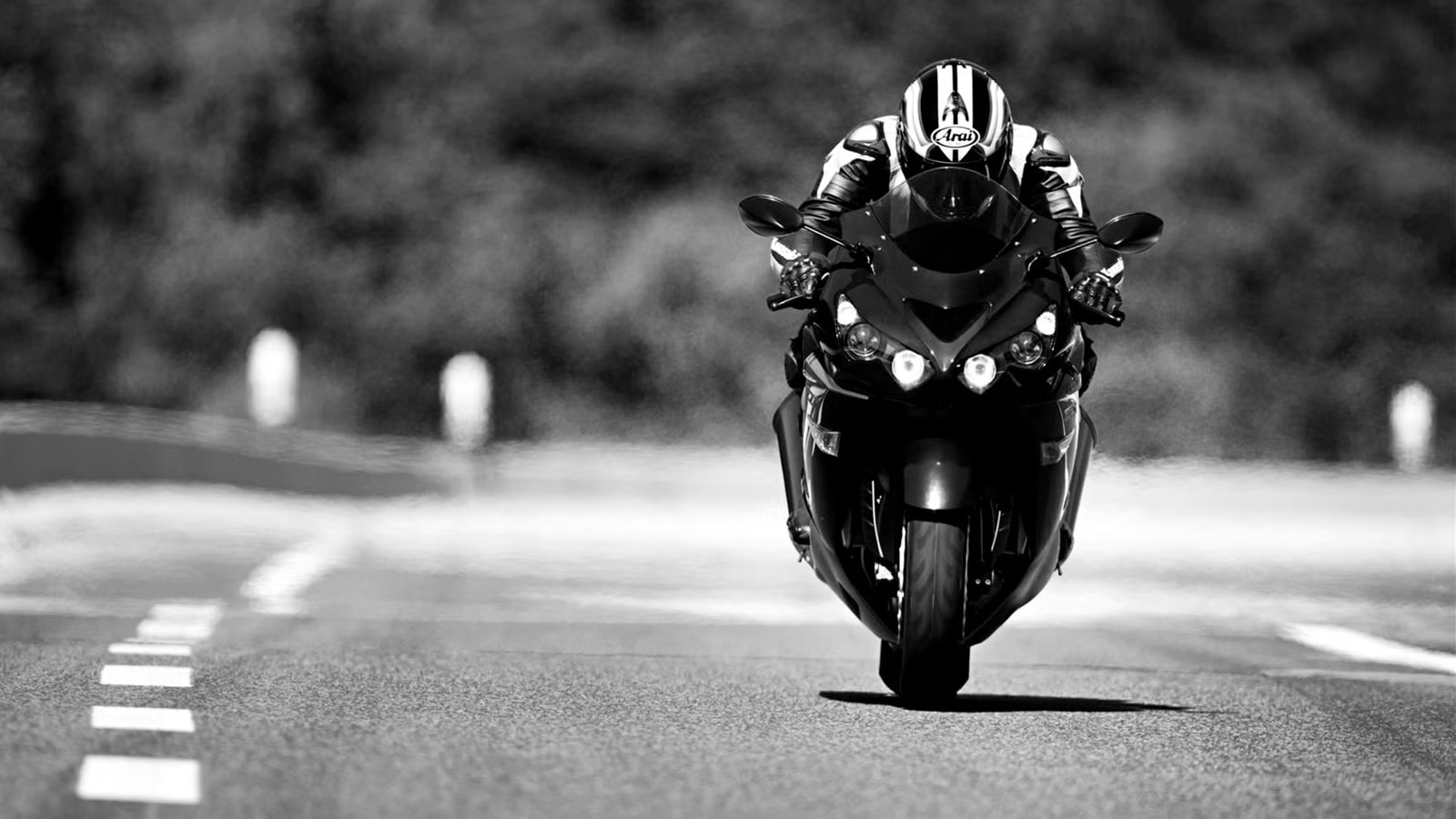
Back in the 80s, Kawasaki kicked off something of an arms race with the GPz900. At the time, it was the fastest motorcycle of the time, and a brief cameo in the original Top Gun movie thrust it into public consciousness. It became a symbol of speed, and speed sold. Naturally, the other Japanese manufacturers took note, and responded with a series of incredible superbikes, all looking to become the fastest production motorcycle in the world. Today, only a few of these speed queens are available on sale as new, and Kawasaki’s biggest four-pot machine remains a prime player.
The Speed Wars Birthed Some Iconic Bikes

Between the mid-80s and late 90s, we got some of the fastest motorcycles ever produced. With Yamaha following the European brands down the motorsport rabbit hole, it left us with three main protagonists in the form of Kawasaki, Honda, and Suzuki. Top honors exchanged hands a couple of times throughout the 80s, but between 1989 and 1995, Kawasaki held the title with the Ninja ZX-11. After this period of domination, Honda brought out the CBR1100XX Blackbird, which finally claimed top honors for Honda. Unfortunately, this was a relatively short reign.

Suzuki came out with the Hayabusa in 1999, and it effectively put an end to this arms race. Although there will be those that look at these old sport bikes through rose-tinted glasses, there is absolutely no denying that these bikes were incredibly dangerous in the wrong hands. All of them were far too powerful for their own good, equipped with engines that were more powerful than their chassis, suspension, and tires could adequately handle.

Regulators stepped in, and ever since then the “Gentleman’s Agreement” has been in effect. All the Japanese brands limited the top speed of their superbikes to 186 MPH, which was a great shame for Kawasaki. The Ninja ZX-12R had already been developed, and it was primed and ready to become the first 200 MPH production motorcycle.
The Kawasaki Ninja ZX-14R Is Still “The Quarter-Mile King”
MSRP: $17,599

Even though it was limited to 186 MPH right from inception, the Ninja ZX-12R proved to be a popular model, with most customers fully aware of what it was capable of doing. It eventually gave way to the ZX-14 in 2006. A final update in 2012 saw an increase in displacement to the current 1,441cc. Even though the Ninja ZX-14R platform is now well over two decades old, and by all accounts into its twilight years, it certainly isn’t out of place in the current lineup. With a sub-10-second quarter-mile time, this old speed queen has still got it.
An Incredible Naturally Aspirated Inline-Four Produces Close To 200 HP

Kawasaki famously turned to supercharging in an effort to put the “fastest ever” debate to bed once and for all. While the H2 certainly has its place, that supercharged monster costs almost twice as much as this old speed queen. The gap in performance will also only be felt long after road-legal speeds have been surpassed, and only for a brief moment before both bikes hit their 186 MPH limiters. In the real world where speed limits exist, the difference is hardly discernible.
Buttery Smooth Performance With Oodles Of Torque

One of the most desirable aspects of the motorcycle is how it delivers its power. You get smooth, linear power delivery all the way up to its redline. Unlike smaller displacement inline-fours, it also has a relatively flat torque curve, which translates to effortless roll-on acceleration no matter what gear you are in. Although these bikes were initially designed to be proper high-performance motorcycles, these engines are virtually bulletproof (having been designed to be ridden at ridiculous speeds for sustained periods of time), and are more than capable of racking up well over 100,000 miles.
The ZX-14R Is A Throwback To Simpler Times

With a wet weight of 593 pounds, the Ninja ZX-14R is no shrinking violet. Getting the most out of it requires a level of skill most of us simply do not possess. It is, rather obviously, a relatively simple motorcycle that was simply designed to go fast in a straight line. Unlike most modern motorcycles, it doesn’t offer any form of connectivity.
You do, however, get a handful of electronic rider aids. It has ride modes, ABS, and mercifully, adjustable traction control. This is a fair bit more tech than any of the old speed queens from the 90s would have had, but it certainly isn’t any great shakes when compared to modern superbikes that make this much power.
For one, there is no IMU in sight, so nothing is lean-sensitive. Modern superbikes have not become much more powerful over the years, but they have become incredibly good at harnessing the power that they do have. The ZX-14R puts the onus back on the rider, which isn’t a bad thing at all; it just requires a level of input modern riders may not be familiar with.
Last Of A Dying Breed

Scary-fast motorcycles like the ZX-14R are part of a dying breed. The Suzuki Hayabusa is the only other bike left from this era, and it recently went into its third generation. But, in most respects, it has lost its hard edge and embraced its sport-touring potential. Suzuki added a slew of electronics to bring it bang up-to-date, and is actually now less powerful than second-gen bikes, as well as the latest GSX-R1000. So it is fair to say that it has been toned down a fair bit. The ZX-14R has also been toned down a little.
Not long ago, it was making well over 200 horsepower with ram air, and now that power figure is down to 197 horsepower (still, way more than you will ever need). It also, as far as we can tell, won’t be around for much longer. It is listed as a 2025 model, and Kawasaki hasn’t said anything about replacing it. While stocks last, it is still well worth considering. These scary fast bikes are not for everyone, and are certainly not for inexperienced riders. But, for experienced riders that still have a need for speed, it is hard to beat one of these ageless superbikes.
Source: Kawasaki

Related posts

Latest Post


No Comments