
The Japanese V8 That Quietly Earned Legendary Status
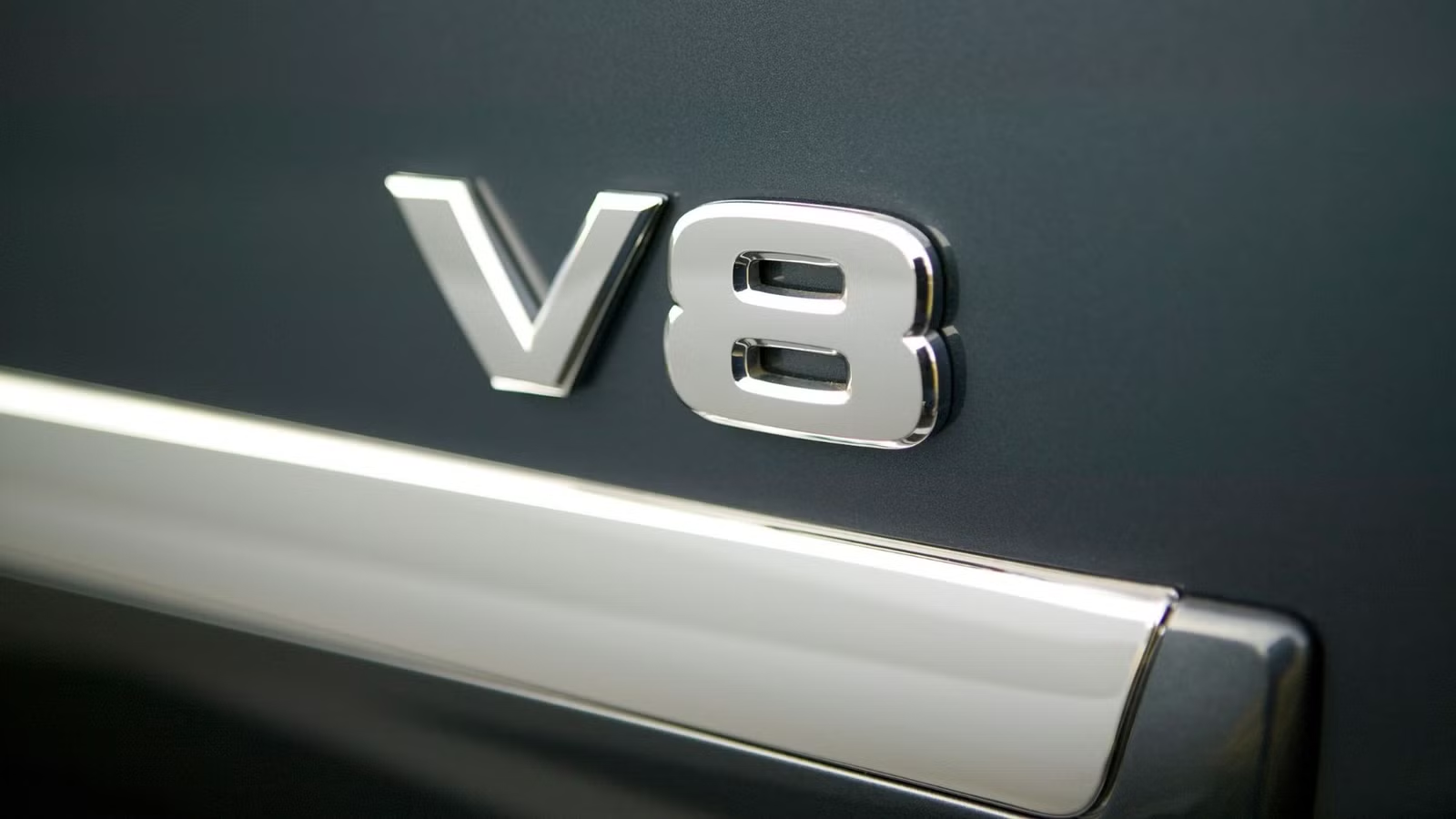
Everyone assumes the meanest, most powerful V8s wear an American badge. But there’s a Japanese V8 that’s been living a double life for two decades, hauling boats and grocery runs under one name in your neighbor’s driveway, and quietly racking up championships at Le Mans under a completely different one. It’s been doing this in plain sight the entire time, no disguise, no secrecy, and the people driving it every single day still have no idea what’s actually sitting under the hood.
The V8 Everyone Wrote Off As Just Truck Power

Most of the heavy-duty SUVs and pickups built with serious towing muscle under the hood have run this V8 at some point. It earned a reputation as one of the best engines in the business for hauling boats, trailers, and everything else people ask a big truck to do. The person behind the wheel almost never thinks twice about what’s actually powering that capability.
That’s kind of the point. An engine built specifically for low-end grunt, north of 300 hp and well over 380 lb-ft of torque depending on the application, isn’t the kind of spec sheet that makes headlines. It never showed up in a single ad built around performance, because performance was never the pitch; towing capacity and reliability were. It sat at the base of entire vehicle lineups without ever being the reason anyone bought in. Buyers picked the truck for the bed length, the SUV for the third row, the badge for the warranty. The engine underneath was just assumed to work, and it did, without anyone stopping to ask why.

This wasn’t a halo engine begging for attention. It was built to be quiet, dependable, and completely unremarkable in exactly the way buyers of heavy-duty trucks and SUVs actually want. Nobody cross-shops a tow rig on horsepower bragging rights, they care whether it fires up every winter and hauls the boat up the ramp without complaint. Think of an undercover agent stuck doing entry-level work, never once blowing their cover. This same V8 has powered everything from full-size, three-row SUVs and rugged off-roaders to work trucks and flagship luxury sedans, a wider spread of duty than most engine families ever get. That range alone should have raised more questions than it ever did.

A Prototype Racing Program Was Quietly Running On This V8’s Own Blueprint

At its core, this is one V8 architecture built in two distinct versions for two very different jobs. The 4.5-liter version was tuned for smooth, refined power in sedans and crossovers. The 5.6-liter version was built with more displacement and a heavier focus on low-end torque, aimed squarely at trucks, SUVs, and off-roaders. The numbers back up the split. The smaller 4.5-liter makes 340 hp and 333 lb-ft of torque, revving out to 6,400 rpm. The larger 5.6-liter actually makes less peak horsepower, somewhere in the 305 to 322 range depending on the application, but trades that for noticeably more torque, well over 380 lb-ft, exactly the tradeoff a heavier vehicle needs.

The bigger displacement isn’t just a bored-out version of the smaller engine either. The 5.6-liter uses a taller block deck to fit a longer stroke, a real internal change, not a simple overbore — the kind of work that goes into building a genuinely different engine rather than badge-swapping the same one.
Both share the same fundamentals, a 90-degree aluminum-block V8 with dual overhead cams and four valves per cylinder. Both use titanium intake valves to save weight and a variable-length intake system that physically changes shape depending on RPM, optimizing airflow for low-end response in one version and higher-rev output in the other. It’s the same engineering playbook, tuned two completely different ways for two completely different jobs.
In period testing, the 4.5-liter sedan version, in a car weighing over 4,100 pounds, ran 0-60 in around 6.0 seconds and the quarter mile in 14.5 seconds at 98 mph — quick for a full-size luxury sedan of its era. The heavier 5.6-liter trades that sprint for pulling power, built to move a loaded trailer, not chase a stoplight-to-stoplight record.
The Nissan VK V8 Family Behind Trucks, Sedans, and Race Cars

The engine capable of all that from one shared architecture is Nissan’s VK V8 family, specifically the VK45DE and VK56DE. VK45DE is the milder 4.5-liter version, and VK56DE is the bigger 5.6-liter one. Between the two, this engine family has powered a striking range of Nissan and Infiniti models across two decades. Here’s the surprise. This is the same engine family that powers everything from the Titan pickup to the Patrol flagship SUV, and it shows up across Infiniti’s lineup too, Nissan’s own luxury division, not some separate American cousin. In Japan, the same architecture went into the Fuga sedan and the ultra-exclusive President, a car most Americans have never even heard of.

That breadth of application is part of why it was so easy to overlook. People loved what these engines could do. Almost none of them knew the real story behind that capability. None of this happened by accident. Building one V8 architecture that could credibly serve a luxury flagship sedan and a heavy-duty pickup let Nissan spread the cost of an expensive engine program across a far wider range of vehicles than any single model could justify funding on its own. The double life wasn’t a coincidence, it was the business case behind the entire engine family.
Nissan’s own engineers have described the sedan and truck versions as engines that share bloodlines, same family, different displacement, different jobs. Both versions of the V8 are built at Nissan’s plant in Decherd, Tennessee, which has turned out well over a million of these engines since production started there in 2003. Think of it like a retired Marine who spent years as one of the most feared operators in the field, then came home to spend his days as somebody’s mild-mannered dad. The VK45DE’s road-going debut came in 2002, and its motorsports career was about to get a lot more serious.
How the Nissan VK45DE Went From Super GT Champion to Le Mans Class Winner

The VK45DE’s first taste of real racing didn’t come in a GT-R. It arrived in 2006, when NISMO dropped it into the Fairlady Z, sold in the US as the 350Z, for Japan’s Super GT series. The R35 GT-R didn’t even exist yet. That changed for 2008, when the redesigned GT-500 class GT-R arrived and NISMO carried the same VK45DE straight into it rather than starting over. Restricted for competition, the engine reportedly made somewhere around 500 horsepower, a serious jump over the road car’s output. The GT-R won seven of nine races that year and the GT500 drivers’ championship in its debut season.
Le Mans came a few years later. When the sport’s rulemakers rewrote the LMP2 prototype regulations for 2011 to require production-based engines, NISMO had exactly the kind of engine those rules were written for, one that had already proven itself across multiple Super GT seasons. NISMO partnered with Zytek Motorsport in the UK to build and supply these engines to customer teams, and cars running it finished first and second in the LMP2 class at Le Mans that very first year.

Between 2011 and 2016, cars running this engine won the LMP2 class outright at the 24 Hours of Le Mans five separate times in six years, missing only in 2012, when a Honda-powered prototype broke the streak. By 2013, 15 of the 22 cars on the LMP2 grid at Le Mans were running this same engine, practically a spec series hiding in plain sight.
While it was busy winning at Le Mans, the 5.6-liter VK56DE was quietly living its own second life. Nissan and the Melbourne-based Kelly Racing team, competing as Nissan Motorsport, sleeved the truck engine’s cylinders and revised the bore and stroke specifically to bring displacement down from 5.6 liters to 5.0 liters to meet Australia’s V8 Supercars regulations. Fitted to the Nissan Altima, it took its first win at Winton in August 2013 and kept racing in the category through 2019, the truck engine and the Le Mans winner turning out to be closer relatives than anyone watching either series ever realized.
Why This Nissan V8 Still Matters as Its Era Comes to an End

That question has one honest answer. This engine mattered because it proved something quieter than headline power figures ever could, spending two decades excelling at the least glamorous job in the industry while a close relative of the exact same architecture was out there winning at the highest level of endurance racing.
That era is ending. Nissan discontinued the Titan after the 2024 model year, and the 2025 Armada switched to a 425 hp twin-turbo V6, closing out naturally aspirated V8 production in Nissan’s US lineup entirely. It’s part of an industry-wide shift away from big, simple V8s toward smaller turbocharged engines built for efficiency, a shift affecting nearly every manufacturer still building trucks and SUVs, not a decision unique to this one engine family.

Fittingly, Nissan’s own materials on that replacement V6 lean on GT-R-derived technology to sell it, an oil pump borrowed straight from the race program, turbine material pulled from jet engines. The same instinct that sent a truck engine racing in the first place is still showing up in whatever replaces it.
Finding one of these V8s today isn’t hard, exactly, it’s more that nobody’s looking. On the collector market, a 2002–2006 Infiniti Q45 running the sedan version of this engine averages under $8,000, with the top recorded sale sitting at just under $30,000 and plenty changing hands for as little as $3,300. That’s a genuine Le Mans-winning engine family sitting in driveways and used car lots across the country, still doing its day job, still keeping the same secret it always did.
Sources: Nissan, Nismo, Classic.com

Related posts


Latest Post


No Comments