
The Japanese Six-Cylinder Engine Is So Reliable It’s Still In Production After Almost 25 Years
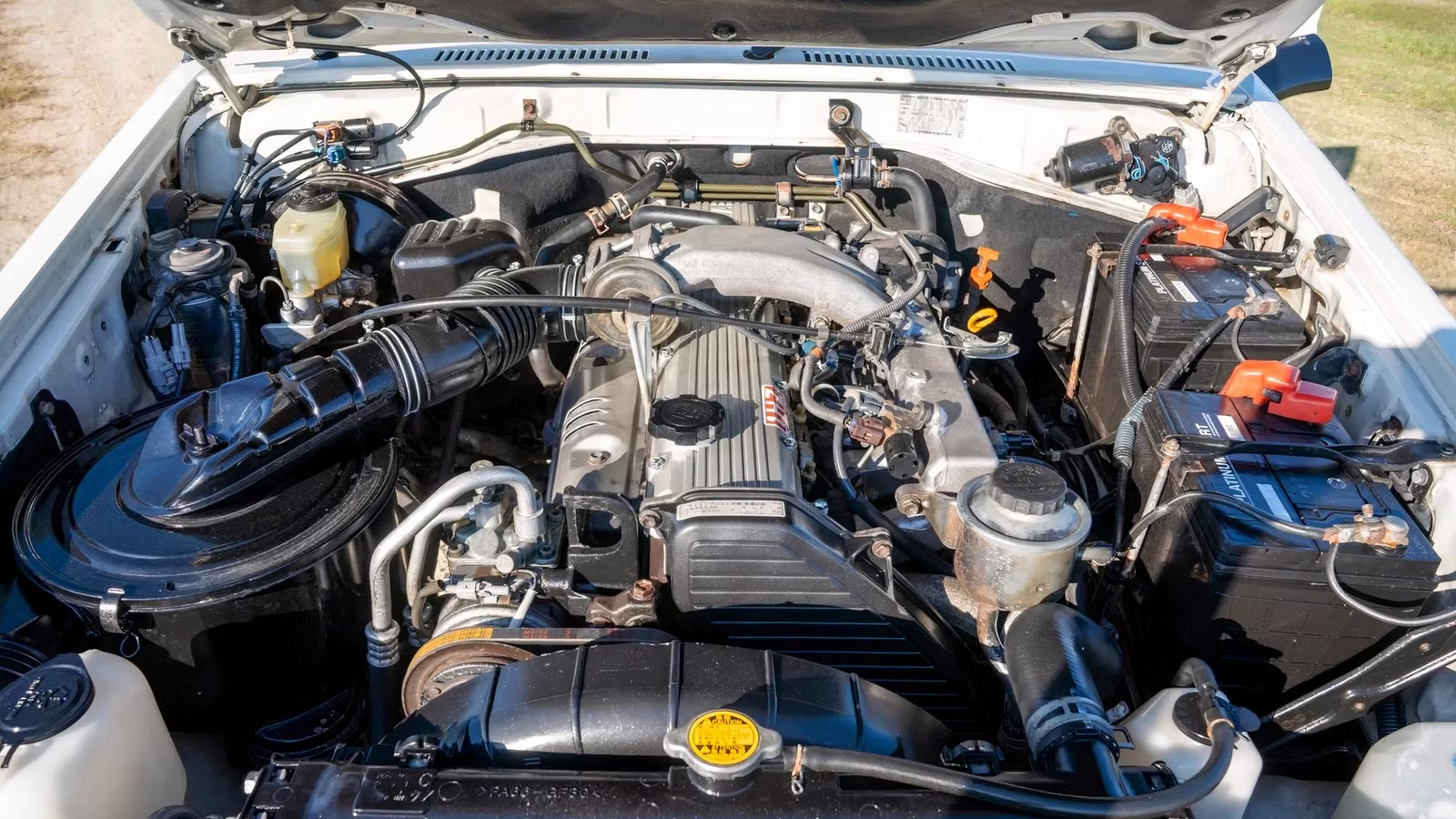
Some engines age into obsolescence. Others age into legend. Toyota’s 1HZ diesel straight-six belongs firmly in the second camp — and what makes it genuinely remarkable is that it was never trying to be cutting-edge in the first place. While the rest of the industry spent the 1990s and 2000s chasing horsepower figures and layering on electronics, Toyota quietly kept building an engine so mechanically straightforward, so deliberately over-engineered for endurance, that it has outlasted entire generations of more sophisticated rivals. Decades after its introduction, the 1HZ is still at work — still powering one of the toughest vehicles on the planet, the Land Cruiser 70 Series — and showing no signs of retirement.
What Makes The 70 Series Such An Important Model

The Toyota Land Cruiser 70 Series holds major importance in the global market because it fills roles that modern SUVs no longer address. The Japanese brand designs it as a working vehicle intended for markets where durability matters more than comfort. Governments, aid agencies, mining companies, farmers, and militaries swear by the 70 Series because it handles extreme heat, poor fuel quality, heavy loads, and constant mechanical use without showing signs of fatigue.
Another key aspect of the 70 Series is its ladder frame construction, which provides immense durability and versatility in the harshest and most challenging conditions. Despite the global automotive world embracing more modern and cost-effective designs, Toyota remains committed to the 70 Series because of how effectively it supports select economies — serving as ambulances, utility trucks, troop carriers, and expedition vehicles in regions where most new SUVs and trucks simply wouldn’t survive.
If the Land Cruiser eroded Land Rover’s market share in Africa, the 1HZ effectively eroded it. As you can see, it’s not a particularly powerful engine, but it has three important things going for it. First, it’s an extremely durable engine. Secondly, it does without complex electronics and emissions systems, which is also why it can’t be sold in the USA. Third, it delivers maximum torque at 2,200 rpm, and that’s what makes it so good to drive off-road. When the going gets tough and you engage low-range, this beast of a car simply idles up and over obstacles like they don’t exist.

What I love most about the 70 equipped with the 1HZ as opposed to the turbocharged V-8 diesel option is the fact that it forces you to slow down and enjoy whatever journey you’re on. A 70 Series equipped with this naturally aspirated six-cylinder diesel settles nicely at 65 mph, making the journey slow-going and more relaxing as a result.
– Gerhard Horn, Senior Editor, CarBuzz
Predictable reliability builds trust in the Toyota brand and reinforces the company’s reputation for long-term dependability. Few vehicles still offer this level of toughness straight from the factory, which makes the Land Cruiser 70 Series a cornerstone product with global relevance despite its age and significantly higher production cost.
The Engine That Refuses To Die

Toyota officially introduced the 1HZ in 1990 for the Land Cruiser 70 Series SUV and truck duo as a direct replacement for the 2H diesel powertrain. The engine is built around a 4.2-liter inline-six block with a single overhead camshaft, a cast-iron block and cylinder head, and an indirect injection design. It produces 129 horsepower at 3,800 RPM and 210 pound-feet of torque at an impressively low 2,200 RPM. Because it generates relatively modest power for its substantial 661-pound thermal mass, the internal components are never subjected to serious stress — allowing the engine to routinely exceed 300,000 miles with nothing more than basic oil changes and timing belt maintenance.
This engine remained in production for more than two decades — a remarkable run by any measure. The Toyota 1HZ was a revolutionary example of over-engineering, arguably making it the finest workhorse powertrain ever produced, with reliability as the central focus of its design regardless of conditions or environment. From a design standpoint, its outright rejection of then-modern technology is exactly what made it so enduring, as Toyota fully embraced the philosophy: if it isn’t broken, don’t fix it.

Toyota designed this engine to operate for the duration of its service life without any ECU or electrical sensors, relying entirely on mechanical components. This is precisely how it earned its reputation as a crucial survival tool in remote regions — especially those where high-grade fuel and diagnostic equipment are simply unavailable.
Why It’s Still Running After 25 Years

The Toyota 1HZ earns its reputation through simple, robust engineering: strong internal components built to tolerate heavy use with minimal maintenance. Key design elements include the cast-iron block paired with a forged steel crankshaft and generously sized bearings — components Toyota built to handle high loads and extended service intervals. The indirect injection design reduces stress on the fuel system and allows the engine to tolerate low-grade fuel and punishing environments without complaint.
The 1HZ uses a swirl-chamber indirect injection design and an exceptionally high compression ratio of 22.7:1, which Toyota later reduced slightly to 22.4:1. This approach allows the engine to ignite even poor-quality diesel fuel reliably. The block features a substantial 94 mm bore and 100 mm stroke, optimizing low-end torque rather than high-speed performance — which makes sense, given that 1HZ-powered vehicles predominantly operate in low-speed, high-demand environments.

The head gasket area benefits from impressive stability, predictable wear, and minimal weak points, delivering consistent performance even in extreme heat. Toyota keeps electronics to a minimum and relies on mechanical fuel injection, which reduces complexity and limits failure modes compared to modern common-rail systems. Long-term owners consistently praise the engine’s ability to cover hundreds of thousands of miles in harsh conditions with nothing more than basic servicing and routine oil and filter changes. Many examples survive decades of off-road and commercial use because parts remain widely available and affordable, and technicians familiar with the design can make repairs quickly and confidently.
The One Thing That Can Actually Kill It

While this engine is built to endure extraordinarily punishing conditions, owners and specialists who know the 1HZ well offer some important upkeep guidance. Forums and owner testimonials consistently praise its durability and minimal maintenance demands — but only in its naturally aspirated factory form. Digging deeper reveals a clear consensus: turbocharging is a popular upgrade given the engine’s modest power output, but it significantly increases the risk of premature component failure, a concern with any older engine design subjected to added boost pressure.
One of the primary problems with adding boost is that the crown of the 1HZ’s pistons is relatively thin. Introducing hot pressurized gases can burn through the piston crown, causing catastrophic failure and costly repairs. Overheating is another common consequence of turbocharging the 1HZ. The 1HD-T is the factory-turbocharged equivalent of the 1HZ, and most buyers seeking more power are better served by choosing one from the outset. The bottom line: leave the 1HZ naturally aspirated. If more power is truly necessary, a conservative low-boost setup running around 10 to 12 psi is the safest approach to preserving the engine’s integrity.
Why You’ll Never Find One In A U.S. Dealership

Toyota does not sell the 70 Series in the United States does not sell the Land Cruiser 70 Series in the U.S. because its relatively archaic design does not meet the modern safety and emissions standards required for sale there. Toyota has chosen not to engineer it into compliance, as doing so would be a costly undertaking that would fundamentally alter the core character of the vehicle.
The 70 Series rides on an older truck platform that lacks the advanced crash structures and modern restraint systems that regulators require. Its diesel engine and mechanical systems also fall well short of stringent EPA and CARB emissions rules without significant redesign. Bringing it into compliance would require expensive hardware such as advanced exhaust aftertreatment and electronic engine management — additions that would raise costs and erode the vehicle’s defining simplicity.

Toyota has evaluated the potential U.S. sales volume and determined it too low to justify the investment in redesign and certification. American buyers tend to prefer SUVs with higher levels of comfort and safety tech, and Toyota already offers the Land Cruiser nameplate in forms that meet local regulations. The brand instead focuses its U.S. lineup on models that combine genuine off-road capability with the technology needed to clear regulatory hurdles. Ultimately, the 70 Series is a purpose-built workhorse designed for conditions that the vast majority of Americans will never encounter.
How Toyota Keeps The 70 Series Alive In Stricter Markets

Toyota turns to its more modern 1GR-FE and 1GD-FTV engines to keep the Land Cruiser 70 Series viable in regions with stricter emissions requirements, such as Europe and Australia. The 1GR-FE is a naturally aspirated 4.0-liter V-6 gasoline engine with a similarly proven and straightforward design. It features port fuel injection, a timing chain, and a conservative state of tune that supports long service life and tolerates variable fuel quality — making it well suited to markets where gasoline is more accessible than diesel and where buyers value smooth power delivery alongside easy maintenance.
The 1GD-FTV is a more modern 2.8-liter turbodiesel that delivers improved efficiency, better emissions compliance, and a stronger torque curve than the 1HZ. Toyota equips it with a contemporary combustion design and reinforced internals, along with emissions hardware calibrated to regional regulations — achieving compliance without compromising the durability the 70 Series is known for.
Where It Goes From Here

Toyota is unlikely to ever discontinue the 70 Series because it serves markets and use cases that no modern replacement can fully address. Governments, utilities, aid agencies, and industrial operators working in remote or underdeveloped regions will continue to depend on it as a tool rather than a lifestyle vehicle. Even electrification adoption in these markets remains deeply uncertain.
Consistent global demand justifies continued production with minimal development costs. The platform relies on amortized tooling, proven manufacturing processes, and shared components, all of which keep margins healthy. Regional regulations continue to permit its sale with targeted updates rather than full redesigns. Discontinuing the 70 Series would leave Toyota without a dedicated heavy-duty work vehicle and would undermine brand loyalty in key developing markets where long-term durability is the primary driver of purchasing decisions.
Sources: Toyota, Hagerty, and EngineExplained

Related posts





Latest Post


No Comments