
The Japanese Motorcycle That Terrified Harley-Davidson
Few moments in motorsport history carry the weight of a genuine paradigm shift — but the arrival of Japanese motorcycles on American shores was exactly that. For years, the domestic market had operated on its own terms: big V-twins, loyal dealerships, and a riding culture built around heritage and horsepower. It was a world that felt permanent, almost self-sustaining, and nobody seriously expected it to be challenged from the outside.

Then came a wave of engineering from Japan that didn’t just compete — it redefined the rules entirely. Backed by reliability, refinement, and performance that held up mile after mile, these machines didn’t announce a takeover so much as quietly execute one. By the time the American motorcycle industry took stock of what had happened, the landscape had already shifted beneath its feet.
The Honda CB750 Changed What A Motorcycle Could Be
|
Engine |
 90 autotech Power |
Torque |
Transmission |
|---|---|---|---|
|
736cc, transverse 4-cylinder |
67 hp |
44.2 lb-ft |
5-speed |
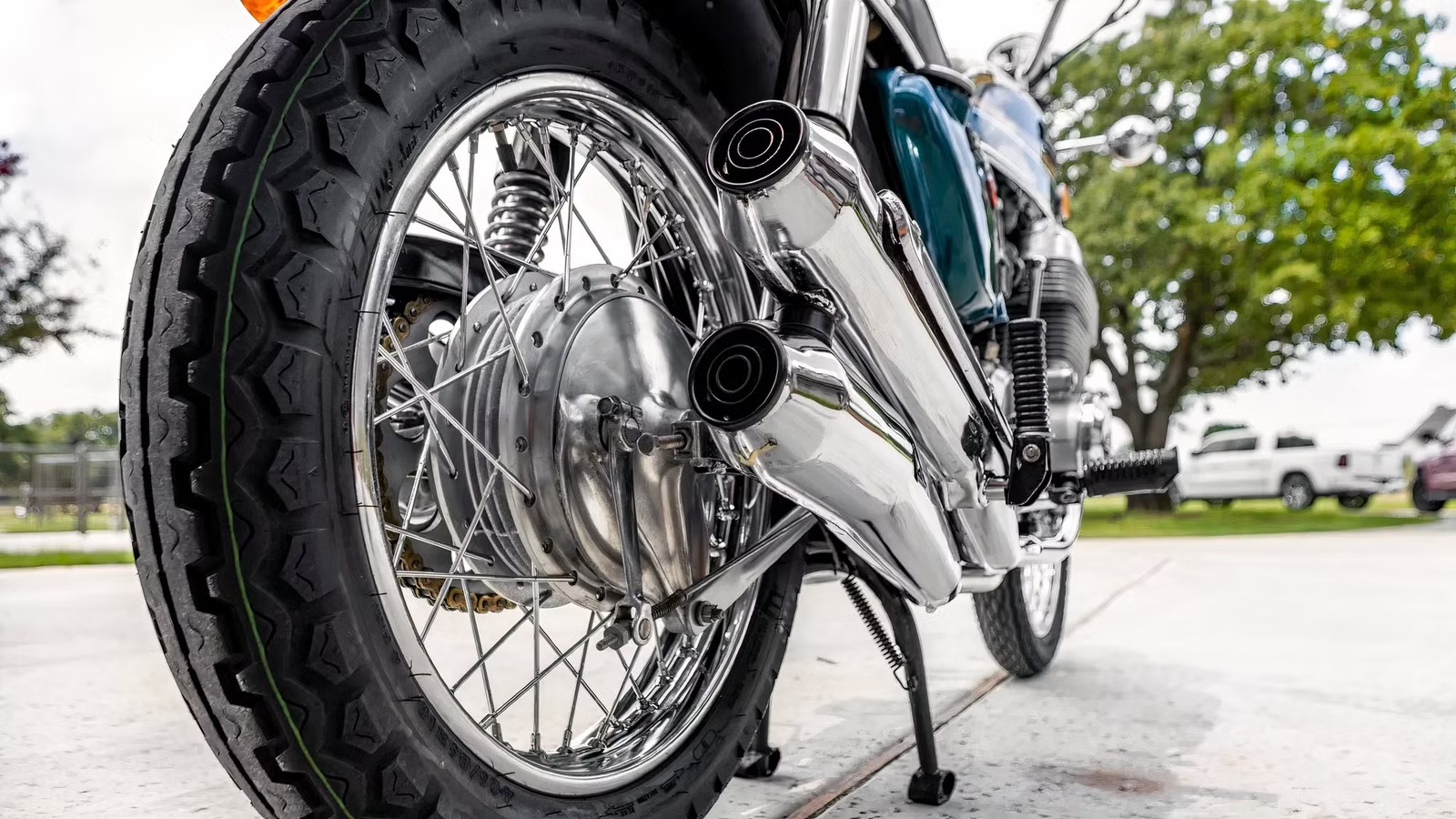
When the Honda CB750 debuted in 1969, it felt like a hard reset. The transverse inline-four layout alone was enough to turn heads, but Honda had more up its sleeve. An overhead camshaft, electric start, and a front disc brake arrived as standard equipment on a mass-produced motorcycle. At the time, that combination bordered on absurd.
What made this Honda such a shock was the technology it packed, certainly, but also how seamlessly everything worked together. The engine delivered smooth, usable power without drama. The bike started reliably, ran cleanly, and didn’t punish its rider with constant upkeep. Riders who were used to big bikes demanding attention suddenly found themselves riding more and wrenching less.
This was a clear turning point. The CB750 proved that performance didn’t have to come with a list of compromises. It could be fast, refined, and dependable all at once. It pushed 67 hp from a 736cc four-cylinder and pulled away from much more powerful bikes of the era. That idea spread quickly, and once it did, there was no going back. And thus began the quiet era that was the superbike revolution in America.
Reality Of Motorcycle Ownership Before The CB750

To get a better sense of the shift, it helps to rewind to what owning a large motorcycle typically involved through the ’60s. Kick-starters were standard, cold starts were unpredictable at best, and oil seepage was often treated as normal behavior. Carburetors demanded frequent adjustment, electrical systems were fragile — with some owners hilariously documenting their experiences — and long-distance riding required patience as much as confidence. The bikes that ruled that era were big, heavy twins built around torque and presence, but they asked plenty in return. Riding was rewarding, but ownership was anything but straightforward. The CB750 was a breath of fresh air by comparison.
It should be noted, however, that early CB750s weren’t flawless. Some have pointed out high-speed stability concerns and braking limitations — issues Honda addressed through ongoing updates. Even so, those early shortcomings did little to slow the momentum it had already created.
Why The CB750 Felt Like A Direct Threat To Harley

From Harley-Davidson‘s perspective, the CB750 was unsettling for reasons that went beyond raw numbers. Yes, it offered strong performance at a lower price point ($1,495, while large bikes were selling between ‘$2,800 and $4,000 in the U.S. at the time’), but the deeper issue was accessibility. This was a big motorcycle that didn’t feel intimidating to own or live with.
How The CB750 Undercut Harley At Its Core

Where the CB750 truly rattled Harley was in how completely it reframed expectations. For nearly half the price of a large American V-twin, buyers got smoother cruising, modern braking, electric start, and a level of refinement that felt almost effortless. Honda didn’t set out to build a luxury machine, but it delivered an ownership experience that felt forward-thinking and easy to live with. The reality was that Harley was being challenged on usability, value, and relevance.
From the rider’s perspective, this was a game-changer, and maintenance expectations shifted overnight. Riders spent less time adjusting, tuning, and troubleshooting. That might sound mundane, but for the era it was revolutionary. A motorcycle that behaved predictably and didn’t demand constant attention transformed the ownership experience entirely. Who wouldn’t want that?
The Whole Package

The CB750 also spoke directly to a younger audience. Speed, technology, and smoothness aligned with changing tastes. Tradition still had value, but it was no longer enough on its own. Harley’s long-standing advantage in displacement and road presence suddenly felt less decisive.
The market’s reaction was immediate. Demand quickly outstripped supply, dealerships struggled to keep CB750s in stock, and waiting lists became common. Honda produced over 430,000 CB750s through 1978, despite reportedly being cautious about the model’s prospects. More importantly, it reset the baseline for what riders expected from a serious motorcycle. Reliability was no longer optional, and smoothness became a genuine selling point. For Harley, the consequences were significant: younger buyers looked elsewhere, performance conversations shifted, and displacement alone stopped being enough. The ground had moved, and a new era had well and truly begun.
Kawasaki’s Z1 Took The Formula And Turned It Up To 15

|
Engine |
Power |
Torque |
Transmission |
|
903cc, transverse 4-cylinder |
82 hp |
54.3 lb-ft |
5-speed |
If Honda introduced the idea, then Kawasaki straight-up weaponized it. The Z1 arrived in the early 1970s with a 903cc inline-four engine and zero interest in subtlety. Its intention was clear: outgun the CB750 in every meaningful way. Performance was the headline. The Kawasaki Z1 delivered speed that pushed production motorcycles into territory previously reserved for racing, posting a top speed of 135 mph and a quarter-mile time of 12.6 seconds.
The Z1 also changed how Japanese motorcycles were perceived globally. Reliability was no longer the primary talking point — performance was. And once Japan had claimed the performance crown, the conversation changed permanently. Riders flocked to Japanese bikes because they were both sensible and seriously fast.
At that point, the horsepower race was inevitable. Think of it as the moment the escalation clause kicked in. “Just one more bike” would never again really mean just one more bike.
What The CB750 And Kawasaki Z1 Are Worth Today

Time has been kind to both machines, but in different ways. Hagerty’s valuation data shows that a ’74 CB750 in excellent condition commands a strong premium, with concours-condition examples stretching well above that. Early models and unmodified survivors command the strongest prices, but the CB750 still feels relatively accessible in the collector market.
The Z1’s Monstrous Peaks

The Kawasaki Z1 occupies a different space entirely. With lower production numbers and a reputation built around outright performance, values have climbed more aggressively. Concours-spec examples fetch significant sums, and the market continues to push higher — a ’74 Z1A recently set a record for itself at Mecum Monterey 2025 by selling for a whopping $82,500.
Collectors view the CB750 as foundational. The Z1 is seen as aspirational. One represents the beginning of a new era, while the other represents its peak. Both are taken seriously, and both have reached the stage where explaining the purchase to your spouse requires charts, graphs, and a very calm tone of voice.
The Japanese One-Two Punch Reshaped The ’70s

Together, Honda and Kawasaki delivered a one-two punch that reshaped the entire motorcycle industry. Honda introduced the concept of mass-produced high performance that didn’t sacrifice reliability. Kawasaki escalated the arms race by leaning hard into speed and visual aggression.
Meanwhile, other manufacturers struggled to keep pace. Development cycles shortened, expectations rose, and riders began demanding smooth power delivery, modern braking, and engines that could handle sustained use without complaint. The market no longer rewarded tradition alone — which wasn’t great news for brands like Harley-Davidson.
Harley-Davidson’s Turbulent Response In The ’70s

Harley-Davidson entered this period under AMF ownership, which complicated everything. Internal instability, production challenges, and quality control issues made it difficult to respond quickly to external threats. While Japanese manufacturers surged ahead with rapid innovation, Harley was fighting battles on multiple fronts.
Performance headlines increasingly belonged to overseas brands, and the market noticed. Harley faced criticism not just from competitors, but from its own customers. Consistency issues hurt perception at precisely the moment reliability had become a core selling point for the competition.
Rather than engaging directly in the emerging superbike war, Harley focused on staying afloat. It wasn’t the prettiest sight — especially for loyalists who still had a soft spot for the brand — but keeping its head above water was the only sensible course of action available.
How Harley Regrouped Instead Of Competing Head-On

The regrouping phase was gradual and deliberate. Harley didn’t attempt to out-Japan Japan. Instead, it doubled down on differentiation, and models like the FX Super Glide helped modernize the lineup while preserving core identity.
Manufacturing improvements followed through the late 1970s and into the 1980s. As a direct consequence, quality stabilized and confidence slowly returned. Rather than chase inline-four configurations or outright speed, Harley leaned into heritage, styling, and lifestyle.
Holding Back On Purpose

In hindsight, that decision defined the brand’s future. Harley avoided a fight it was unlikely to win and focused on what made it distinct. The Japanese invasion forced Harley to rethink its approach, even if it never forced imitation. It’s true what they say: sometimes the smartest move is knowing which race you’re not running.
Sources: Honda, Kawasaki, Motorcyclist, Hagerty, Mecum, Ride Apart.

Related posts

Latest Post


No Comments