
The Japanese Hybrid SUV With The Highest Driving Range In 2026
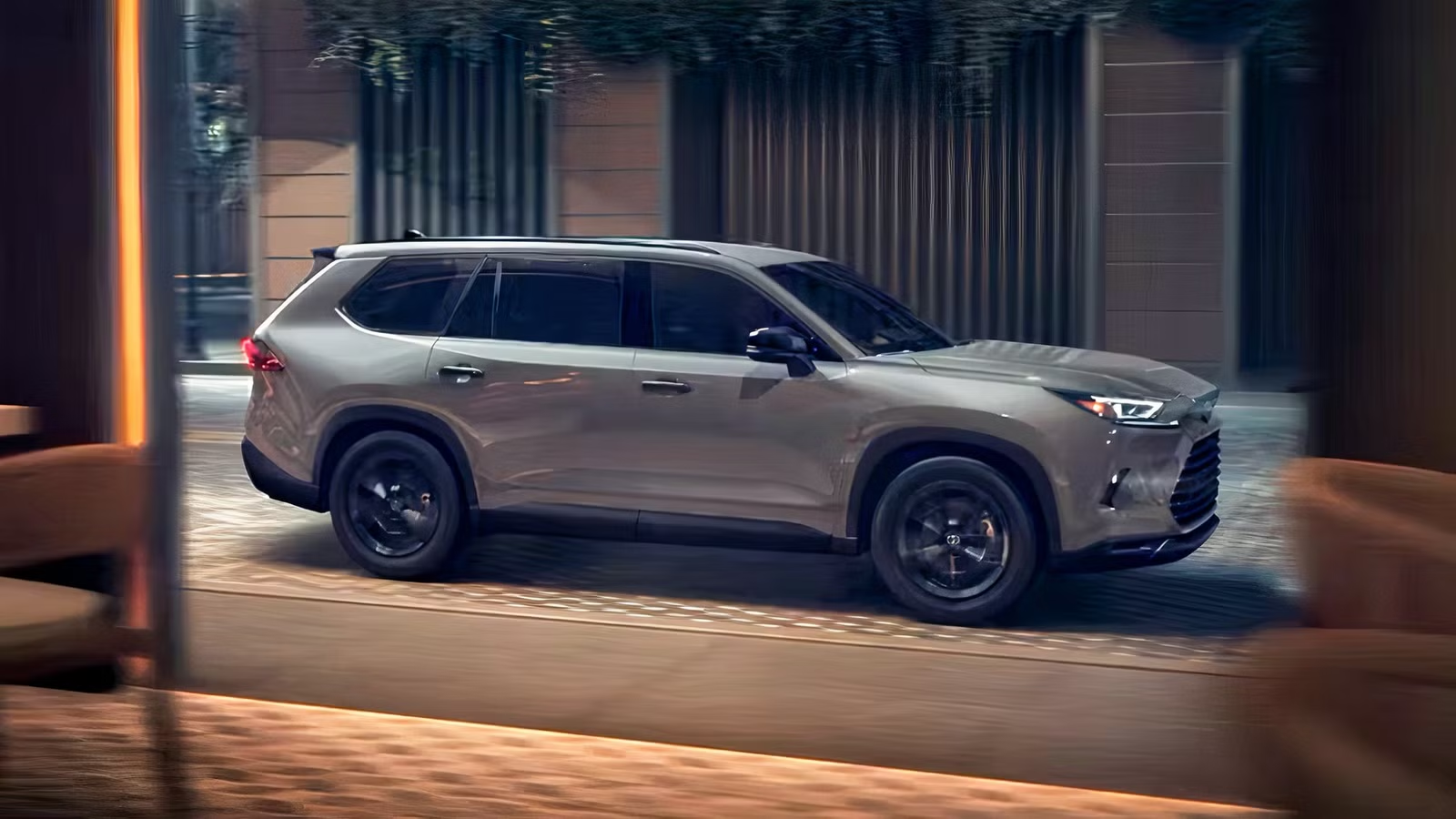
Range anxiety is usually a conversation reserved for EVs, but it’s just as relevant when you’re planning a long family road trip in a three-row SUV and don’t want to stop every 400 miles. If maximum distance between fill-ups is a priority, the field narrows quickly — especially when you add “Japanese-made” and “three rows” to the criteria. That combination tends to deliver a reassuring blend of efficiency, reliability, and build quality that families covering serious annual mileage have come to depend on. And within that already selective group, one model stands out for sheer single-tank range.

The hybrid SUV segment has never been more competitive, with Japanese manufacturers leading the charge. But if you want to minimize fuel stops on interstate hauls and long-distance family vacations, the answer points squarely at a large, three-row hybrid from the brand that has done more than anyone to normalize gasoline-electric powertrains in America. It isn’t the most fuel-efficient vehicle in absolute MPG terms, but its generous tank capacity gives it a decisive range advantage over every rival in the segment.
The Toyota Grand Highlander Hybrid Covers 619 Miles On A Full-Tank
The base entry-level Toyota Grand Highlander Hybrid front-wheel drive option covers an EPA-estimated 619 miles on a single tank of gas from its 17.2-gallon tank, making it the Japanese hybrid SUV with the highest estimated range in the new vehicle market. It also returns a strong 36/37/37 MPG estimate on the EPA’s city/highway/combined cycle. Opting for the all-wheel-drive system reduces range to 595 miles and brings efficiency down to 34/36/32 MPG.


The flagship Limited and Platinum trims are largely unchanged, apart from their 34 MPG highway estimates. If you drive the base model, the EPA estimates that you’ll save around $2,000 on fuel every five years, pay $2.40 to drive it 25 miles, and $59 to fill the tank. It also estimates you’ll spend $1,450 on fuel every year.

2026 Toyota Grand Highlander Hybrid EPA Estimates
|
FWD |
AWD |
Hybrid Max |
|
|
Range |
619 Miles |
585 Miles |
464 Miles |
|
Fuel Economy Combined |
36 MPG |
34 MPG |
27 MPG |
|
Fuel Economy City |
37 MPG |
36 MPG |
26 MPG |
|
Fuel Economy Highway |
34 MPG |
32 MPH |
27 MPG |
Toyota is one of the few brands in the U.S. that’s committed to transitioning most of its lineup into gasoline-electric hybrid products. We’ve already seen the Camry and Sienna adopt this strategy to great market reception, with both models consistently posting strong monthly sales figures.

You can also have the Grand Highlander with the turbocharged 2.4-liter four-cylinder Hybrid Max powertrain, but the best range this configuration will achieve is 464 miles, as it shares the same tank and battery. In return, you get significantly better performance and towing capability, so it caters to an entirely different buyer. As of the first half of 2024, Toyota confirmed it had sold 55,382 Grand Highlander examples and 20,569 Grand Highlander Hybrid models, underscoring just how niche the fuel-efficient variant remains in this segment.
The Toyota Grand Highlander Hybrid Produces 245 Horsepower

The Toyota Grand Highlander Hybrid clearly prioritizes efficiency over performance, despite featuring a powertrain that produces a fair amount of power. Under the hood, you’ll find a naturally aspirated 2.5-liter four-cylinder Atkinson-cycle engine that produces 186 horsepower at 6,000 RPM and 177 pound-feet of torque at 4,400 RPM.

A pair of permanent-magnet electric motors supplements the engine, lifting combined output to 245 horsepower. Toyota doesn’t publish a combined torque figure or break out individual motor outputs. Both the front- and all-wheel drive models use Toyota’s direct-drive eCVT. The Hybrid Max turbocharged variant produces a combined 362 horsepower and 339 pound-feet of torque — with the engine alone contributing 271 horsepower — and pairs with a conventional six-speed automatic transmission.
Performance Specifications
| Engine | 2.5-Liter Four-Cylinder And Two Electric Motors | Turbocharged 2.4-Liter Four-Cylinder And Two Electric Motors |
| Transmission | Direct Drive eCVT | Six-Speed Automatic |
| Horsepower | 245 HP | 362 HP |
| Torque | 177 LB-FT | 400 LB-FT |
| Driveline | Front- or All-Wheel Drive | All-Wheel Drive |
| Towing Capacity | 3,500 Pounds | 5,000 Pounds |
| 0-60 MPH | 7.2 Seconds | 6.3 Seconds |
| Top Speed | 113 MPH | 113 MPH |
Per Toyota’s figures, both standard hybrid variants complete a 0–60 MPH sprint in around 7.2 seconds with a 113 MPH top speed. The Hybrid Max claims a 6.3-second 0–60 MPH time, though independent reviewers have cut this down to an impressive 6.1 seconds. Both configurations use two permanent-magnet motors; in the all-wheel drive setup, Toyota moves the second motor to the rear axle, which is why performance figures remain identical between the two.

All hybrid variants also share an identical 3,500-pound towing capacity, making this a genuinely practical three-row family hauler. The turbocharged model raises that ceiling to a more accommodating 5,000 pounds. What you can expect to enjoy is high reliability levels, as the brand’s 2.5-liter hybrid unit has consistently proven to be a resilient powertrain.
How Much Space The Toyota Grand Highlander Hybrid’s Interior Offers

Being a three-row SUV, the Grand Highlander Hybrid features more than enough interior space for all of its occupants. Up front, you get 41.5 inches of headroom and 41.7 inches of legroom, with 60.2 inches of shoulder space. The second row offers a generous 40.2 inches of headroom and 39.5 inches of legroom, while the third row provides 37.2 inches of headroom and 33.5 inches of legroom. That makes the rearmost seats best suited to children, particularly on longer road trips. Cargo space is a strong point, with up to 20.6 cubic feet available behind the third row.
Interior Dimensions
| First Row | Second Row | Third Row | |
| Headroom | 41.5 Inches | 40.2 Inches | 37.2 Inches |
| Legroom | 41.7 Inches | 39.5 Inches | 33.5 Inches |
| Shoulder Room | 60.2 Inches | Not Specified | 57.5 Inches |
| Cargo Capacity | 97.5 Cu.Ft. | 57.9 Cu.Ft. | 20.6 Cu.Ft. |
Fold the third row flat and that figure expands to an impressive 57.9 cubic feet; drop the second row as well, and you reach 97.5 cubic feet. Toyota puts total passenger volume at 149 cubic feet. The standard seating configuration accommodates eight occupants including the driver, though you can opt for a seven-seat layout by choosing the more premium trims that come with second-row captain’s chairs.
How Much A 2026 Toyota Grand Highlander Hybrid Costs

Toyota offers its Grand Highlander Hybrid in four trim configurations, making it one of the more diverse hybrid SUV lineups currently available in the U.S. The range opens with the base LE at $45,010, followed by the XLE at $46,180 before options. The Platinum trim sits at the top of the standard hybrid lineup, while the Platinum Max commands a $59,575 MSRP. All-wheel drive is available across every trim and adds $1,600 to the price. Toyota also applies a mandatory $1,450 delivery, processing, and handling fee to all Grand Highlander Hybrid sales. Given the breadth of trim options, the lineup doesn’t lean heavily on optional packages.
2026 Toyota Grand Highlander Hybrid Pricing
|
Starting Price |
|
|---|---|
|
Hybrid LE |
$45,010 |
|
Hybrid XLE |
$46,180 |
|
Hybrid Limited |
$52,510 |
|
Hybrid Nightshade |
$53,490 |
|
Hybrid MAX Limited |
$55,490 |
|
Hybrid MAX Platinum |
$59,575 |
The only significant extras are the premium $425 exterior colors, which include Wind Chill Pearl White and Ruby Flare Pearl Red. All trims also have access to Toyota’s extensive accessories catalog, covering interior and exterior protection, storage and cooling solutions, digital equipment, dog-friendly items, camping gear, and more.
The Trims Are Well-Equipped At Base


The base Hybrid LE comes standard with three-zone automatic climate control, a seven-inch digital cluster, a 12.3-inch touchscreen, wireless Apple CarPlay and Android Auto, and a six-speaker sound system. Stepping up to the Hybrid XLE adds SofTex-trimmed upholstery across all three rows, second-row captain’s chairs, a wireless charger, and a leather-wrapped steering wheel. The higher-end Limited and Platinum trims layer on premium features, including:
- 11-Speaker JBL sound system
- Driver-seat memory function
- Heated and ventilated second-row seats (Platinum)
- Power tilt/slide panoramic sunroof
- Leather upholstery
- Heated steering wheel
- 10-inch HUD (Platinum)
- 12.3-inch digital cluster
The Nightshade trim adds a blacked-out cosmetic package for a sleeker, sportier look inside and out. Feature-wise, it closely mirrors the Limited trim, distinguished primarily by its black accent treatment throughout. Every trim includes Toyota Safety Sense 3.0 as standard equipment, encompassing pre-collision warning with pedestrian detection, full-speed range dynamic radar cruise control, lane departure warning with steering assist, and more.

All models come standard with Toyota’s comprehensive warranty package and Toyota Care roadside assistance and service plan. This includes the brand’s class-leading 96-month or 100,000-mile hybrid system warranty, two complimentary scheduled services, and two years of roadside assistance. The plan can be extended for an additional four years or 45,000 miles at extra cost.
Sources: Toyota, The EPA

Related posts


Latest Post


No Comments