
The Japanese Cruiser That Feels More Premium Than Its Price Tag
Spend enough time around entry-level cruisers, and a familiar pattern emerges. The clutch can feel rubbery in traffic, vibrations creep in as speeds rise, switchgear lacks tactile quality, and the overall experience constantly reminds you that cost came before refinement. That’s long been accepted as the price of affordability.
Most motorcycles under $6,000 wear their budget status proudly from the moment you swing a leg over them. However, every now and then, a motorcycle comes along that challenges those assumptions by delivering a level of polish, engineering, and day-to-day usability that simply doesn’t match its modest window sticker.
The Hidden Drawbacks Of Entry-Level Cruisers
The Allure Of Low-Stakes Accessibility
Entry-level cruisers continue to attract thousands of first-time riders every year, and for good reason. They aren’t intimidating, they’re affordable to buy and insure, and they make city riding feel approachable. Low seat heights inspire confidence, modest engine outputs keep mistakes manageable, and relatively light curb weights make parking-lot maneuvers far less stressful than they would be on a heavyweight V-twin. The sub-500cc cruiser segment also appeals to commuters who simply want a comfortable motorcycle without spending touring-bike money. A bike like this can weave through downtown traffic, fit into compact parking spaces, and return excellent fuel economy while still delivering the relaxed ergonomics cruiser fans appreciate.

Unfortunately, that accessibility has also created a mindset across much of the industry. Many manufacturers assume these motorcycles are temporary purchases. The expectation is that buyers will spend a season learning before moving up to a larger machine. When that’s the philosophy behind product development, investment naturally goes elsewhere. Premium electronics, refined engineering, sophisticated drivetrains, and upscale finishes usually remain reserved for middleweight and heavyweight motorcycles that generate higher profit margins. As a result, entry-level cruisers often feel like motorcycles designed to be replaced rather than owned long-term.
The Frustration Of Budget-Tier Limitations

The result is a familiar list of compromises: brakes that feel wooden and imprecise, styling that leans generic rather than distinctive, and engines tuned for the bare minimum rather than any real personality. Beyond the spec sheet, there’s a real ownership headache that doesn’t get talked about enough. A heavy clutch pull turns stop-and-go city traffic into a forearm workout. Stall at a green light with a line of cars behind you, and that embarrassment sticks with a new rider longer than any spec ever will. Add in the general sense that you’re riding something disposable, and it’s no wonder so many beginners are shopping for their next bike within six months of buying their first.
The Honda Rebel 300 E-Clutch Feels More Premium Than Its Price Tag
Base Price: $5,349

For 2026, the Rebel 300 enters American dealerships with a starting MSRP of $5,349, introducing Honda’s E-Clutch system as standard equipment. That represents roughly a $500 increase over the outgoing conventional version, which initially sounds significant in a class where buyers carefully compare every dollar. Look closer, though, and the math begins to make sense.
Honda didn’t simply add another electronic gadget for marketing purposes. Instead, it transplanted genuinely meaningful technology from motorcycles that sit much higher in its lineup. Rather than treating beginners as customers who deserve less, Honda has started giving them access to engineering previously reserved for substantially more expensive machines. That’s what makes the Rebel 300 E-Clutch feel unusually premium.
A Sport-Bike-Derived Engine That Doesn’t Feel Like A Budget Thumper
Liquid Cooling And A Slipper Clutch Most Rivals Skip

Pop the tank cover and you’ll find a 286cc single-cylinder engine that isn’t some purpose-built cruiser mill. It’s the same DOHC, four-valve architecture that does duty in the CB300R naked bike and the CBR300R sport bike, and it shows in how the Rebel revs. Where most cruiser engines in this class are tuned for low-end thump and not much else, the Rebel’s single is happy to spin out to redline, making a claimed 27 horsepower and 20 pound-feet of torque along the way.
Liquid cooling is the other piece that separates it from budget-tier rivals like the Royal Enfield Meteor 350, which still relies on air cooling to keep temperatures in check. That, paired with an assist and slipper clutch, means the Rebel delivers power more smoothly and consistently, without the heat soak or mechanical clatter that air-cooled singles are prone to at low speeds.
The E-Clutch Is Technology Trickled Down From A Pricier Class

The bigger story, though, is what’s happening at the clutch itself. Honda’s E-Clutch uses two small electric actuators to handle clutch engagement and disengagement on the rider’s behalf, reading inputs from the shift lever and throttle to time the release. The clutch lever is still there, and pulling it in hands full control back to the rider whenever they want it. It’s not a DCT, and it’s not an automatic — it behaves more like an anti-stall system bolted to a quick-shifter.
What makes it relevant to the “premium” argument is where it came from. E-Clutch debuted on the CB650R and CBR650R, two middleweight Hondas that start north of $8,600.Riders on those bikes are paying a premium partly for that piece of engineering. On the Rebel 300, you get the same core technology for a little over a third of that price.
Fit, Finish, And Details That Don’t Scream “Entry-Level”

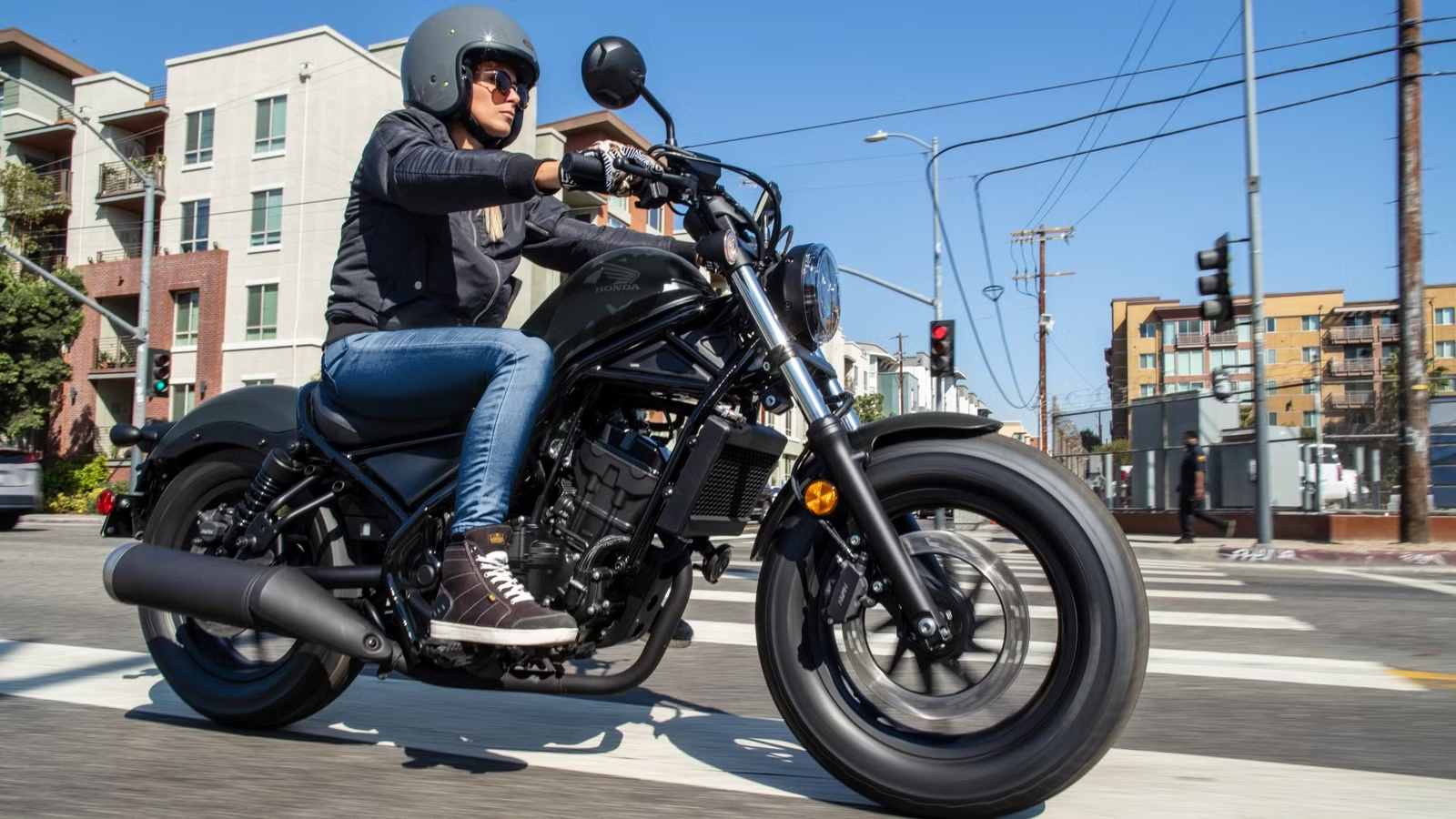
Honda didn’t reinvent the entry-level cruiser formula, but it paid attention to the small details that riders interact with every single day—and those details collectively create a far more premium ownership experience. The lighting package is a good example. Rather than mixing halogen and LED components to save money, Honda equips the Rebel with LED lighting throughout. The round quad-element headlight gives the front end a modern signature without abandoning the bobber-inspired styling, while the LED indicators and taillight improve visibility and lend the motorcycle a cleaner, more contemporary appearance.
The instrument cluster follows a similar philosophy. Instead of an old-fashioned analog gauge, the Rebel gets a compact negative-LCD display that is crisp, easy to read, and neatly integrated into the cockpit. Speed, gear position, fuel level, trip information, and other essentials are displayed clearly without looking like an afterthought. Honda also resisted the temptation to cheapen the exterior. Color-matched steel fenders, a blacked-out exhaust, engine covers, frame, and wheels give the motorcycle a cohesive appearance that looks intentional rather than inexpensive. Whether finished in Matte Black Metallic or Pearl Smoky Gray, the paint quality and panel fit reinforce Honda’s long-standing reputation for excellent build quality.
Where Honda Still Kept Costs Down

Of course, calling the Rebel 300 E-Clutch “premium” doesn’t mean pretending it’s perfect. Honda made deliberate decisions about where to spend its development budget, and a few omissions remind you that this is still an affordable motorcycle. Unlike some competitors, there’s no ABS-equipped version available for the U.S. market, and riders won’t find smartphone connectivity, navigation, ride modes, or a TFT touchscreen. The LCD is functional rather than feature-packed, and that’s clearly by design.
The solo saddle is another compromise. Its narrow profile complements the bike’s slim silhouette and helps shorter riders reach the ground with confidence, but taller riders or anyone planning longer highway rides may wish for additional padding. Fortunately, Honda’s extensive accessory catalog offers upgraded seats, passenger accommodations, luggage, and other touring-oriented additions. These omissions actually strengthen the Rebel’s value proposition.
High-End Bobber Styling That Punches Above Its Weight
The Art Of The Affordable Custom

Honda leaned hard into bobber cues here, and it works. The blacked-out tubular frame is left mostly exposed, the tires are chunky enough to look substantial without weighing the bike down, and the fuel tank carries that upswept, peanut-shaped profile that’s become the Rebel family’s signature. The quad-LED headlight cluster up front looks like something borrowed from a much pricier build, and combined with the paint quality, the whole package avoids the generic, catalog-built look that plagues a lot of budget cruisers.
Ergonomics Designed For Instant Confidence

Ergonomically, the Rebel is built to make a new rider feel capable fast. A 27.2-inch seat height means most riders can plant both feet flat at a stop, and the mid-mounted controls keep the riding position upright and natural rather than stretched out. The tradeoff is that taller riders — anyone pushing six feet — may find the cockpit a little cramped over a long ride. It’s a small compromise, and one most first-time buyers in this segment will happily accept for the confidence it buys them at every stoplight.
Add it all up — the sport-bike engine, the trickle-down clutch tech, the finish work that doesn’t cut corners where it counts — and the Rebel 300 E-Clutch earns its premium label honestly. It’s not the most powerful bike in its class, and it’s not the cheapest. It’s just the one that doesn’t feel like it’s apologizing for its price tag.
Source: Honda Powersports

Related posts




Latest Post


No Comments