
The Integra Type S Buyers Are Trading Civic Type Rs To Own
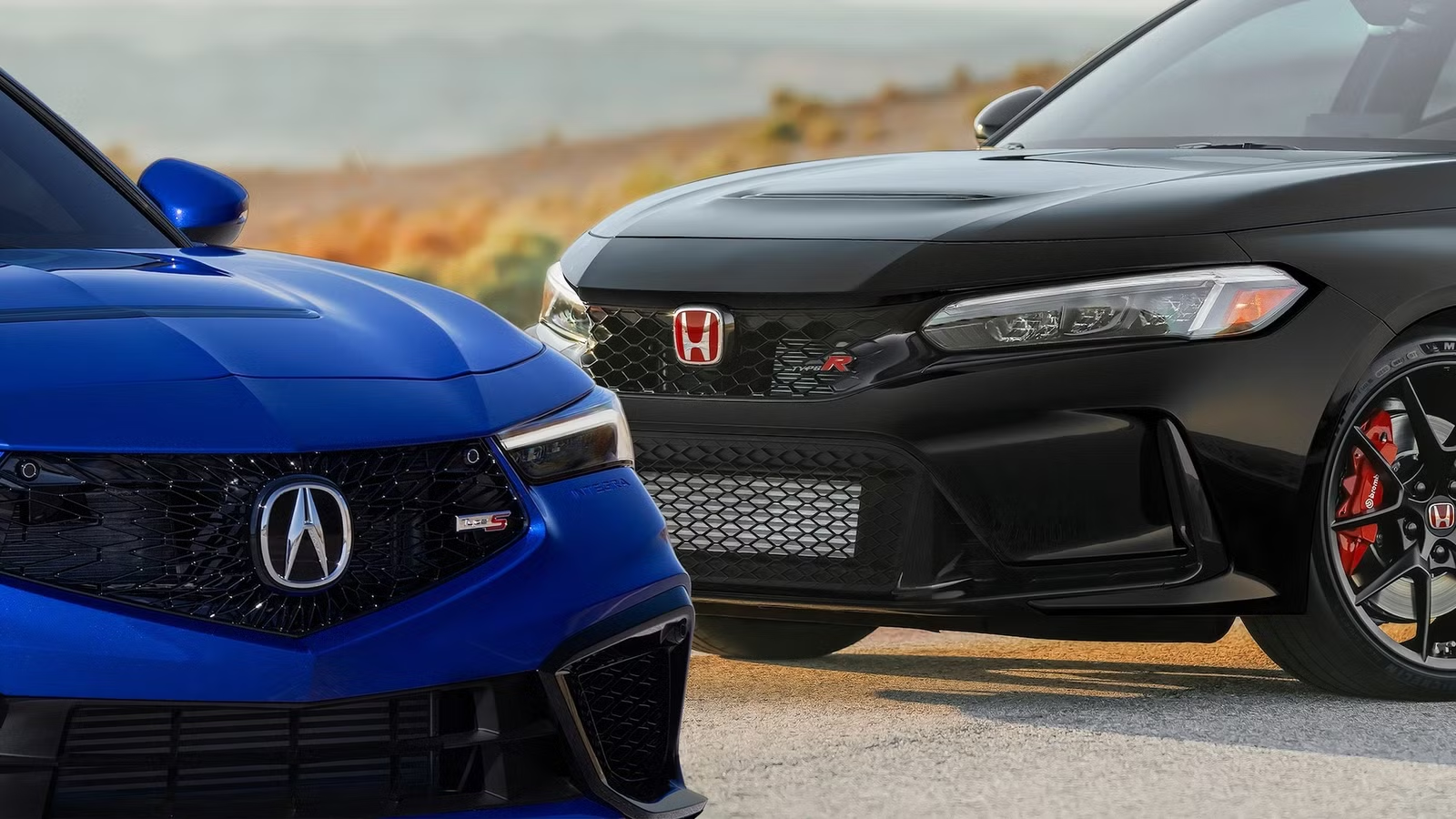
Honda Civic Type R buyers are consistently moving over to the Acura Integra Type S. Real-world evidence from enthusiasts like CivicXI, IntegraForums, and Reddit shows a consistent migration of Civic Type R owners stepping over to the Acura Integra Type S. On CivicXI’s CTR-to-ITS Trade-In Threads, former FL5 and FK8 owners frequently report trading in their Hondas to eliminate punishing daily ride stiffness and cabin road noise. Furthermore, extensive buyer discussions on IntegraForums highlight how historical dealer markups on the Civic Type R effectively erased the $6,500 MSRP delta, prompting cross-shoppers to choose the Acura at sticker price for its heated leather seats, superior acoustic insulation, and understated wide-body styling.

Honda’s apex hot hatch carries a starting MSRP of $47,395, while the mechanically related 2026 Integra Type S demands $53,900. On paper, the Integra Type S costs roughly $6,500 more than the Civic Type R.
This raises a compelling question for enthusiast buyers: Is the Integra Type S genuinely worth the higher price tag, and why are so many Civic Type R shoppers making the step-up to the Acura? Documented buyer behavior reveals what Acura’s premium actually delivers on the street, and where the iconic red-badge Civic Type R still has the edge.
Same Engine, Completely Different Philosophy: How Acura Retuned The CTR’s DNA
Shared Heart, Distinct Tuning

Under the hood of both the Civic Type R (FL5) and Integra Type S (DE5) lies the same high-output 2.0-liter turbocharged inline-four powerplant. In the Honda, it carries the engine code K20C1, while Acura officially badges its version the K20C8. The latter unit is mechanically identical to the K20C1, differing primarily in factory engine management software and exhaust routing.
The Honda K20C1 develops 315 horsepower and 310 pound-feet of torque, whereas Acura’s K20C8 tuning frees up an extra five horsepower, bringing the power figure to 320 horsepower, while torque remains unchanged at 310 pound-feet. Both engines send power to the front wheels exclusively through a six-speed manual transmission with automatic rev-matching and a helical limited-slip differential.

Where the two diverge dramatically is in acoustic strategy. The Integra Type S replaces the Civic Type R’s center-exit, baffled exhaust setup with a high-flow straight-through triple-exhaust system equipped with an active exhaust valve. In Sport+ mode, the Integra Type S delivers a raw, throatier exhaust note with genuine overrun pops, contrasting sharply with the Civic Type R’s artificial reliance on synthetic cabin sound augmentation.
How Acura’s Retuned Suspension Solves The CTR’s Biggest Daily-Driver Problem

The Integra Type S truly begins to stand out when you look beneath the skin at its recalibrated chassis tuning. While the Civic Type R relies on a track-focused dual-axis strut front and multi-link rear suspension with fixed, aggressive spring rates and stiff damper software tuned for maximum lateral grip and circuit stability, the Integra Type S takes a far more road-compliant approach. The Civic Type R’s rigid track calibration starkly contrasts the Integra Type S’s re-tuned Adaptive Damper System (ADS).
Acura softened the baseline valving so that Comfort mode acts as a true daily compliance setting, and Sport mode aligns roughly with the Civic Type R’s Comfort setting. This in turn makes the Integra Type S much easier to live with, eliminating the punishing low-speed ride jitter common in the Civic Type R over potholed pavement and preserving high-speed stability without compromising spine comfort on long highway stints.
Inside The Type S: What The $6,500 Premium Buys In Practice
The Interior Features That Make CTR Owners Say They Can’t Go Back


Inside the cabin is where the Integra Type S’s price premium over the Civic Type R immediately starts to pay off. While the Civic Type R offers a heavily focused, race-car-inspired interior with bright red carpets and aggressive cloth bolsters, the Integra Type S replaces it with heated leather-trimmed sports seats, soft-touch dashboard panels, perforated leather touchpoints, and significantly enhanced acoustic insulation throughout the floor pan and firewall.
The primary differentiator here is the standard 16-speaker, 710-watt ELS Studio 3D audio system. Fitted as standard equipment on the single-trim Type S, it elevates daily commuting far beyond the Civic Type R’s basic Bose sound system.
Flared Fenders, No Wing: How The Integra Hides Its Hot-Hatch DNA

Park the two side by side, and their design philosophies diverge immediately. The Honda Civic Type R proudly embraces its boy-racer lineage, dominated by a towering pedestal rear wing, functional hood scoop, and bright red badges that announce its track intentions from a mile away.
In contrast, the Acura Integra Type S achieves its muscular stance through wide body proportions rather than towering aerodynamics. It features flared fenders that widen the track by 2.8 inches over the standard Integra, a vented aluminum hood, and a subtle rear ducktail spoiler that replaces the CTR’s wing. The result is a planted, wide-track profile that retains all the aggressive road presence of a modern hot hatch without looking like a dedicated circuit weapon.

For commuters, this styling difference provides a “stealth wealth” advantage. The Integra Type S reads as an upscale luxury liftback in executive parking lots while retaining 100 percent of its hot-hatch driving punch.
Dealer Markups, Insurance Rates, And Why The Math Favors The Acura More Than You’d Expect
MSRP Delta vs. Dealer Pricing

At sticker price, the mathematical gap between the two platform mates sits around $6,500. On paper, that gap leads many buyers to question whether the Acura badge is worth the step-up. However, real-world dealer transactions tell a nuanced story.
Due to tight allocation numbers and cult-like demand, Civic Type R models frequently face market adjustments and dealer markups that narrow or completely eliminate the price gap at the point of sale. Conversely, Acura dealers have generally maintained more consistent MSRP alignment. When a buyer faces a market-up $50,000 Civic Type R versus an Integra Type S sitting at its $53,900 sticker, paying the slight delta for the Acura’s added luxury, standard features, and softer daily ride becomes an easy financial decision.
Long-term financial ownership costs bring unique trade-offs for each model. The Civic Type R’s classification as a high-performance sport compact often translates to higher insurance premiums, particularly for younger drivers. The Integra Type S, categorized under Acura’s luxury hatch umbrella, frequently benefits from lower risk brackets despite sharing identical mechanical hardware.
The Civic Type R benefits from legendary residual value retention thanks to its iconic red-badge heritage and track enthusiast demand. While the 2026 Integra Type S depreciates slightly faster in its initial three years, its higher baseline comfort keeps it desirable on the pre-owned market for luxury-oriented daily drivers.
Long-Term Usability And Reliability


Living with either car for 50,000+ miles reveals clear ergonomic differences. The Civic Type R’s deep, race-style bucket seats feature high, rigid side bolsters that show heavy friction wear over time from daily ingress and egress. The Integra Type S uses wider, heated leather-trimmed sports seats with lower bolsters, making getting in and out effortless while preserving the upholstery over long-term ownership.
Under the skin, routine service requirements are virtually identical. Both vehicles utilize the same turbocharged 2.0-liter engine, six-speed manual transmission, helical limited-slip differential, and Brembo front brake hardware. Servicing costs for oil changes, brake pads, fluid flushes, and tire replacements remain identical, allowing Acura owners to enjoy luxury dealership amenities without paying higher mechanical maintenance costs.
Where The CTR Still Wins And Final Trade-Offs
Track Performance And Aftermarket Depth
Despite the Integra Type S’s road refinement, the Civic Type R remains the undisputed king of circuit driving. By forgoing the Acura’s sound insulation and luxury trim, the Civic Type R carries a lighter curb weight (~3,188 pounds). Combined with its aggressive front splitter, functional rear wing, and stiffer chassis calibration, the Civic Type R delivers higher downforce, flatter cornering through high-speed sweepers, and more immediate steering feedback at the limit.
Furthermore, the Civic Type R enjoys an unmatched aftermarket ecosystem. Tuning shops, track teams, and aftermarket manufacturers prioritize the FL5 platform, offering an endless catalog of track-ready brake cooling ducts, aggressive suspension arms, specialized ECU maps, and race-proven aero upgrades.
Tribal Recognition And Community Cachet

Beyond track times, there is an intangible element that money cannot buy: the unmatched heritage of Honda’s red badge. The Type R emblem carries decades of motorsport prestige, earning instant credibility at track days, car meets, and local drives.
While the Integra Type S earns respect for its polished execution, purists will always revere the raw, uncompromising lineage of the Civic Type R. Owning a CTR connects drivers to a passionate global community and guarantees long-term auction visibility among collectors who value pure, unadulterated hot hatches.
Stepping sideways from a Civic Type R into an Integra Type S is not a compromise on performance; it is a deliberate recalibration of priorities. Both vehicles represent the pinnacle of front-wheel-drive engineering, utilizing the same superb manual gearbox and turbocharged engine architecture.

The choice ultimately comes down to where you spend your time behind the wheel. Choose the Civic Type R if your weekends revolve around track days, back road canyon carving, and maximizing circuit performance. Its lighter weight, downforce aero, and raw feedback make it the ultimate enthusiast weapon.
Choose the Integra Type S if your vehicle serves as a daily driver, highway commuter, and weekend performer. The $6,500 premium buys real-world ride compliance, acoustic insulation, an incredible ELS 3D sound system, and a stealthy road presence that makes every mile easier to live with.
Sources: Honda, Acura, Edmunds, CivicXI, IntegraForums

Related posts


Latest Post


No Comments