
The Diesel Kawasaki Built So Marines Never Had To Haul Gasoline
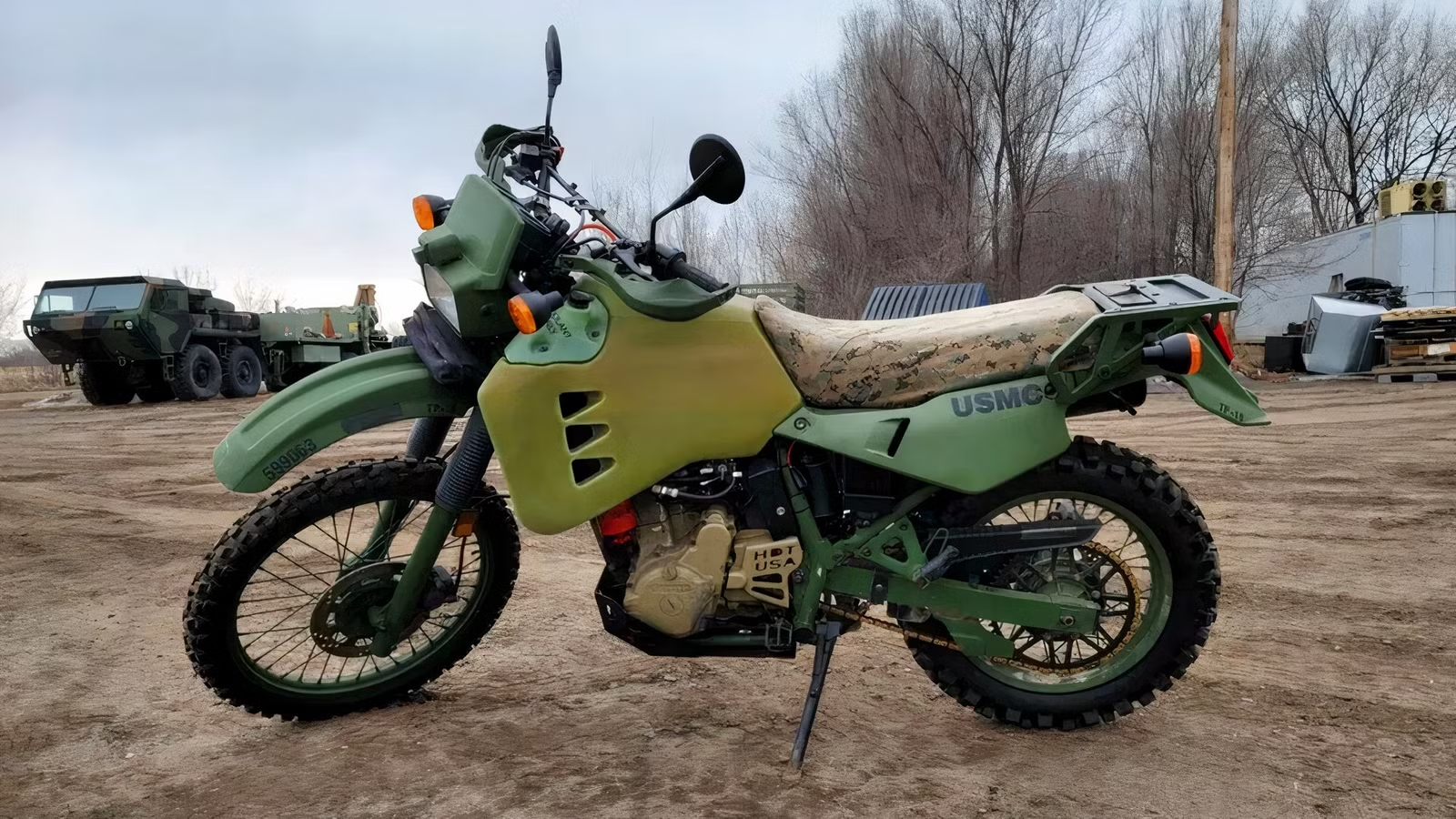
Lately, diesel fuel has not been a popular choice, mostly because it is environmentally unfriendly. However, it is not uncommon in the automotive world, as many car manufacturers still produce diesel vehicles. After all, diesel engines are fantastically economical, produce massive torque, are simple to maintain, and are generally very reliable. Having said that, Marines traded a conventional gasoline engine on a motorcycle for a purpose-built diesel powerplant for entirely different reasons.
Why Marines Wanted To Swap Gasoline Fuel

When military forces run long convoys hundreds of miles from their nearest base, every gallon of fuel has to be transported. On top of that, helicopters, trucks, generators, and other equipment often use the same fuel type, while oddball motorcycles rely on gasoline. As a result, hauling multiple fuel types complicates logistics and requires separate storage, transportation, and handling. That problem is exactly what military planners spent years trying to solve.
NATO’s Single-Fuel Strategy

To fix this battlefield headache, NATO adopted the Single Fuel Concept, making almost everything run on the same JP-8, a kerosene-based aviation fuel. That objective eventually led engineers to reimagine a proven dual-sport chassis to drink the exact same fuel, so as not to abandon two-wheeled mobility altogether. As you read on, you will see how a unique diesel motorcycle ended up solving a problem that had nothing to do with fun.
The HDT M1030M1 Was A Logistics Weapon Built To Run On Diesel


Developed by Hayes Diversified Technologies in collaboration with Cranfield University, the HDT M1030M1 was designed specifically to meet Marines’ battlefield fuel requirements. It was built around Kawasaki’s versatile KLR650 platform withw a purpose-built engine that could run on military diesel and JP-8 aviation fuel. More importantly, this reliable utility machine was capable of reconnaissance, courier duties, and movement across difficult terrain. All while delivering extended miles of range and enough power to handle any terrain.
Developed From Kawasaki’s KLR650 Platform

The gasoline-powered Kawasaki KLR650 has already earned a reputation for durability, simplicity, and off-road capability. Therefore, it made perfect sense to adopt it for military use. In addition, its frame offered enough room for a larger diesel powerplant. However, the HDT fitted rugged suspension, an upgraded air filtration system, blackout lighting, protective equipment, and more aggressive dual-purpose tires. It also received a reinforced rear equipment rack capable of carrying up to 50 pounds.
Purpose-Built Single-Cylinder Diesel Replaced Gas Powerplant

Unlike the usual industrial engine swaps, the M1030M1 used a purpose-built, liquid-cooled four-stroke single-cylinder diesel designed by HDT and its engineering partners. Although early development involved a 584cc version, the final Marine motorcycle used a larger 611cc engine. As such, it featured a heavy-duty connecting rod, along with a forged steel crankshaft and cast aluminum crankcases, and a high 20:1 compression ratio to burn heavy fuels efficiently.
400-Plus Miles Of Operational Range

On paper, the output was rated at 28 to 30 horsepower when new. Though it is lower than the gasoline-powered KLR650, its 33 pound-feet of torque at a low 2,500 rpm provided strong pulling power. Power was sent to the rear wheel through a five-speed transmission and a chain final drive. The main advantage, however, was fuel economy, delivering between 96 and 110 mpg at a steady pace. Combined with a translucent 4.2-gallon tank (for monitoring fuel level), it could easily do more than 400 miles on a single fill-up.
Worked For Marines But Never Reached Civilian Showrooms

After years of development, the HDT M1030M1 entered service with the U.S. Marine Corps in the early 2000s. It included military features such as blackout lighting, infrared illumination for night-vision use, a handlebar guard, a skid plate, and a rear equipment rack. Meanwhile, riding on 21/17-inch alloy rims wrapped in knobby tires, it offered 24-inch water-fording capability. It could also reach 0 to 60 mph in approximately 9.7 seconds, with a reported top speed near 90 mph, further supporting its military role.
More Weight, Less Power, And Higher Price

After its military induction, a civilian version seemed like a logical next step. So HDT proposed a road-legal diesel motorcycle called the D650-A1 Bulldog during the mid-2000s. But the diesel engine added around 32 pounds over the gasoline KLR650 weight. It also produced less power comparatively, along with additional mechanical complexity and vibration. Further, a proposed high retail price of $18,999 was a major obstacle at the time, compared to a $5,000 tag on the gas KLR. Moreover, the bike never entered production due to heavy military demand for the M1030M1 and later the company changed hands.
The Royal Enfield Taurus Shows Why Diesel Bikes Never Took Off

To understand why diesel bikes struggle commercially, you only need to look at the infamous Royal Enfield Taurus. Built in India during the early 1990s, the Taurus took the opposite economy-focused approach. It came with an off-the-shelf 325cc air-cooled Greaves Lombardini industrial single-cylinder diesel engine bolted into a classic Bullet frame. While it delivered a staggering 165 mpg economy, it produced just 6.5 horsepower and 10.7 pound-feet of torque, limiting top speed to about 40 mph alongside heavy vibration. In hindsight, the Royal Enfield was far too slow, whereas the HDT’s Bulldog was far too expensive for everyday riders.
Now Commands Bragging-Rights Prices

Interestingly, the M1030M1’s failure to reach showrooms has helped make surviving examples unusual collectibles. Roughly 440 units were delivered against an initial order for 522 units to the military before the fleet was retired from active duty by the mid-2010s. Among them, many were sold through surplus auctions over the years. Today, however, these diesel motorcycles are in private listings and auctions, with asking prices generally ranging from $10,000 to $20,000 depending on condition, originality, and equipment.
Sources: CycleWorld, Theautopian, Rideapart and Bringatrailer

Related posts
Latest Post


No Comments