The Hybrid SUV With Enough Range To Make Long Road Trips Stress-Free
8 minutes reading
Monday, 28 Sep 2026 08:00 0 44 autotech
The SUV market offers more than enough hybrid options today to make fuel stops on long road trips seem almost irrelevant. Along with help from the evolution of turbo tech, engines have gotten smaller over the last decade, and hybrid systems have gotten a lot more efficient. Nearly every major brand is now using hybrid or plug-in hybrid technology to squeeze every last mile from the tank, and this Hyundai SUV not only delivers a high tank range, but does it with comfort and ease of use in mind.
The better hybrid systems out there use a gas engine alongside one or more electric motors, with a battery pack storing energy recovered through regenerative braking. Toyota’s Hybrid Synergy Drive, for example, uses a power-split device to blend engine and electric power, while Hyundai and Kia systems use parallel systems that can switch between engine, motor, or both.
Plug-in hybrids take this idea further with much larger batteries, often giving you enough electric range for short journeys before the gasoline engine takes over. Conventional hybrids can’t travel nearly as far on electricity alone, but their smaller batteries recharge continuously while driving, so no charging stop is needed.
Front 3/4 of Lexus RX 450h+ Luxury drivingLexus
For this reason, it is arguable that conventional hybrid models are better for longer highway hauls. The electric motor can handle low-load driving and assist when the engine doesn’t need the extra grunt. At highway speeds, the gas engine does most of the work, but energy recovery and electric assistance still help reduce fuel consumption. It’s almost hard to think of a market without them now.
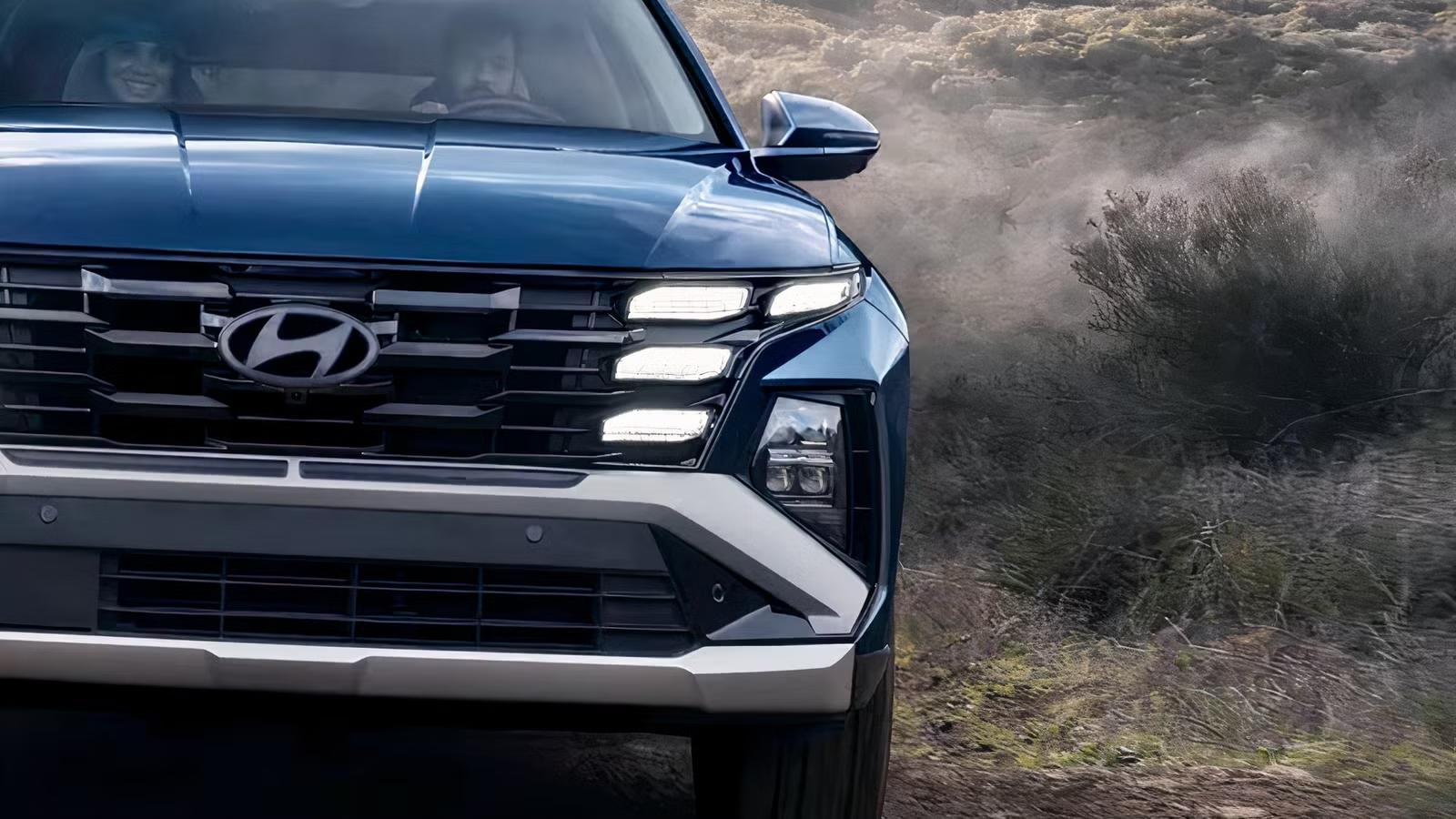
Front 3/4 action shot of 2026 Hyundai Tucson Hybrid in blue driving in cityHyundai
This is where the 2026 Hyundai Tucson Hybrid Blue SE comes in. It is the entry-level grade of Hyundai’s compact hybrid SUV, but don’t let that put you off—it delivers where it matters most. For a starting price of $31,300 for the FWD model ($32,450 for the AWD model), you get the most fuel-efficient model in the range, enough space inside for you and four passengers, a decent-sized cargo area, and enough technology to make long drives across the country a breeze.
Up To 520 Miles Of Range Makes Fuel Stops Less Frequent
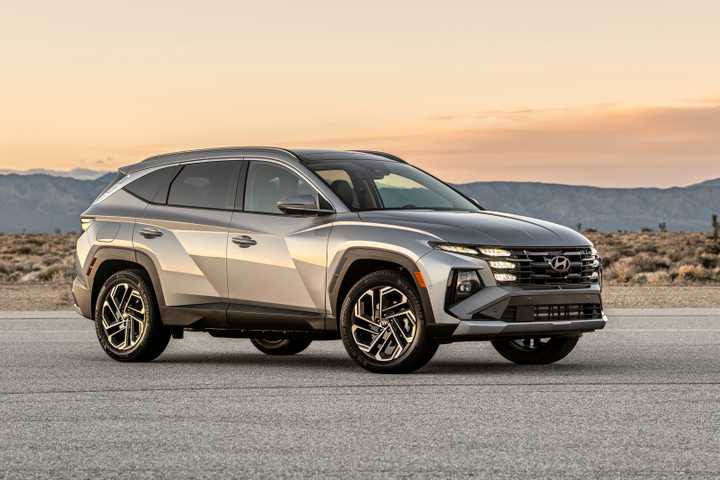
Rear 3/4 shot of 2026 Hyundai Tucson Hybrid parkedHyundai
According to FuelEconomy.gov estimates, the ’26 Tucson Blue SE can offer a full-tank range of up to 521 miles. The tank is 13.7 gallons and will cost you roughly $59 to fill. This means, on average, it will cost you $2.84 to drive 25 miles, and just $1,700 a year.
These calculations are based on driving 45 percent city, 55 percent highway, and up to 15,000 miles a year, but that still means you could save up to $3,000 on gas over five years compared to the average modern vehicle. The real takeaway, though, is that you can drive from Sacramento to San Diego, or Miami to Tallahassee and still have some fuel left in the tank when you get there.
AWD Costs $1,500 More But Matches FWD’s MPG On The Highway
Rear 3/4 shot of 2026 Hyundai Tucson Hybrid driving on roadHyundai
Despite the AWD tipping the scales at up to 3,719 pounds, both Hyundai and the EPA say that the new Tucson Blue SE can achieve 38 combined mpg, whether you opt for FWD or HTRAC AWD for the extra $1,500. Where the differences lie is in city and highway mpg ratings. FWD models achieve 40 mpg in the city and 35 mpg on the highway. HTRAC AWD models achieve 38 mpg in the city and on the highway, so spending the extra money on the all-wheel-drive system could actually pay dividends if you spend a lot of time covering highway miles.
Owners Rate It 4.3 Out Of 5 For Performance — Here’s Why That Holds Up
2026 Hyundai Tucson Hybrid front wheelHyundai
Just having a fuel-efficient powertrain today isn’t quite enough to make a hybrid SUV appealing, even if it does have a low price as well. It has to be a good all-rounder; the market has become so competitive today that just being good at one thing doesn’t cut it. Owners seem to think the new Tucson Hybrid is one of those all-rounder SUVs.
According to owner reviews on Kelley Blue Book, the 2026 Tucson Hybrid is rated 4.1 out of 5 overall, 4.2 out of 5 for value, 4.3 out of 5 for performance, quality and reliability, and 4.6 out of 5 for styling and comfort. 75 percent of owners who have left a review say they’d recommend it. Similarly, on J.D. Power, it is rated 81 out of 100 overall, and 83 out of 100 for driving experience and reliability.
231 Horsepower Gives It Enough Power For Highway Driving
2026 Hyundai Tucson Hybrid front 3/4 shotHyundai
What makes the Tucson Blue SE stand out is that it is very efficient, and it has enough power under the hood to make passing on the highway relatively effortless. Both FWD and AWD models get a 1.6-liter intercooled and turbocharged GDI DOHC inline-four mated to a single motor, which combined is good for 231 horsepower and 271 pound-feet of torque.
Power is routed through a six-speed automatic with shift-by-wire; you get paddle shifters, and you can adjust how much regenerative braking steps in. All this translates to a 0–60 mph time of 6.9 seconds and a top speed of 120 mph. These aren’t super-SUV numbers, but for something that delivers such long tank range and capable highway performance, they are more than enough.
2026 Hyundai Tucson Hybrid interiorHyundai
2025 Hyundai Tucson Hybrid Rear SeatsKia
Inside, you won’t feel cramped or short on space. Hyundai says there is 108.2 cubic feet of passenger space. This includes 40.1 inches of front headroom, 41.4 inches of front legroom, 39.5 inches of rear headroom, and a very impressive 41.3 inches of rear legroom. For a compact hybrid SUV that only measures in at 182.7 inches in length by 73.4 inches in width, it is packaged very well.
You also get 38.7 cubic feet of cargo space with the rear seats in place, and up to 74.8 cubic feet with the rear 60:40 split-folding tucked away. For long family trips across the country, it has enough space inside and a long enough range for everyone to keep to themselves for quite a long time.
Shot of 2026 Hyundai Tucson Hybrid cargo areaHyundai
You are also well covered for in-cabin technology and features. The Tucson Hybrid base model is equipped with a 12.3-inch touchscreen up front, wireless smartphone integration, a Hybrid Tracking Map that shows real-time powertrain efficiency, dual-zone climate control, and a six-speaker audio system.
In the back, passengers get dual USB-C ports, dedicated air conditioning vents, and a fold-down center armrest. It may be a little simple compared to some high-end hybrid SUVs currently on the market, but it is built to get the job done in the most sensible fashion. On top of all that, the cloth seating surfaces are stain-resistant, carpeted flooring lines the entire cabin, piano-black accents add a touch of high-end detail, and soft-touch plastics are durable but attractive.
Tucson Hybrid Blue SE Is A Smart Pick For Road Trippers
Profile shot of 2026 Hyundai Tucson Hybrid parked under a tree in a cityHyundai
While the new Tucson Hybrid Blue SE does an exceptional job when it comes to gas-tank range, there are hybrid SUVs that go farther. Models like the 2025 Kia Sorento (FWD) have a reported range of up to 655 miles, and the 2026 Hyundai Santa Fe Hybrid has a reported range of up to 637 miles. However, starting prices for both of them are $36,700 and $38,000, respectively.
You also only get slightly more cargo capacity in both the Sorento (75.5 cubic feet) and Santa Fe Hybrid (79.6 cubic feet), but all for a fair amount more money. The Santa Fe Hybrid is also rated slightly lower on J.D. Power for reliability (81 out of 100), while the Sorento receives only a 73 percent recommendation rating from owners on Kelley Blue Book. Where the Tucson Hybrid excels is in getting a bit of everything right. One owner on Kelley Blue Book says it nicely.
After looking at countless compact SUVs, the 2026 Hyundai Tucson Hybrid was the one that truly stood out. It has noticeably better storage space than most vehicles in its class, and the interior feels surprisingly luxurious for the price with a clean, comfortable cabin design.
If desired, you could move up the trim levels for more features. The SEL Convenience is where the Tucson starts feeling properly equipped, with heated front seats, H-Tex leatherette-trimmed seats, and a 12.3-inch driver cluster, and if you step up to the Limited, you get leather seating, a Bose audio system, blind-spot monitoring, and a 12.3-inch HUD. The issue here is that they are both more expensive ($35,250 and $42,425, respectively) and mpg ratings take a hit.
The SEL Convenience can return 37 mpg on the highway, and 36 combined, while the Limited has a predicted gas-tank range of 493 miles. Still respectable, but if you are logging serious highway miles, the Blue SE looks better. It skips the expensive extras but keeps the Tucson’s formula intact. Spend more, and you get more luxury, but if minimizing fuel stops is the priority, the simpler option is the better value.
Base Trim Engine
1.6L Smartstream I4 Hybrid
Base Trim Transmission
6-speed automatic
Base Trim Drivetrain
All-Wheel Drive
Base Trim Horsepower
178 HP @5500 RPM
Base Trim Torque
195 lb.-ft. @ 1500 RPM
Base Trim Fuel Economy (city/highway/combined)
38/38/38 MPG
Base Trim Battery Type
Lithium ion (Li-ion)
Make
Hyundai
Model
Tucson Hybrid
Sources: Hyundai, FuelEconomy.gov, J.D. Power, and Kelley Blue Book.











No Comments