
Dodge Coronet & Plymouth Satellite Muscle Wagons: The B-Body Haulers
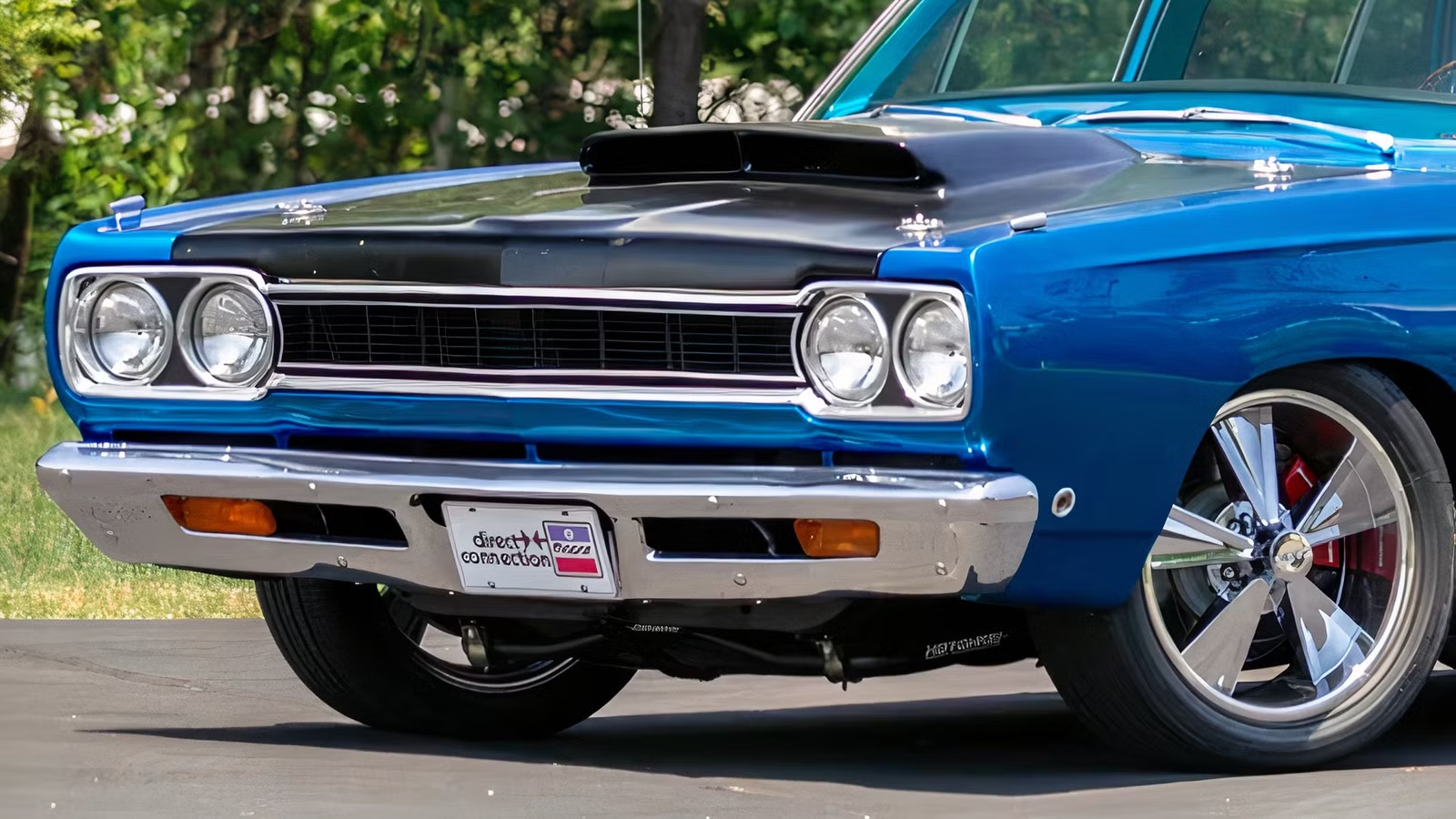
Mopar captured magic in a bottle in a particularly special way in the 1960s. In an era where bold and brash nomenclature was backed up by some of the biggest, most powerful engines of the period, the muscle car years were particularly kind to that side of the Detroit triumvirate. Everything in the lineup had some level of muscle car DNA latent somewhere within itself. This included cargo vans, pickup trucks, and even the most humble form factor of them all in those days, the station wagon. With a legendary platform underneath it, Dodge and Plymouth made a grocery getter that was genuinely old-school cool.
The B-Body, An Under-the-Radar Cultural Institution

We tend to heap praise and admiration onto cars themselves, not the platforms they ride on. But the Chrysler/Mopar B platform, or the B-body, as it’s known, is one of those exceptions to the rule. Effectively, most of the company’s greatest hits came from the B-body during the first muscle car war. Everything from the Dodge Charger to the Plymouth Road Runner, Belvedere, and GTX made use of it at one point or another. With five different wheelbases available between 1962 and 1979, the B platform was remarkably adaptable for its time.
It allowed great swaths of Dodge and Plymouth’s lineups to be accommodated by just a single platform at any given period. From 1967 to roughly 1974, the B platform’s 117-inch wheelbase variant was heavy-duty enough to handle serious horsepower, as well as middle-of-the-road family haulers if the use case demanded it. Interestingly, the B platform adopted a unibody construction rather than a body-on-frame.
With an isolated front K-member and clever Torsion-Aire suspension, beefier axles, and more powerful front disc brakes, the Mopar B platform had the underpinnings to make just about anything possible. When the time came to turn the 117-inch B platform into a wagon, the results were nothing short of remarkable. They hauled people, they hauled cargo, and above all, many of them hauled serious freight as well.

10 Most Valuable 440 Six Pack Mopar Muscle Cars
These rare Mopar muscle cars with triple two-barrel carburetors are commanding six-figure prices at auction.
The Coronet and Satellite Wagons

The Dodge Coronet and Plymouth Satellites of the late ‘60s and early ‘70s were bread and butter vehicles for the Mopar family. Representing the lucrative mid-size market segment, the Coronet and Satellite were the bridge between the smaller Darts and Valiants and the full-size C-body Fury and Monaco. Available as a coupe, a sedan, and a drop-top, these two Mopars sold in their hundreds of thousands during the mid-to-late 1960s.
But their wagon variants were inarguably the most practical. With a minimum of 38 inches of rear legroom in early variants, and as much as 39.4 inches in later variants, there were SUV levels of room to move around in the back of a B-body wagon. Add 45 inches between the wheel wells and 84.9 cubic feet of storage with the rear seats folded, and these were serious haulers. The Coronet preceded its Satellite Wagon cousin by three model years, only arriving in 1968 to Dodge’s ‘65.
By the time the two shared dealership space across America the duo had an arsenal of engines available, suited to different price levels in the market segment. At the bottom, a 3.7-liter Slant-6 straight-six engine was the everyman’s workaday drivetrain, usually paired with a three-speed automatic gearbox. Up the line, a string of V8s from the A, B, and LA line shared similar cubic displacements, but differed in architecture, weight, and internals. The “Poly” head A-series was a legacy motor, present in the early Coronet/Satellite of this generation before giving way to the smaller LA wedge-head V8 and the larger B and RB blocks. With this in mind, you could really crank up the power if you checked the right options boxes.
Adding the 383 and 440

Mopar fans like to get caught up in the cubic displacement numbers game. Given what they were dealing with, how could you blame them? But as far as Dodge or Plymouth muscle wagons of the late ’60s go, all roads pass through the B-series 383 and the RB-series 440, the “Magnum” family in Dodge service, or the “Super Commando” in Plymouth. The identical engine bay proportions in the Satellite and Coronet to the Charger, Road Runner, and GTX, meant there was nothing stopping Mopar from giving their wagons the muscle treatment.
The smaller 383 (and we use the word “small” very loosely indeed) was the entry-level Mopar big block. Beyond its modest paywall was access to low-end torque once reserved only for big trucks and dragsters. Most came with choked-to-death two-barrel carburetors, something that almost amounted to a fuel-saving measure in those days, if you can believe it. But with a simple change in carburetor setup from two to four barrels, things went from pedestrian to exhilarating nearly as fast as these wagons sprinted to 60.

With a 335-horsepower 383 four-barrel motor and a four-speed manual, these wagons could hit the quarter mile in roughly the mid 15-second range. That might not sound like much by modern standards, but back then, that was RS6 Avant-fast. If you wanted to cross into full-blown supercar territory, you stepped up to the raised-block (RB) 440-cubic-inch V8. Pushing out 375 horsepower and an eye-watering 480 lb-ft of torque, the 440 Magnum and Super Commando motors crossed the quarter-mile line four to five full seconds faster than a standard six-cylinder model.
The Forgotten Dodge Muscle Car That Rivaled The Road Runner
Dodge built a cheaper B-body bruiser with Road Runner bones, big-block options, and way less glory than it deserved.
A Hemi Cameo, Allegedly’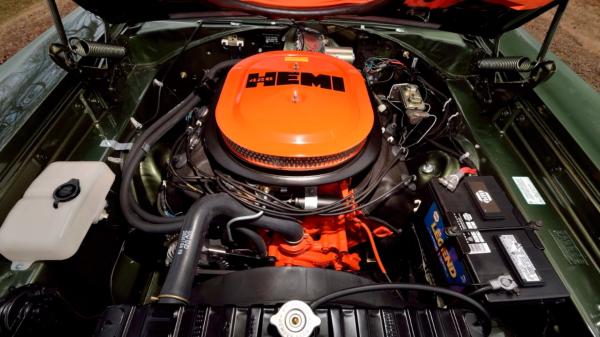
Believe it or not, rumors still swirl that for one year in 1966, Mopar saw fit to add a loophole in its dealer network’s ordering process. Called the Fleet Special Orders (FSO) code, it acted much like GM’s Central Office Production Order (COPO). Using the FSO, it is alleged that you could have had your Mopar wagon shipped with a 426-cubic-inch “Dual-Quad” Hemi V8. Of course, a hilariously small number of B platform wagons ever left the factory in this spec, assuming it even happened. Perhaps as few as four or five Coronets, and Plymouth’s precursor to the Satellite, the Belvedere, made the quantum leap from the normal 440 Magnum/Super Commando to 426 Hemi
|
Displacement |
Power |
Torque |
|
426 Cubic Inches |
425 HP |
490 LB-FT |
Power figures? We’re talking 425 horsepower and 490 lb-ft of torque, good for zero to 60 in under six seconds and a quarter-mile sprint in the low 13 second range. In other words, that is a wagon with a Hemi practically lifted from a dragster, casually crushing Ferraris and Lamborghinis of the era with pure, unadulterated brute force. At least, assuming it’s not an old-wives tale. It might fall apart at the first corner, but for a brief window early on, these Hemi wagons really were supercar fast. At least, for the time, they very well may have been. Today only a handful of 440 B platform wagons of these years still exist, maybe as many as 300 or less.
Of course, they don’t command nearly as much money as popular Chargers and Road Runners. But it is not uncommon to see complete rotisserie restorations, numbers-matching originals, and even restomods on the platform sell for $40,000 or more. For what is, at the end of the day, a B-platform muscle car with which you can transport families, huge loads of cargo, or both, that is an astonishingly small amount of money to pay. Compared to what you pay to drive a Charger or Road Runner from the period, it is an entirely different proposition, one that is considerably more affordable.
Source: Mecum

Related posts


Latest Post


No Comments