
Porsche’s Most Powerful Car Just Drove Beneath The World’s Biggest Aircraft
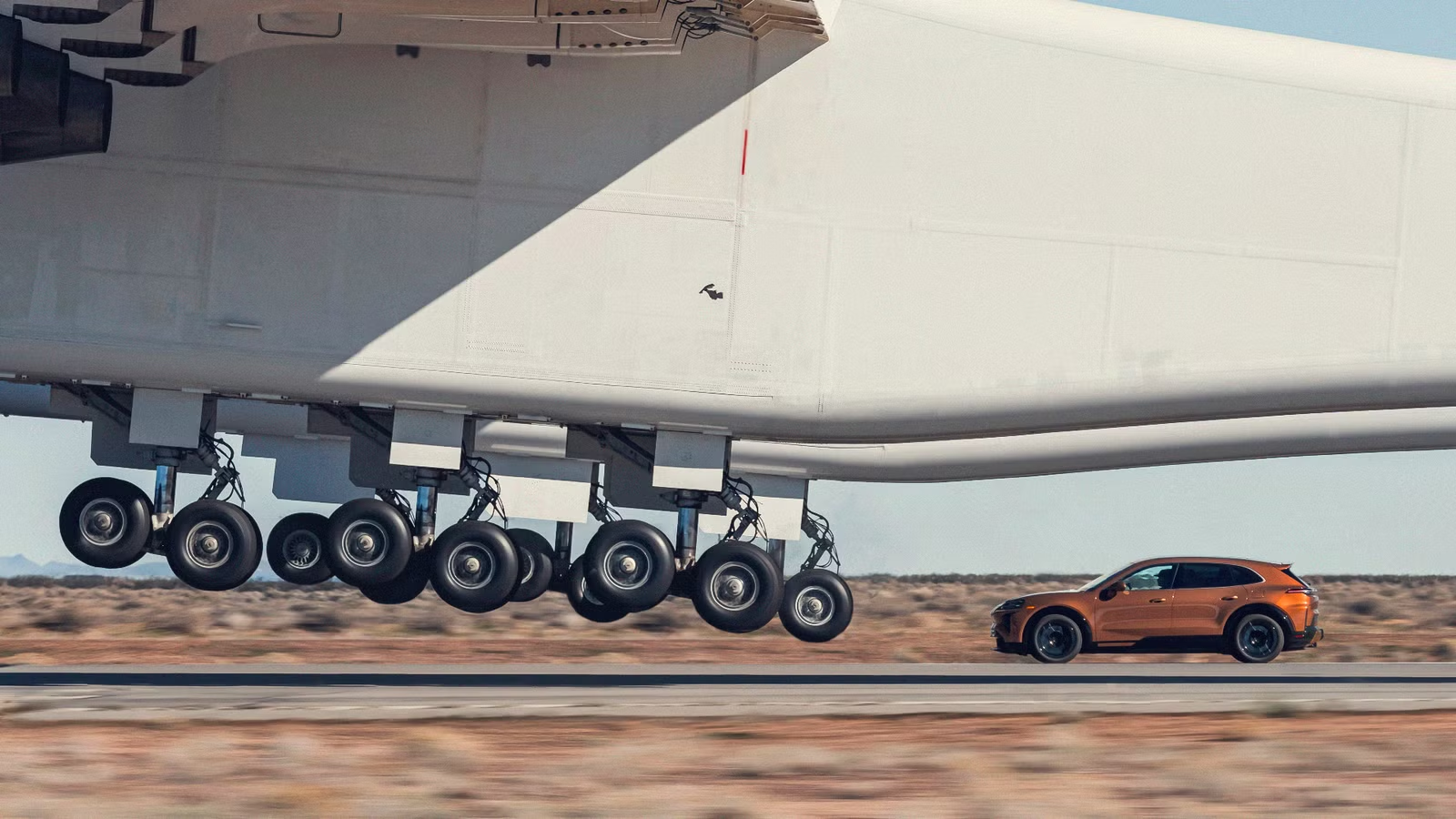
Porsche’s new Cayenne Turbo Electric just became the first production car to drive beneath the world’s largest aircraft — not once, but four times, twice during takeoff and twice during landing. The feat was completed this week at Mojave Air and Space Port, with endurance racer Patrick Long at the wheel, threading a 1,139-hp SUV through a narrow pocket of calm air while six jet engines screamed overhead.

The aircraft in question is Stratolaunch’s Roc, a composite behemoth with a 385-foot wingspan and 340,500 pounds of thrust — larger and more powerful than an Airbus A380. The premise sounds absurd on paper, but Stratolaunch engineers had done the math: a precise bubble of calmer air exists just behind the trailing edge of Roc’s landing gear during takeoff and landing. Stay in that bubble, and the surrounding storm becomes survivable. Leave it, and you’re in the full force of six jet engines’ worth of blast and turbulence.
The Engineering Problem: A Moving Bubble At 170 MPH
The aerodynamic oddity that made this possible stems from Roc’s unusual twin-fuselage design, built to serve as a launch platform for spacecraft and hypersonic test vehicles. Stratolaunch engineers calculated that the turbulence beneath the aircraft during takeoff and landing is not uniform — there is one exception, a small zone of relative calm positioned just behind the landing gear and ahead of the tail. The catch: that zone moves with the aircraft. From the moment Roc’s engines spool up through the full takeoff roll, the driver has to stay locked in that exact position. There is no drifting back to regroup.


For the car, the demands were specific. It needed enough power to match Roc’s acceleration across the entire speed range, active aerodynamic stability at speeds exceeding 160 mph, and the braking authority to stop on a finite runway after the pass. The Cayenne Turbo Electric checked every box. Its 1,139 hp and 2.4-second 0-to-60 time gave Long the performance margin he needed; the car’s active aerodynamics kept it planted as speeds climbed past 100 mph and into territory most production SUVs have never seen.
Long’s Account: Six Engines, 170 MPH, And A Glance At The Speedo

Long, a former Porsche factory team driver with decades of endurance racing behind him, described the minutes before the first takeoff run as among the most focused of his career. He started slow, using minimal power to hold position while Roc’s engines built toward full thrust. Once all six spooled up and the speeds shot north of 100 mph, he engaged Boost mode and committed everything the Cayenne had to staying right on the landing gear.
“The sound from those six engines was overwhelming, and I could feel the turbulence bouncing off the car, but it remained rock solid,” Long said. The situation intensified at the moment of Roc’s liftoff — the aircraft’s engines, now airborne, were pointed directly down at the Cayenne. Long glanced at the speedometer and saw a number north of 170 mph before easing off the throttle. The Cayenne’s optional carbon-ceramic brakes then did the unglamorous but critical work of scrubbing that speed before the runway ran out.
Stratolaunch chief test pilot Jonathan ‘Beast’ Bearce, flying Roc during the runs, couldn’t see Long from the cockpit. Watching the footage back afterward, he said Long’s positioning was perfect. “That took a lot of guts — I was seriously impressed by Patrick’s composure and how the car handled pressure,” Bearce said.
Landing Runs And The Chase Car Tradition
With the takeoff passes complete and the theory proven, the team pushed further. Long also drove beneath Roc during landing, timing his approach to arrive in the bubble just behind the landing gear as the aircraft descended toward the runway. The technique echoes a decades-old U.S. Air Force practice — chase vehicles have guided Lockheed U-2 spy planes to touchdown for years, helping pilots who can’t see the ground from the cockpit judge their altitude. Roc has roughly three times the U-2’s wingspan, which gives a sense of the scale involved.
In total, the Cayenne Turbo Electric completed four passes — two takeoffs, two landings — and came through unscathed. Passengers on the landing runs included automotive journalist Mat Watson and Stratolaunch crew chiefs Shauntel Williams and John McKinney. Porsche Design brand ambassador Orlando Bloom was also along for one of the landing runs. The Cayenne Turbo Electric, which joins combustion and E-Hybrid variants in the current lineup, is the most powerful production Porsche ever built. This week at Mojave, it earned that designation in the most direct way possible.
Source: Porsche

Related posts

Latest Post


No Comments