
The Cult Classic Sportbike That Gen Zs Don’t Know
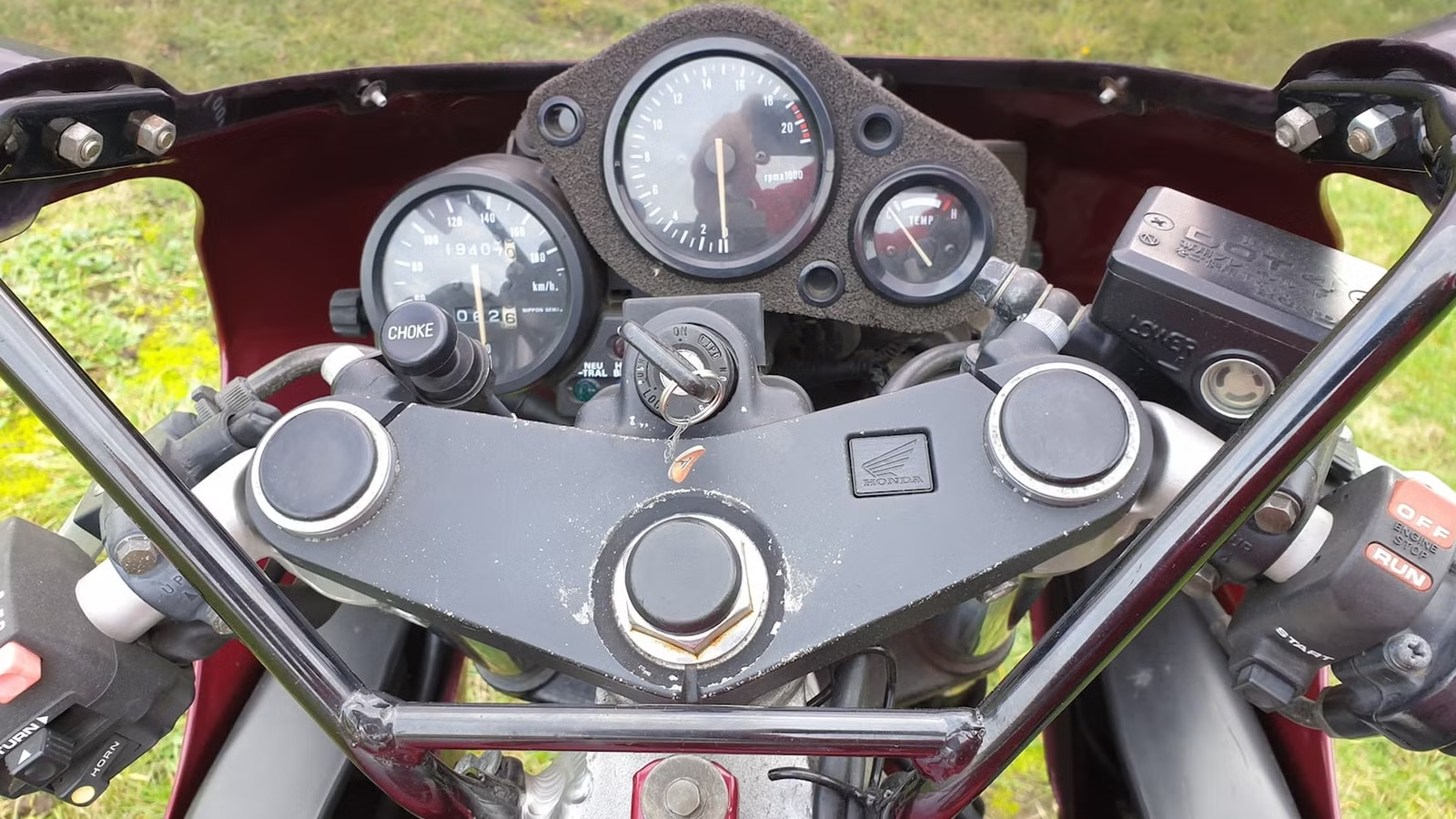
Motorcycles have always had a gift for revving — it’s baked into their DNA. Smaller engines, lighter reciprocating parts, and shorter strokes all conspire to push bikes into RPM territory that cars can only dream about. Consider the Lexus LFA, with its Yamaha-tuned V-10, which redlines at 9,000 rpm, or the 1,000 hp V-12 Aston Martin Valkyrie, which tops out at 11,100 rpm. Remarkable numbers for four-wheeled machines — yet both are thoroughly outclassed by a quarter-liter motorcycle that most riders today have never heard of.

That bike revved higher than a contemporary F1 car, was built around a regulatory loophole that only existed in one country, and disappeared from showrooms before most of its potential audience was born. It deserves a much closer look.
High Revs Can Equal High Fun
Anyone who likes engines will likely enjoy more revs. There’s nothing quite like the feeling and the noise of an engine note rising, the power growing, everything around you coming to life. Some people prefer torque — the low-end grunt that gets you off the line and shreds tires in the process. There’s nothing wrong with that; everyone has their preferences. But headlines aren’t written by torque. They’re written by power and revs. And those headlines are where manufacturers like to one-up each other, in a never-ending game of Top Trumps.

This obviously isn’t a bad thing, as it’s led to some of the best machines in history. Competition drives everyone forward, and in the world of high-revving motorcycles, there have been some genuine standouts.

Take the Ducati Panigale V4 R, for example. Created to satisfy World Superbike homologation rules, it is a 218 hp motorcycle that is essentially a street-legal WSBK bike. Its 998 cc engine revs to 16,500 rpm, making peak power right at the top of the rev range at 15,750 rpm.
Then there’s the Yamaha YZF-R6. The 2006 iteration of the bike initially carried a claimed redline of 17,500 rpm — but that figure wasn’t accurate. The tachometer read 17,500 rpm and the marketing material echoed it, yet the bike actually hit a programmed rev limiter around the 16,000 rpm mark. Yamaha later admitted the tachometer read roughly 1,000 rpm higher than the true figure and that the bike never genuinely reached 17,500 rpm, ultimately offering a buyback for dissatisfied customers. But while there have been bikes with high redlines — and bikes that merely claim high redlines — there’s a 249 cc sports bike that has them all beat.
The Honda CBR250RR Revved Higher Than An F1 Car

|
Engine |
Power |
Torque |
Top Speed |
Redline |
|
249 cc Four-Stroke |
44 hp @ 14,500 rpm |
17.3 lb-ft @ 11,500 rpm |
115 mph |
19,000 rpm |
The Honda CBR250RR is one of the highest-revving motorcycles in history, notorious for its 19,000 rpm redline. But to understand the CBR250RR, you first have to understand the environment it was built for. It’s Japan in the late 1980s, and you want to become a biker. Unlike in the US, licenses are strictly tiered by engine displacement. A basic license covers you up to 125 cc; a moderately more demanding one opens up bikes to 400 cc; and a third tier allows anything over 400 cc, though it was notoriously difficult to obtain at the time. So you go for option number two. There’s a catch, though: bikes over 250 cc require an inspection every six months, and those inspections cost several hundred dollars.
The choice is clear: you want a 249 cc motorcycle. Kawasaki had the ZXR250, Yamaha had the FZR250R, and Suzuki had the GSX-R250R-SP — all race-inspired machines with fairings and high redlines. Honda needed something to cut through the noise and make itself the obvious choice. Enter the CBR250RR.

Revving higher than anything else on the market, the CBR250RR landed squarely in the sweet spot of Japan’s licensing and legal requirements. Arriving after its competitors gave Honda the advantage of knowing exactly which benchmarks to beat. The ZXR250 had 45 hp and an 18,000 rpm redline, so Honda gave the CBR250RR 44 hp and a 19,000 rpm redline. The FZR250R was a little softer, so Honda made theirs more refined. The GSX-R250R-SP ran slightly heavy, so Honda made its lighter. Everything the competition did well, Honda set out to do better.
The bike launched in 1990, exclusively in Japan. This was largely because Honda was targeting a regulatory sweet spot that didn’t exist elsewhere, meaning a 250 cc machine wouldn’t have the same commercial pull in other markets that a larger bike would. Emissions standards and regulations in the US and EU were additional hurdles, making it more trouble than it was worth to sell the CBR250RR abroad. While it was never officially sold in Australia, the bike did find a second home there, becoming a popular grey-market import.

It’s little surprise, given that modern reviews consistently praise the bike’s 19,000 rpm redline — though they note that riders need to use every one of those revs to keep the bike on the boil. Even so, a sky-high redline paired with just 45 hp means riders are unlikely to get into serious trouble pushing it on a country road.
Some examples have made their way to the US over the years. However, with used prices reflecting the bike’s cult status, they represent a significant investment for anyone unfamiliar with its history.
Why High-Revving Small Bikes Like The CBR250RR No Longer Exist
As wild as the CBR250RR’s 19,000 rpm redline sounds today, there’s a clear reason bikes like it have largely disappeared. Modern motorcycles are shaped by a very different set of priorities — namely emissions regulations, cost efficiency, and real-world usability.
High-revving inline-four engines like the one in the CBR250RR are complex and expensive to build, especially in small displacements. They rely on lightweight internals, tight tolerances, and high-quality materials to survive those extreme engine speeds. Today, manufacturers have largely moved toward simpler twin-cylinder layouts in the 250–400 cc class, which are cheaper to produce, easier to maintain, and deliver better low-end torque for everyday riding.
Emissions standards have also played a major role. Engines that rev to the moon tend to be less efficient and harder to keep within modern environmental limits without significant engineering investment. For most manufacturers, it simply doesn’t make financial sense to develop a screaming 19,000 rpm engine when a lower-revving twin can meet regulations and sell in far greater volumes.
That’s what makes the CBR250RR so special in hindsight. It represents a time when manufacturers were willing to push engineering boundaries even in the smallest classes, creating bikes that prioritized excitement and innovation over practicality. Today, that kind of approach is usually reserved for flagship superbikes — not quarter-liter machines.
The CBR250RR Deserves To Be Remembered

In the motorcycling world, it’s usually the bigger bikes that get remembered — machines with oodles of power and performance that propel their riders forward at eye-watering speed. Whether it’s a race replica, a big cruiser, or something else entirely, larger bikes are almost seen as the end goal in a rider’s progression.
Smaller bikes, by contrast, are often treated as a stepping stone — something for beginners to learn on before moving up when finances or skill allow. Bikes like the Suzuki GSX-R750, the Yamaha R1, and the Honda CB750 sit at the higher end of the displacement spectrum and are rightly remembered as the legends they are. But this fixation on bigger means that smaller machines can go undeservedly unnoticed.

The CBR250RR, being a smaller bike from the early 1990s, isn’t going to surface in many algorithms. Its power output won’t win it much attention, nor will its top speed or torque figures. And with the final bike rolling off the production line in 1999, it predates almost every member of Gen Z. But that’s no reason to let the CBR250RR fade into obscurity.
With algorithms fixating on the biggest, the fastest, or the most extreme, a wealth of genuinely interesting machines never gets the coverage it deserves. The CBR250RR is one of them. So do yourself a favor and look beyond the superlatives — you just might find some gems.
Sources: Ducati, Motorcycle Daily, Motoplanete, Top Speed, Bring a Trailer

Related posts
Latest Post


No Comments