
The Forgotten Yamaha Triple That Predicted The MT-09 Forty Years Early
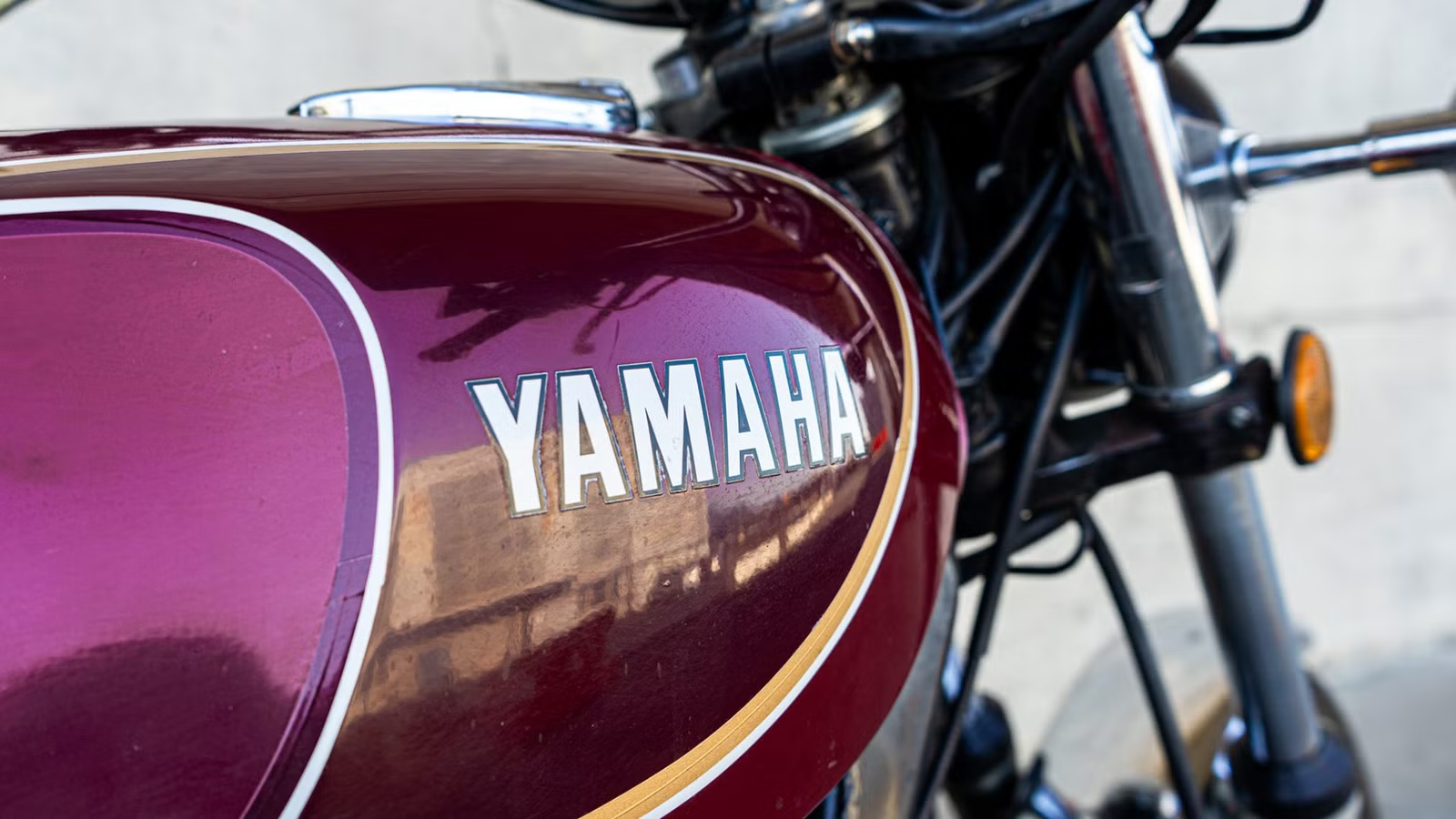
In 1976 there were already a number of Japanese motorcycle manufacturers that were focusing on high-revving inline four-cylinder engines. At the time Kawasaki’s Z1 was ending its production run, Suzuki was building the GS750 and Honda had the CB750F – all four-cylinder, four-stroke motorcycles. Yamaha bucked the trend and unveiled the XS750, which featured an inline three-cylinder.

Enthusiasts overlooked it at the time as the XS750 was not the most powerful or the fastest in the straight line. However, fast-forward a few decades and the XS750 (and the later XS850) would see its character and engineering philosophy become the foundation of Yamaha’s modern triple success, embodied in the CP3 engine.
Why Yamaha Chose Three Cylinders When Everyone Wanted Four
Although the Honda CB750 laid the foundation for the modern sports motorcycle, it was the Kawasaki Z1 that took it a step further. The 903-cc engine delivered an impressive 82 brake horsepower and 54.3 lb-ft from its four-cylinder engine. This was already the case in 1972. With a genuine top speed of 130 mph, it was understandable why it was loved by riders.

Three years later, Yamaha released a motorcycle that offered “only” 64 bhp and 43.4 lb-ft of torque. But, Yamaha wanted to offer a different product and experience to riders than simply launching another fast motorcycle.
The aim of the engine was to offer a smooth, torque-focused, and slightly more compact alternative.That would in turn lead to a motorcycle in a slightly different class, aimed more at the growing large-capacity touring and sport-touring segment.
The XS750 Was Yamaha’s Smooth Touring Alternative To The Superbike Arms Race

|
Displacement |
Horsepower |
Weight |
|
747cc |
64 HP |
550 LBS |
The XS750 was fitted with an inline three-cylinder engine of 747-cc capacity. Suited perfectly for the touring market, it was not chain-driven but shaft-driven. Its curb weight was 550 pounds and its aim was clearly at comfortable open road touring rather than canyon carving through the mountains. Even so, the lighter engine (versus four-cylinder units) allowed more freedom in terms of chassis design and rider ergonomics.
The engine also allowed Yamaha to focus on mid-range torque, rather than peak power at high engine speeds. Compared to twin-cylinder competitors, the three-cylinder was also smoother. The aim of the shaft drive was to offer a lower level of maintenance compared to a chain drive.
The Motorcycle That Beat Expectations Despite Losing The Horsepower War

Although it was clear the XS750 was slower than rivals, offering a top speed of 109 mph, there was still an overall appreciation for the XS. This included the engine that was built for tractability as well as dependability, and the fact that the overall package ticked a lot of boxes for different riders.
Cycle World even called it, in its original test, one of the top touring motorcycles, though the publication would have liked to see a reduction in weight. Most notably, in 1977 the readers of Motorcycle News voted the XS750 as the “Machine of the Year”, after the Kawasaki Z1 was voted the winner for four consecutive years. This clearly signaled the overall appreciation of the XS by the motorcycling community.
That Porsche Flat-Six Sound Was The XS Triple’s Secret Weapon
It is the three-cylinder engine that truly gave the XS750 a personality unlike any of its Japanese contemporaries. The 68.0 x 68.6 mm bore and stroke ratio meant it was almost perfectly square while the Mikuni carburetors fed the cylinders.
The 120-degree crankshaft design resulted in each piston reaching top dead center one after the other. This excellent primary balance resulted in the engine requiring no balance shaft.
At idle, the engine settles into a deep, uneven burble, a sound notably fuller than that of an inline four-cylinder engine. Enthusiasts over the years have noted that the engine and exhaust note is reminiscent of an air-cooled Porsche flat-six – a nearly universally admired sound.
The XS850 Proved Yamaha Had Not Given Up On The Triple

After a few years of production, Yamaha decided to improve the model and released the XS850 for the 1980 model year. The improved package represented a clear evolutionary step. The engine was enlarged to 826-cc by increasing the bore to 71.5 mm, while the result was an expected increase in performance, now 79 bhp and 49.1 lb-ft.
An oil cooler was added to assist in maintaining a more consistent operating temperature, and the carburetors were replaced by Hitachi constant-velocity (CV) units. This was all done to bring the Yamaha in line with competitors that were building larger capacity motorcycles.
Why Yamaha Abandoned The Triple Before It Became Cool

By the early 1980s, buyers’ decisions were driven more by performance than character. Competitors in the shape of the Kawasaki Z1 evolved into the KZ1000, Suzuki had its GS1000 and Honda offered the CB900F, not to forget the incredible CBX.
Four-cylinder engines had become synonymous with high-end Japanese motorcycles. Yamaha did not have a choice but to follow the market trend, and its next move was its flagship model in the shape of the XS1100 – which was a four-cylinder model. After production of the XS850 ended, for a number of decades Yamaha mainly offered four-cylinder and twin-cylinder engines for road riding.
The Forgotten Yamaha Triple Finds A Second Life With Custom Builders

As the love for some motorcycles fades, it is usually only a matter of time before a section of the enthusiast community takes notice and starts to buy or customize examples. That is partly what has been happening to these XS models. Most notable is the example of Jesse Meyer from Minnesota and his café racer XS750 Oxford, which received coverage in 2020. Another prime example is a café racer, draped in black and gold, which was built by the guys at Backdoor Garage, called “Lola”.
The XS models have not achieved the collector status of BMWs or the Honda CB750 for example, resulting in them being slightly underrated and in the process having a loyal following from experienced builders as they offer an affordable platform.
The XS750 Was The Blueprint For Yamaha’s MT-09 Revolution

Who would have thought that just over three decades later, in 2013, Yamaha would launch a three-cylinder model again, and that it would be appreciated so greatly by enthusiasts?
Today, this 890-cc inline three-cylinder forms the basis of models such as the MT-09, XSR900, and the Tracer 9—all able to trace their lineage back to the mid-1970s.
The modern examples remind us of a time when Yamaha’s unique three-cylinder models rewarded riders looking for something different from the ubiquitous four-cylinder Japanese motorcycles of the 1970s.
Sources: Motorcycle News, Cycle World, Motocryclespecs.co.za, BikeBound

Related posts

Latest Post


No Comments