
The Forgotten Spanish Two-Stroke That Invented The Modern Crate Race Bike
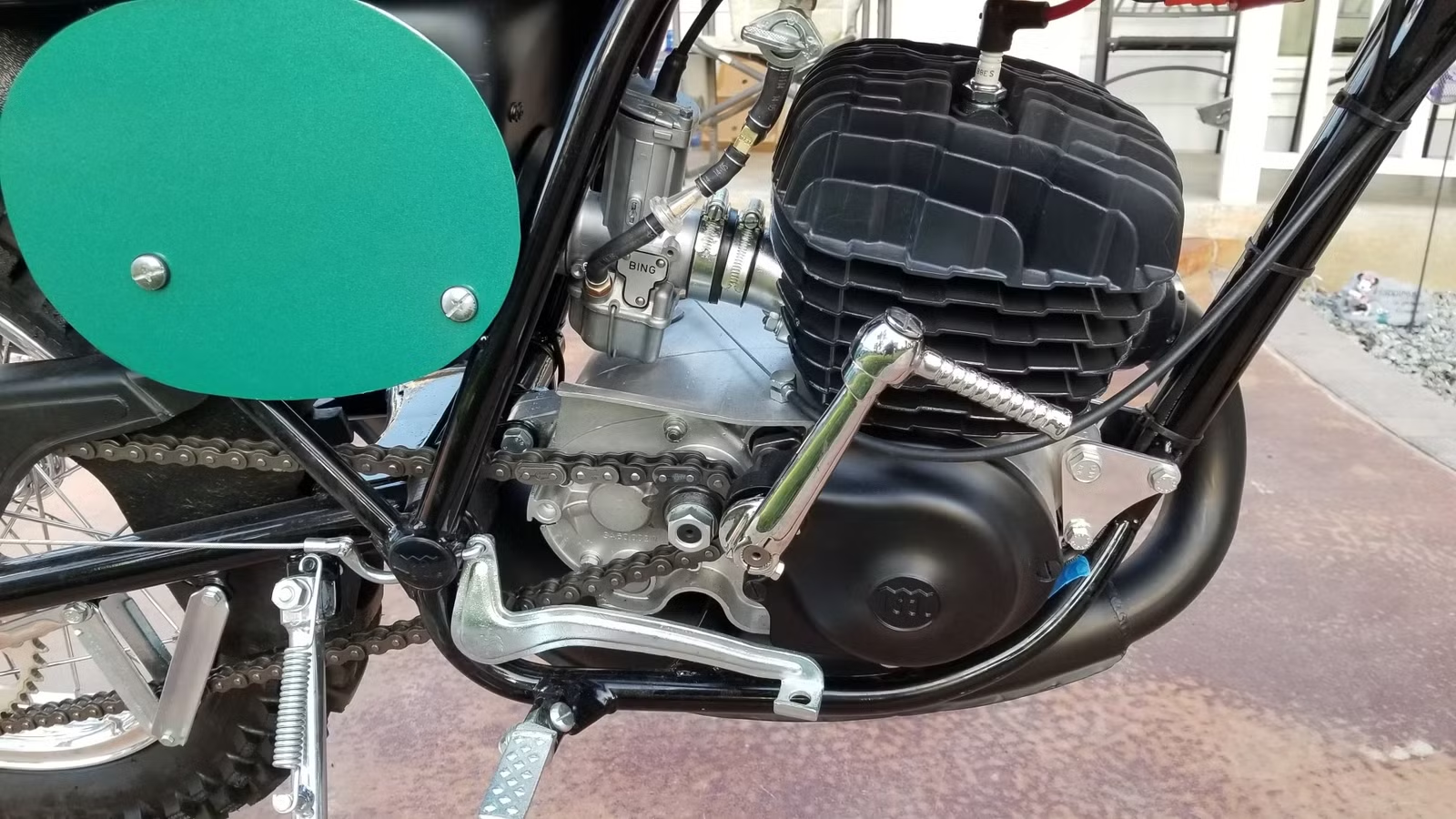
When the topic of race replica motorcycles comes up, most will think of something like the Ducati Panigale V4, the Honda RC30, or the Suzuki RGV250; bikes that replicate their track-racing versions with aerodynamic fairings and harsh suspension. But for all the circuit-honed bikes of the world, there was one that arguably created the modern crate bike, and it wasn’t built for smooth asphalt at all — it was built for dirt.
Before Japan Took Over, Spain Was A Motocross Powerhouse

Even as late as the 1960s, motorcycles remained one of Spain’s primary modes of transportation. The Spanish Civil War, followed by years of economic isolation under Franco’s early regime, meant car ownership remained out of reach for many families, leaving small-displacement motorcycles to dominate the roads.
Spain was also fiercely nationalistic, imposing import restrictions to protect its domestic motorcycle industry. The motorcycle became a point of national pride, and Spanish brands like Montesa, Bultaco, OSSA, Derbi, and Sanglas became not only the machines people saw on their roads, but also major names on the international stage. Spain’s rugged terrain also made it the perfect proving ground for off-road motorcycles, with brands like Montesa and Bultaco finding particular success in both motocross and trials.
Motocross itself was also enjoying a boom across Europe during the 1960s. Success on Sunday translated into sales on Monday and, with Japanese manufacturers like Honda, Yamaha, Suzuki, and Kawasaki not yet dominant in the sport, Spanish brands became renowned for building lightweight, race-focused machines that appealed to both professional racers and ambitious privateers alike.

Factory Replicas Were Rare Until Spanish Brands Changed The Formula

Race bikes used to belong to two distinct classes: either they were factory machines that came with the power, reliability and engineering of a machine that a manufacturer was proud to have its name on, or they were heavily-modified privateer affairs that often produced less power, had worse reliability, and fell short of the bike’s true potential. But as the 1960s drew on, manufacturers began to notice the increasing demand for factory-spec consumer bikes, and started introducing models capable of delivering the same level of performance.
These were bikes like the CZ 250, Husqvarna 250 Cross, or the Bultaco Pursang Mk5. While not explicitly marketed as race replicas, these bikes offered consumers as close a taste of the real thing as they could get without having to buy the full factory machine. But while these bikes were leaving showrooms, Japanese manufacturers were increasingly looking towards Europe as a new market. Able to produce bikes in far greater quantities than their European counterparts, they forced established manufacturers to compete on quality and performance rather than simply relying on numbers.
Montesa responded by sourcing parts from specialist manufacturers, raising production standards without sacrificing the lightweight, competition-focused character that its bikes had become known for. With these new, factory-inspired machines, Montesa took the idea one step further and created a motorcycle that carried not only the performance, but also the name, of one of its most successful factory riders of the era.
The 1973 Montesa Cappra 250 VR Was The Original Crate Race Bike

|
Engine |
Power |
Weight |
|
246 cc two-stroke |
35 HP |
224 lbs dry |
With other brands tentatively dipping a toe in the water of race replicas, Montesa decided to take the leap in 1973 with the Cappra 250 VR. The bike was as close to the factory Cappra 25 MX Works bike that it was based on as a production model could be, to the point that the VR part of the name stood for Vehkonen Replica — a reference to Finnish rider Kalevi Vehkonen. He was a factory Montesa rider at the time and finished fourth overall in the 250 cc Motocross World Championship, making his Montesa the first European-built bike to finish in that position that season.
Unlike some race replicas of the time, the Cappra 250 VR wasn’t merely a liveried-up road bike — it actually shared many of the same components. The frame used the same geometry as the race bike, helping to give it a much more lively ride than some competitor bikes of the time.
The similarities continued with the engine, as both used the same basic 246 cc power unit. Displacement, bore, carburetors, ignition, and gearbox were all shared between the two bikes — a highly uncommon move, even in the 1970s. Even integral components like the fork design, wheel layout (wheels shod with Pirelli tires, no less), and tank were carried over to the VR, creating a bike that needed little to no aftermarket modification to be race-ready.

Of course, not everything was exactly the same. The engine, while strong in the VR, had not gone through the same rigorous balancing and tuning as the engines in the factory bikes, meaning the customer version was reportedly slightly down on power. The works bikes also had access to prototype and experimental parts that a customer understandably wouldn’t, which made the VR further from the race bike by the end of the season. But while others slapped some stickers on their bikes and called it a day, Montesa had created arguably the closest production equivalent to a factory race bike.
The Cappra Evolved Rapidly Before Disappearing Just As Quickly

Things in motorsport never stand still. The Cappra 250 VR, being a race replica, was doomed to constantly be compared to shifting goalposts as the race bike received upgrades that the customer bike didn’t. In 1974, Montesa released the Cappra 250 VR75, which focused on making the engine less peaky, the overall bike more reliable, and improving the suspension.
1975 saw the bike change to the Cappra 250 VA. With Japan finally releasing their answers to the bike in the Yamaha YZ250 and the Suzuki RH250, Montesa made it more compact, smoother, and gave it more suspension travel to align with where motocross performance was moving to.
This accelerated in 1976 with the Cappra 250 VB, as Japanese alternatives increased the pressure on the Spanish brand. Weight was reduced, brakes were improved, and the frame was revised, but the end was approaching for the Cappra. The Cappra 250 VR became the VE in 1977, though these changes weren’t enough to keep it ahead of the curve against the might of Japanese manufacturing. The Cappra line continued until 1983, with Montesa stopping production in a completely different market from the one the bike had been born into ten years earlier.
Honda Ended The Cappra, But Its Influence Lived On

While the Cappra may have given way to Japanese brands and bikes, the Japanese links didn’t end there. Honda bought Montesa just three years after the end of the Cappra, effectively saving the Spanish brand from going under. But while some would see this as a European brand fighting, and ultimately losing to, a Japanese manufacturer, the reality was more nuanced. Montesa remained a brand in its own right, with production of its bikes remaining in Spain. Honda, meanwhile, gained more of a foothold in the trials market, and the duo released the Montesa Cota 4R, which went on to become one of the most successful modern trials bikes.
While history has largely forgotten the Cappra 250 VR, its impact on the industry can’t be denied. Like so many others, the bike broke boundaries by offering consumers exactly what they wanted, allowing them to feel every bit the factory racers that the bike essentially was built to replicate. And it did so well before many of the circuit-racing replicas more commonly associated with the market ever existed.
Sources: Cycle News

Related posts


Latest Post


No Comments