
The Forgotten Pontiac That Was GM’s Most Serious Attempt To Build A BMW
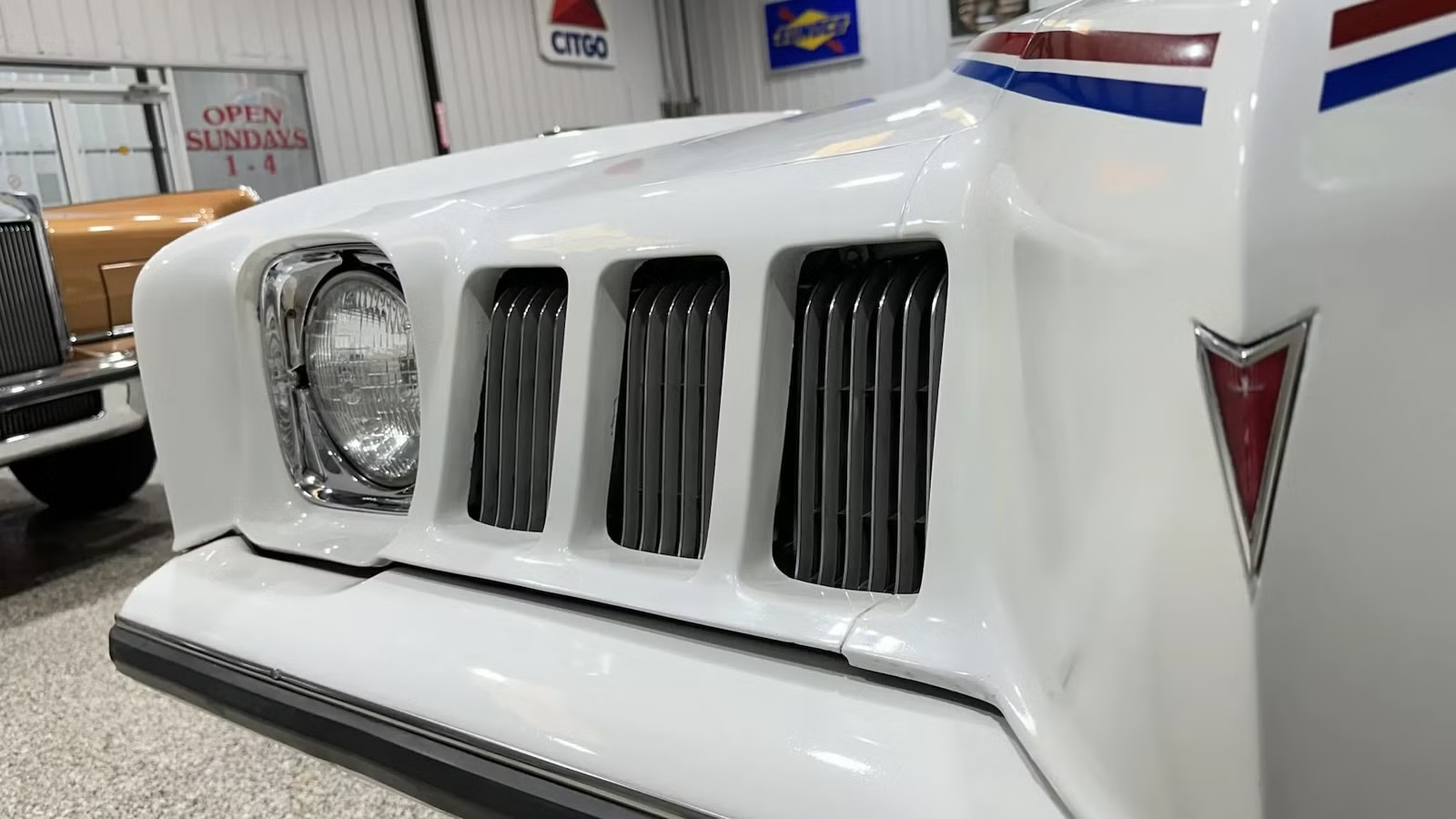
Automakers like Pontiac and BMW typically don’t go together, as they’re American and German competitors. Plus, Pontiac is sadly discontinued. Perhaps this is why this Pontiac car that carries a torquey punch is being forgotten. However, it deserves more attention for turning colonnade body cars into serious contenders, even though ideas were borrowed from European rivals to improve its comfort and handling. With BMW flavor surrounding the exterior and interior, this Pontiac model is distinct and exotic compared to earlier models.
General Motors Wanted European Handling And Flair

In the 1960s, muscle cars by General Motors and other American automakers were designed to handle straight-line speed. This caused a bit of a problem, because European rivals had better handling and could outrace them. Plus, muscle cars were dangerous and hard to control. As a result, they were being targeted by rising insurance premiums in the early 1970s.
As the malaise era struck, people were losing interest in muscle cars that weren’t exactly practical. They were stripped of the basics such as air conditioning and radios. Meanwhile, European performance options from Mercedes-Benz and BMW were drawing the eye with luxury features and plenty of power.
Also, General Motors built the Colonnade A-Body frame to meet impending federal rollover safety regulations. It integrated newly mandated five-mile-per-hour impact bumpers and could withstand the extra weight and stress of heavier emissions equipment as well. So, the next step to maintaining muscle and sales was to combine American power with European performance features.

The 1973 Pontiac Grand Am Packs Plenty Of Heat

It doesn’t matter that the 1973 Pontiac Grand Am was born during the smog era. This car still churns out tons of torque. With the available 455 cubic-inch (7.5-liter) V8, the Grand Am delivers 250 horsepowr and 380 lb-ft of torque. It can accelerate from zero to 60 miles per hour in roughly 6.1 seconds with a 14.7-second quarter-mile time and top speed of about 125 mph.
Meanwhile, the 1973 BMW 3.0 CSL (Coupe Sport Lightweight) uses a 3,153 cc (3.2-liter) inline-six engine with 206 hp and 211 lb-ft of torque. It can accelerate from 0 to 60 mph in about 6.5 seconds and completes a quarter mile in around 14.7 seconds with a top speed of 137 mph. It’s called the Batmobile because of its tech and wild aerodynamic package with a large rear wing, roof spoilers, and fender fins.
Though the two cars never raced, the Pontiac Grand Am was designed as a personal European luxury car instead of a race car. The Grand Am would’ve been a serious contender, though, as it blended V8 American muscle with European-inspired road manners. It actually managed to improve upon European handling with a superior design.
Here’s What The Pontiac Grand Am Borrowed From BMW

Pontiac effectively built an American BMW by drawing on European suspension designs for its distinct Radial Turned Suspension. The RTS package was designed by Pontiac engineer Phil Collins after driving a BMW 3.0S in Europe. It includes Plicell shock absorbers that resist fluid aeration, larger stabilizer bars to handle body roll during aggressive cornering, and harder suspension bushings. Plus, the premiere frame has larger main rails to enhance passenger protection.
The variable-ratio power steering delivers a firmer, more direct road feel for confident and responsive handling. The setup also helps maximize the grip of standard GR70-15 tires. These tires have an exceptional grip compared to the traditional General Motors bias-ply tires. It also has European GT-derived exterior styling with dual torpedo-shaped side surfacing and louvered rear quarter windows.
But the Endura polyurethane front nose bumper is a pure Pontiac creation. It has a sloping three-piece design to meet five mph bumper mandates. The bumper was incredibly innovative at the time as it allowed the car to bounce back from low-speed accidents without taking damage. But like European cars, it has a pointed V-shape, and it’s paired with twin vertical-slot grilles with a color-matching finish.
The 1973 Pontiac Grand Am Interior Features Distinct European Luxury

You’ll find European luxury influences in the interior of the 1973 Pontiac Grand Am as well. It has a driver-focused, aircraft-like dashboard that’s angled like a cockpit that borrows from premium imports. The nomenclature even displays the engine displacement in liters on the trunk lid, borrowing from popular European trends.
The dashboard stands out with genuine African crossfire mahogany trim, and the standard rally gauge cluster includes a trip odometer and an electric clock. Plus, the three-spoke custom sport steering wheel features a large padded center hub. For a unique touch, the headlamp dimmer switch is integrated into the turn signal stalk.
The deep-set, fully adjustable reclining bucket seats, including adjustable lumbar support, were available with wide-wall corduroy or leather-like Morrokide vinyl. Drivers had tons of 1970s color schemes to choose from, including burgundy and saddle. It contrasted with the colors of the door panels and plush loop-pile carpeting.
Collectors Are Sleeping On The 1973 Pontiac Grand Am

Surprisingly, the 1973 Pontiac Grand Am flies under the radar as a sleeper model that gets passed up for older muscle cars. Models in fair, driving condition can be found for between $5,000 and $10,000. Models in good quality with lower mileage increase the value to about $15,000 to $20,000. Then 1973 Grand Am models in pristine condition or extremely rare survivors may fetch between $25,000 and over $55,000.
Meanwhile, 1970 Pontiac Trans Am models often sell for between $60,000 and over $200,000 depending on the engine and quality. The 1970 Pontiac GTO typically goes for between $45,000 and over $75,000. Then Judge and extremely rare convertible models can tip the scales at over one million dollars. Unfortunately, the Grand Am title doesn’t have the same reputation and prestige as other iconic monikers like the Firebird, GTO, and Grand Prix.
While comfortable and oozing luxury refinement, it’s stuck in the shadow of muscle cars packing massive 455 cubic-inch engines. The 1973 model year marks the beginning of strict emissions standards that sapped power. Plus, not everyone is a fan of the A-Body style redesign. Some Pontiac fans prefer the older, sleeker body style compared to larger and bulkier colonnade cars.
Source: Pontiac, BMW, Hagerty

Related posts






Latest Post


No Comments