
The Forgotten Infiniti Sleeper With a 340-HP V8 Nobody Wanted
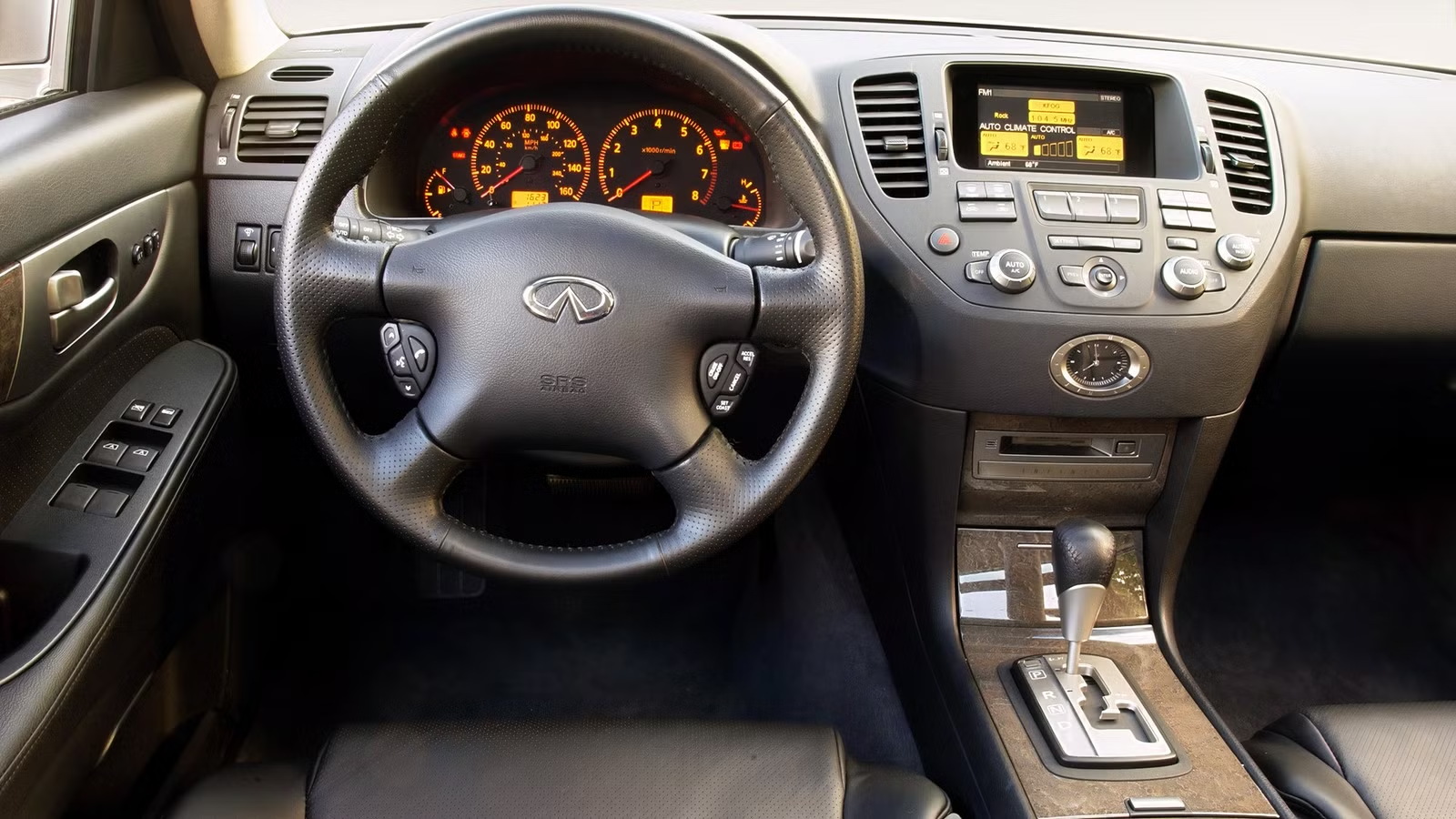
In the early 2000s, Infiniti was in the middle of an identity rebirth. For years, Nissan’s luxury division had lagged behind Lexus and the dominant European brands. The launch of the G35 coupe and sedan helped elevate the brand, capturing the attention of enthusiast buyers almost overnight. But right alongside that sporty G35 sat a mid-size luxury sedan packing a punchy V8 straight from Infiniti’s flagship cruiser. It was one of the purest factory sleepers Japan ever exported, and hardly anyone noticed before it was gone.
The Best Sleeper Sedans Often Never Become Sales Successes

Automotive history is filled with many brilliant cars that were simply too subtle-looking for their own good. The formula of stuffing a big, powerful V8 into a boring-looking sedan has created some of the most iconic enthusiast cars ever made. We had cars like the Mercury Marauder, which is essentially a better-looking Ford Crown Victoria with a 302-horsepower Ford 4.6-liter V8. We have the Australian-built Holden Commodore as the Chevrolet SS with a 415-hp LS3 V8 and a manual transmission.
From Germany, Audi gave us the C5 S6, which was an executive sedan with a 340-hp 4.2-liter V8, but was overshadowed by flashy AMG and M cars. Volvo answered with the S60 R with a turbocharged five-cylinder making almost 300 hp and a sophisticated all-wheel-drive setup. But these cars had one thing in common. Despite having great powertrains, they weren’t attention-grabbing.
Luxury Buyers Wanted Prestige, Not Hidden Performance

The early-2000s luxury market was filled with flashy cars. If someone was dropping $40,000 to $50,000 on an executive sedan, they wanted the world to know. BMW had perfected the sport-sedan aesthetic with the E39 5 Series. Mercedes-Benz exuded wealth with the distinctive design of the E-Class. Lexus had the stately-looking LS and GS, while Cadillac gave us the CTS that looked like a stealth fighter.

In this company of luxury cars, “stealth performance” was a tough sell. Luxury car buyers wanted a car that was instantly recognizable with prominent badges, sweeping body lines, and immediate curb appeal. A car that deliberately hid its potential underneath a boring design didn’t speak to the average luxury buyer.
Infiniti’s Experiment Started With A Humble Japanese Executive Car

To understand how Infiniti’s stealth hot-rod came to exist, you have to look across the Pacific to Nissan’s home market in Japan. In the late 1990s and early 2000s, Nissan had two iconic sister sedans built on the rear-wheel-drive Y34 platform: the Nissan Gloria and the Nissan Cedric. These weren’t traditional sports sedans.
They were Japanese executive sedans often used by corporate managers, taxi companies, and government officials. In essence, they were fleet cars. The Y34 styling reflected its purpose: a big sedan with a lack of aggression. These cars had four engines to choose from. The base engines were a 2.5-liter and 3.0-liter naturally aspirated VQ V6 with 210 hp / 195 lb-ft and 240 hp / 228 lb-ft, respectively. There was also a turbo version of the 3.0-liter VQ and a turbo 2.5-liter RB25 engine making 260 hp / 239 lb-ft and 280 hp / 285 lb-ft, respectively.
The Ordinary Gloria Became Something Nobody Saw Coming

When Infiniti needed a mid-size sedan to bridge the massive $20,000 price gap between the entry-level G35 and the top-tier Q45 flagship, they looked at their home market. Using the Y34 platform in North America was a fast, cost-effective solution. However, American buyers expected real muscle from an executive sedan. Infiniti couldn’t just drop in a modest six-cylinder and expect to compete with American and German V8s. So, Nissan’s engineers had to make some changes: they got rid of the domestic V6 engines, stiffened the chassis, refreshed the interior with premium leather and exterior chrome trim, and shoehorned their largest engine into the Y34 engine bay.
The Infiniti Y34 M45 Could Quietly Outrun BMW’s E39 540i

The Infiniti M45 arrived in North America as a 2003 model, and its spec sheets instantly grabbed the attention of automotive journalists. At a time when the BMW E39 540i with a 4.4-liter V8 produced 290 hp, the Lexus GS430’s 4.3-liter V8 pushed 300 hp, and even the Mercury Marauder with its all-American 4.6-liter V8 made 302 hp, Infiniti’s sedan was churning out more power and torque than all of them. It had the same understated design as its Japanese Cedric and Gloria siblings, but with way more performance.
This car could keep up with its rivals in a straight line. Pin the throttle, and the rear tires would easily break loose before the traction control stepped in. This almost 3,900-pound sedan could hit 60 mph in about 5.7 seconds and clear the quarter mile in roughly 14.1 to 14.3 seconds. Not as fast as dedicated performance cars, but not far behind either. All of this was made possible because of its engine.
The Q45’s V8 Changed Everything

The heart and soul of the M45 was the VK45DE, a 4.5-liter, naturally aspirated, all-aluminum quad-cam V8. Borrowed directly from Infiniti’s range-topping Q45 sedan, this engine remains one of the finest naturally aspirated powertrains Nissan ever built. The VK45DE loved to rev all the way to its 6,400 RPM redline, where it made 340 hp and 333 lb-ft of torque, which was more power and torque than its aforementioned rivals. It produced a deep, mechanical growl under heavy acceleration, yet was quiet and composed when cruising at 80 mph. It was coupled with a slick-shifting five-speed automatic transmission with manual shift control, sending effortless, smooth power to the rear wheels.
The M45 Was Much More Than A Straight-Line Sleeper

While the M45 had the straight-line speed, it wasn’t built to be an all-out performance car. Infiniti fitted the M45 with a performance-tuned suspension with stiffer springs, thicker anti-roll bars, and 18-inch alloy wheels wrapped in wide rubber. The result was a surprisingly balanced rear-wheel-drive chassis. Throttle response was instant, and in a corner, the car maintained impressive composure for a heavy executive sedan.
Inside, drivers were greeted with rich leather upholstery, climate-controlled seats, optional voice-activated navigation, and a Bose premium audio system; all of these made cross-country trips a breeze. In many ways, the M45 was Japan’s equivalent to the legendary Mercedes-Benz 500E. Just as Porsche helped Mercedes stuff a flagship 5.0-liter V8 into a standard W124 body to create the ultimate Q-car, Infiniti stuffed its flagship 4.5-liter V8 into an unassuming executive vehicle. It was raw muscle hidden in the body of a regular-looking sedan.
But Nobody Bought This Car

Despite its staggering performance, the M45 was a failure. Over its entire two-year production span for the 2003 and 2004 model years, Infiniti managed to sell just 8,067 units in the United States, and there were a few reasons for this. Infiniti just didn’t have the brand power of the established luxury brands to justify its $42,000 MSRP. At this price point, there were better prestigious options, even though they had less performance. Its original JDM styling and proportions also looked out of place with the luxury trend of North America in 2003.
Internal competition also didn’t help since the newly launched G35 at $30,000 was stealing the spotlight and looked way more modern. Finally, the Y34 chassis was already near the end of its global life cycle when it came to North America. Infiniti replaced it after just two years with the ground-up redesigned 2006 M35/M45 (Y50 chassis).
One Of The Best Luxury Performance Bargains Left Under $15,000

Decades later, the market failure of the Y34 M45 has turned it into a bargain for car enthusiasts. Because the badge doesn’t carry the clout of a BMW M-car or an AMG, these cars are very affordable. Clean, well-maintained examples can routinely be picked up for anywhere between $6,000 and $12,000. Low-mileage examples can go up to $21,000, but that’s the exception. For that money, you get a 340-hp, rear-wheel-drive executive sedan, bulletproof Nissan engineering from its heyday, and exclusivity. With just 8,000+ units ever sold, you are far more likely to see a Ferrari or a Porsche at a local car meet than another Y34 M45.
The Y34 M45 May Finally Be Getting The Recognition It Never Received

As interest in Japanese performance cars from the 1990s and early 2000s continues to skyrocket, enthusiasts are looking beyond the usual suspects like the Skyline, Supra, and RX-7. The spotlight is turning toward forgotten gems, particularly rear-wheel-drive performance sedans. The Y34 M45 is one of those brief, unrepeatable moments when a manufacturer decides to do something wild and stuff its flagship V8 into an unassuming four-door sedan just because they could. It may have taken over twenty years, but the world is finally realizing just how good this sleeper really was, and it’s only a matter of time before we start seeing a lot more people buy them for the value they offer.
Sources: Nissan, Infiniti, Bring a Trailer

Related posts



Latest Post


No Comments