
The Forgotten Evo That Won Mitsubishi’s First WRC Title Before America Ever Got One
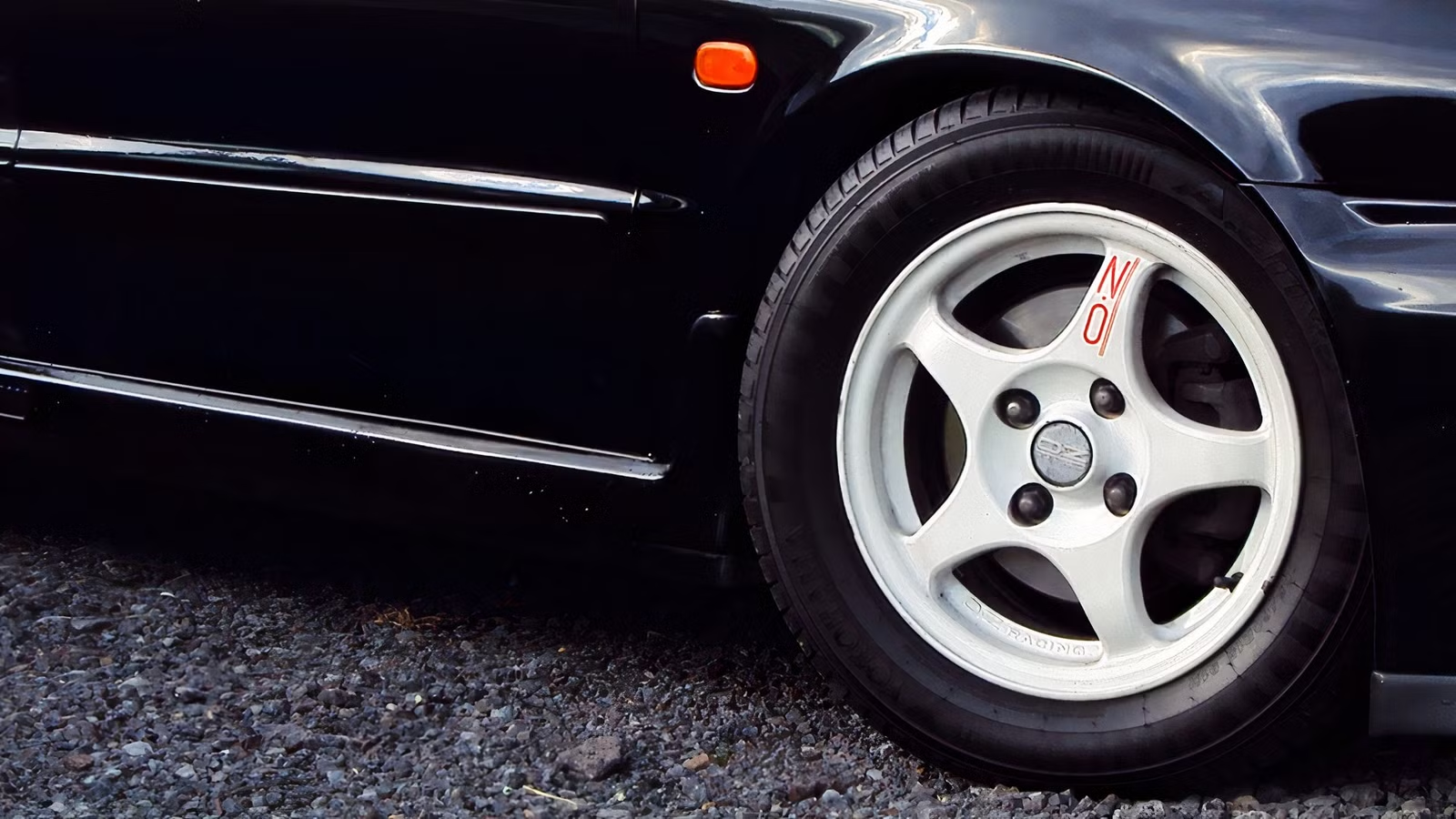
Tommi Mäkinen and an early Lancer Evolution didn’t scrape their way to Mitsubishi’s first WRC Drivers’ Championship in 1996. They won five of nine rounds—Sweden, Kenya, Argentina, Finland, and Australia—and locked up the title with two rallies still to run. It was the first of Mäkinen’s four consecutive drivers’ championships, achieved in a compact, turbocharged, four-wheel-drive sedan American enthusiasts couldn’t buy new. That is an extraordinary way to build a legend.

America did not get a showroom Evolution until Mitsubishi unveiled the Evo VIII for the U.S. market at the Los Angeles Auto Show in January 2003. Evo I through VI were never officially sold here, even if private imports put some cars on American soil. For anyone comparing Evo generations today, that gap matters: the badge reached America with its championship reputation already built.
Five Wins Made Mitsubishi’s First Drivers’ Champion
Those five wins came across very different rallies, not one friendly surface or format. Mitsubishi’s 1996 season account describes almost 1,500 kilometers of timed running at the Safari Rally, where the team changed major components during service to head off failures. Mäkinen and the car had to be fast, but they also had to survive. Winning still meant keeping the thing together.

One distinction matters: Mitsubishi did not win the manufacturers’ championship in 1996. That title came in 1998. Subaru had already shown what a turbocharged AWD sedan could do in rallying, so Mitsubishi wasn’t inventing the formula. What 1996 proved was that Mitsubishi’s version could win a World Rally Championship in Mäkinen’s hands.
Those Rally Rules Put Winning Hardware On The Road

Group A tied the rally car to a real production model. The FIA’s homologation threshold required 2,500 identical examples to be manufactured within 12 consecutive months. That didn’t make every showroom Lancer a works rally car with plates, but it forced Mitsubishi to start with legitimate production hardware.
The Evo I arrived in October 1992 with the Galant VR-4’s turbocharged engine and four-wheel-drive formula packed into a smaller Lancer. Its initial 2,500-car run reportedly sold in three days, with a second run taking the Evo I total to 5,000. The Evo II added a mechanical rear limited-slip differential. In stripped RS trim, deleting power windows, ABS, and the rear wiper saved about 70 kilograms, or 154 pounds, against the GSR. The pattern was clear: traction, less weight, and hardware with a job to do.
The Forgotten Evo III Built The Legend America Bought

The car was the Mitsubishi Lancer Evolution III, launched in Japan in February 1995 with a 2.0-liter turbocharged 4G63T. A five-speed manual sent power through full-time four-wheel drive. The Evo I supplied the concept and the Evo II improved it, but the Evo III delivered the family’s first title-winning season. And that reported 5,000-unit figure belongs to the Evo I, not the III.
Toyota’s Gazoo catalog lists the 1,260-kilogram GSR road car at 270 PS—about 266 hp—at 6,250 rpm, with 309 Nm of torque at 3,000 rpm. Mitsubishi’s works rally specification lists 45.0 kgf·m, about 441 Nm, for the competition engine. That rally figure is not stock road-car torque.
Mitsubishi Did More Than Add 10 PS

The Evo III’s 10-PS jump over the II was only the headline. Mitsubishi upgraded the turbocharger, raised compression from 8.5:1 to 9.0:1, and enlarged the exhaust front pipe to reduce restriction. The turbo, exhaust, airflow, and cooling changes worked as a package designed to keep delivering when the car was pushed hard. Another 10 PS looked nice on paper. Making the whole thing work harder mattered more.
That Wild Bodywork Wasn’t For Show

The Evo III looked angry because its body had work to do. Larger front openings helped cool the engine, while ducts in the air dams fed air to the brakes and transfer case. Mitsubishi also revised the side and rear air dams, rear spoiler, and wickerbill, and says the package reduced lift. As rally speeds climbed, controlling airflow and temperature mattered more.
The RS was the harder-edged choice; the GSR kept more of the comforts you’d appreciate on an ordinary drive. The harder specification sounds appealing until you actually have to live with it. And one detail is easy to backdate by mistake: Active Yaw Control did not arrive until the Evo IV in August 1996. The title-winning III did its work with the earlier hardware.
Today’s Collectors Can Buy What Mitsubishi Is Saving

American enthusiasts have had access to the Evo III through the age-based import route for years. NHTSA’s 25-year exemption runs from each car’s manufacture date, so 1995 and 1996 examples crossed that threshold in 2020 and 2021. By October 2026, this is established access, not a fresh loophole.
But 25 years old does not mean the process is as simple as shipping the car and sorting out the paperwork later. The federal exemption covers applicable Federal Motor Vehicle Safety Standards, not every emissions, customs, or state-registration issue. EPA’s separate provision for vehicles over 21 years old requires the same engine model and configuration originally installed. An identical replacement can qualify; a different swap doesn’t become original because it still says Mitsubishi on the cam cover.
Originality Matters Before And After Importing

State rules require their own verification. California, for example, distinguishes grey-market vehicles from its collector-car category and still requires Smog Check for model-year 1976-and-newer collector cars. Federal eligibility is not a promise of easy registration everywhere.
Modified cars deserve the same scrutiny. Any power claim above the factory 270 PS needs evidence and a parts list explaining where it came from. A dyno sheet can show output; it cannot establish originality or prove the engine fits the import route you’re relying on. Compare the chassis identification, import paperwork, equipment, and service records. Decide whether you want a modified driver or something close to factory specification, then judge it on that basis. That question of what to preserve gets even more interesting when the car is the real rally winner.
Mitsubishi Kept The Winner’s Battle Scars

Mitsubishi faced exactly that with the Evo III that won Finland’s 1996 1000 Lakes Rally. The company started restoring it in 2022 and had the car running again by 2024. Experienced engineers worked alongside younger colleagues, including Haruna Ikeda. This wasn’t a tribute car. It was one of the machines that helped make Mäkinen and Mitsubishi champions.
An April 2024 restoration report says the engine, transmission, AWD system, and suspension were disassembled and restored. The dents and battle scars stayed. Preserving them was the right call. Polishing those away would be much like restoring a boxer’s portrait by removing the bruises.
Mitsubishi says Ikeda moved into rally-engine development in 2025, while the Evo III returned to public action during Rally Japan 2024 demonstration running. The restoration became more than a museum exercise: younger engineers learned from it, fans saw it move again, and the car still looks like it earned every scar. That is exactly why those scars belong there.
Sources: Mitsubishi Motors, Mitsubishi Cars, FIA, NHTSA, EPA, California Bureau of Automotive Repair

Related posts


Latest Post


No Comments