
The Forgotten Dirt Bike That Set The Template For Modern Motocross
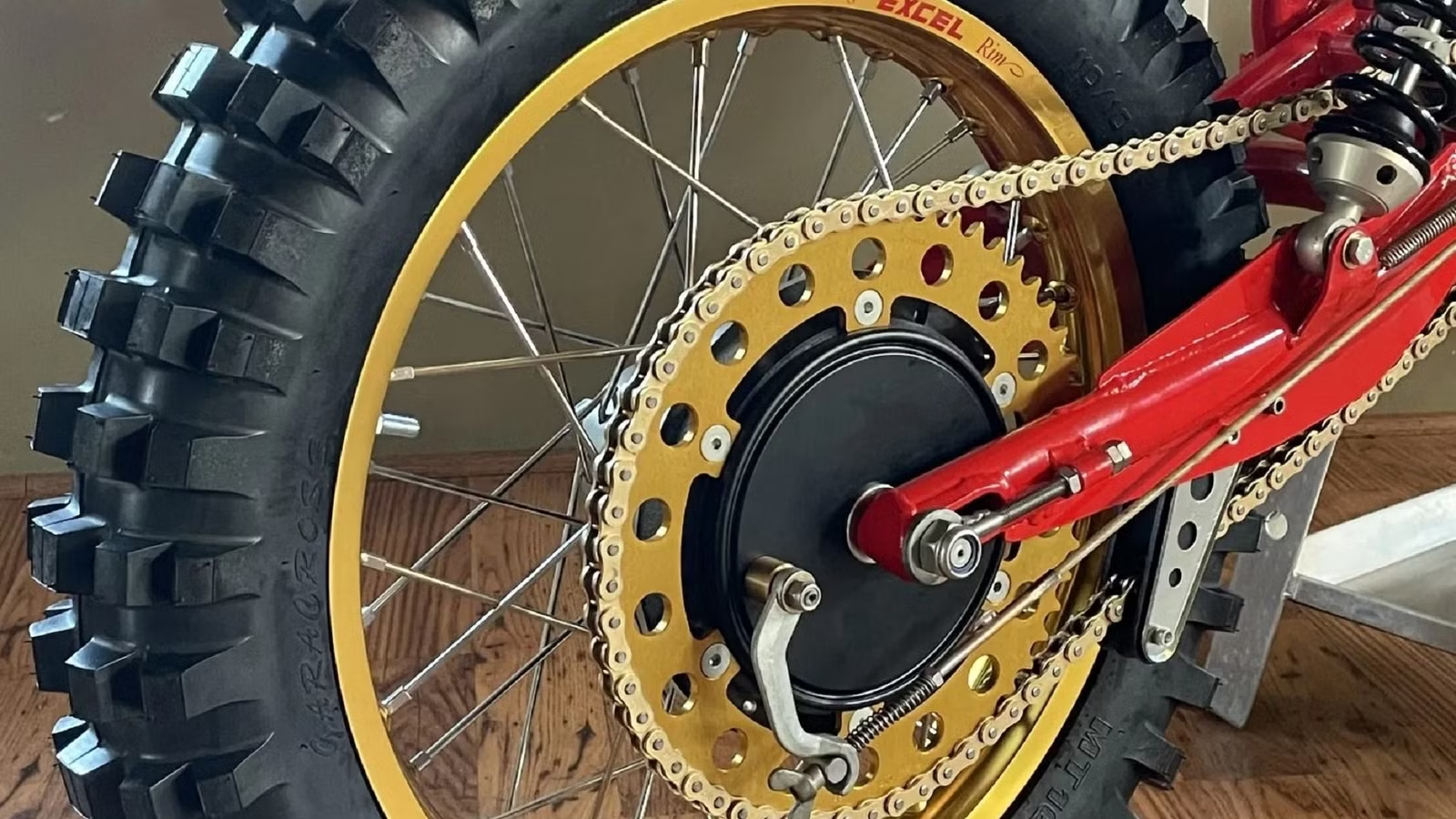
Believe it or not, the strangest motocross legend of the early 1980s came from a company that didn’t have a giant factory with endless cash, armies of engineers, and test tracks groomed smoother than a golf course. It was a small German outfit that reached its sharpest engineering moment right as the walls started cracking around it.

American motocross, still young and loud at the time, had fallen for one raw European two-stroke. A small factory built a bike that showed where dirt bikes were going next. Then family infighting, pressure from Japan, and one ugly part’s decision turned a peak into a cliff.
 53 autotech
Honda’s Turbocharged Motorcycle Was Decades Ahead Of Its Time
Honda built a turbocharged motorcycle loaded with future tech in the 1980s, but it lasted only one model year.
Before Motocross Became Industrialized, One Small Factory Was Setting The Pace

In the 1960s and 1970s, American motocross still had a bit of county-fair chaos in it. The sport came from Europe, but it grew fast in the United States after riders, promoters, and importers started bringing the show across the Atlantic. Edison Dye, often called a key figure in bringing motocross to America, used European stars and bikes to show U.S. fans what real off-road racing could look like. Lightweight two-stroke motorcycles helped sell the dream because they looked purpose-built, not converted from street bikes with a number plate slapped on like a mustache on a family dog.
European brands had real weight then. Husqvarna, CZ, Bultaco, KTM, and one German maker gave American riders machines with a simple pitch – less polish, more speed. These bikes were almost like race tools: they had sharp frames, tall seats, loud pipes, and a general dirt attitude.
One small German company built a deep bond with American off-road culture because its bikes did something riders could feel in one corner. They turned, put the front wheel where the rider pointed it, and felt narrow, lean, and ready. North America became a huge part of the company’s world, with some accounts placing it close to half of global sales. Soon, motocross was about to become more industrial, more Japanese, and much harder for a family-run factory to survive.
The 1981 Maico 490 Mega 2 Is Regarded As One Of The Greatest Motocross Bikes

The machine at the center of the story here is the 1981 Maico 490 Mega 2. Maico, the small German company behind it, built it like a weapon for the Open class, the big-bore division where throttle control separated heroes from yard sales with helmets. Many riders still rank the bike among the best production motocross machines of its era.
The 490 Mega 2 mattered because it joined huge two-stroke power with rare control. It used an air-cooled 488cc single, a big Bing carburetor, and a five-speed gearbox. Test numbers vary by source and setup, but period and later accounts agree on the important part – it made open-class power in a way riders could use. It pulled hard, hooked up, and let good riders spend more time racing and less time wondering where their rear fender went.
It also looked like a Maico, and that’s a good thing. The coffin-style tank, square-barrel engine look, red frame, high fenders, and stripped-down bodywork gave it a shape no Japanese bike quite matched. Nothing about it felt soft, and nothing about it felt styled for a showroom. It gave Maico loyalists a reason to believe a small factory from Germany could still stand in the same gate as Honda, Yamaha, Suzuki, and Kawasaki.
The German-Designed Japanese Superbike That Was Briefly The Fastest Production Bike On Earth
This bike was radical, divisive, and incredibly fast — and for a brief window, no production motorcycle on earth could touch it.
The 490 Mega 2 Still Feels Like A Modern Motocross Blueprint

To a large extent, the 490 Mega 2 helped show what a modern motocross bike needed to become, not because every later bike copied it bolt for bolt. Its bigger legacy sits in the priorities it made clear – rider position, chassis balance, weight placement, usable power, and geometry that let a bike change direction without feeling nervous.
Maico understood that horsepower alone was not enough. Any factory could produce bigger pistons and louder exhausts. The hard part came after that – the frame had to keep the front end planted, the swingarm, steering head, pegs, seat, and tank had to work as one package. Cycle World’s 1981 test pointed out how Maico used race feedback and fast production changes to build bikes around handling, even though the factory had limited test space of its own. The company simply listened to racers, because racers served as its real wind tunnel.

Compared with the awkward 1980 Mega 1, the 1981 bike made key changes. Maico lengthened the wheelbase, lowered the front, changed the rider compartment, raised the pegs, and gave the bike a flatter seat and tank area. Those choices helped riders move around and helped the big motor feel less like a runaway farm animal. The 490 Mega 2 still had flaws, especially in suspension setup and brakes, but its basic shape pointed toward the motocross idea that rules today – the rider needs room, the chassis needs balance, and power means little if the bike will not finish the corner.
Modern motocross bikes now use aluminum frames, fuel injection, liquid cooling, disc brakes, linkage suspension, and electronics. The Maico had none of that, but its best ideas still feel familiar. Big power had to come with control. A bike had to carve, not just charge. The rider had to sit in the machine, not on top of a red ladder. That is why knowledgeable vintage riders talk about the 490 Mega 2 with unusual respect.
The Rare Sportbike From The ‘90s That Collectors Quietly Obsess Over
A rare ’90s homologation special hid in plain sight, but collectors know why this road-legal racer is becoming impossible to ignore.
The Japanese Big Four Were Coming, But That Wasn’t What Killed Maico

By 1981, the Japanese Big Four had already changed motocross. Honda, Yamaha, Suzuki, and Kawasaki brought scale, money, dealer networks, and fast development cycles. They could revise a model, support racers, ship parts, and back dealers in ways smaller European companies struggled to match. In the Open class alone, the 490 Mega 2 faced serious machines like the Honda CR450R, Yamaha YZ465, Suzuki RM465, Kawasaki KX420, Husqvarna 390CR, and KTM 495.
Still, Maico’s downfall does not fit the simple version of history where Japan industrialized motocross, and Europe quietly lost. That version sounds tidy, but motocross is rarely tidy. Maico still had ideas – the 1981 490 Mega 2 proved that. It had the engine character riders wanted, the cornering feel they trusted, and the race-first identity Japanese brands still worked to match in certain ways.

The Japanese companies had better systems, but Maico had magic in the dirt. The problem came when the magic needed steady parts supply, clean management, and quality control. A brilliant chassis cannot save a brand if customers stop trusting the parts bolted to it. Riders forgive quirks. They forgive hard starting, heavy clutch pull, and brakes with the ambition of a wet sponge. They do not forgive expensive race bikes that fail in ways that can hurt them.
That is where the story gets darker. After the 1981 high point, Maico chased the single-shock future. The move made sense on paper because motocross suspension was changing fast. But the company paired that shift with a cheap Italian Corte Cossa shock choice and a linkage setup that caused major failures. At the exact moment Maico needed calm execution, it gave loyal riders problems.
Maico Didn’t Get Beaten As Much As It Blew Itself Apart

The decline sped up in 1982 and 1983. Bitter Maisch family infighting weakened the company from within, and the shock failures damaged its name from the outside. Broken shock shafts, warranty strain, falling sales, and a market that lost confidence fast all contributed. In racing, trust takes years to build and one bad season to ruin it all.
Then came more trouble. The 1983 models did not rescue the brand. Reports from the period and later histories point to rear hub failures and transmission problems that made Maico look fragile just as Honda, Yamaha, Suzuki, and Kawasaki grew stronger. By 1983, the company entered bankruptcy, and later efforts under related names and new owners never fully restored the old reputation.
That is why the 1981 Maico 490 Mega 2 feels bigger than an old dirt bike. It represents the last clear flash of a small maker that understood how a motocross bike should feel under a fast rider. Surviving 490s now draw serious attention from vintage racers and collectors, with recent auction listings and market trackers showing continued demand for clean examples. The Japanese machines wrote the next chapter of motocross history, but the forgotten German bruiser helped sketch the future before that.
Source: Maico, Motocross Action Magazine, Bring a Trailer, Cycle World

Related posts

Latest Post


No Comments