
The Ford Quad-Turbo V12 Supercar Detroit Buried Before Production
In the 1990s, one type of vehicle was leading the performance and technological wave: the supercar, and one continent was doing it best. Across the Atlantic, European powerhouses were pushing the boundaries of traditional engineering. They implemented aeronautical and Formula 1 technology, with hundreds of thousands of dollars in price tags.

Yet one country was missing from the table: America. Back in the 60s, at Le Mans, America proved that it could build an all-conquering supercar. But decades had passed since then; Detroit had the muscle and displacement, but when it came to a low-production hypercar, they had no answer.
A small group of engineers inside Dearborn decided to change that in just 18 months. They set out to build a machine so advanced that it would completely redefine what American performance meant. But there was a catch: just as the world realized what Detroit could produce, the dream of having an American supercar had to be put on hold for nearly a decade.
The Mid-90s Horsepower Race That Left Detroit Behind

The intensity the ’90s brought to the supercar world is something to behold. Highly precise machines were replacing analog supercars from the 80s. Raw performance was not the only thing that mattered, but how that performance was produced and delivered in conjunction with the chassis was a key factor.
McLaren shattered the perception of what a flagship high-performance car was with the three-seater F1. A car engineered with meticulous precision, whose engine bay was lined with gold leaf to manage heat dissipation. Ferrari, with the F50, brought the track to the road, with the naturally aspirated V12 from a Formula 1 car mounted directly into the F50 as a structural member of the chassis. While boutique manufacturers like Bugatti, with its quad-turbocharged EB-110, demonstrated that the next generation of performance cars belonged to the bold.
Meanwhile, the American performance scene was more rooted in tradition, with pushrod V8s and live rear axles. Producing high-volume sports cars like Mustangs and Corvettes, even the V10-powered Dodge Viper was a blunt-force machine that lacked the finesse and mid-engine layout to truly take on European rivals.
First-Gen Ford GT Reincarnated As The Lynx GT1
You don’t get much more epic than the Le Mans-winning Ford GT, but the Lynx GT1 is capable of up to 1,500 horsepower, and that’s pretty darn close.
Ford’s Shadow Project To Challenge Europe’s Finest

The developmental gap didn’t go unnoticed by Detroit, and a small group of engineers began working on a brand-new project at Ford Performance. They were not interested in upgrading an existing platform; they wanted a vehicle that would showcase absolute engineering dominance. The project had an incredibly fast-paced development cycle and took under six months to bring the plans from paper to the road.
To pull off this almost impossible project, Ford Performance had to tap into its global empire. The Ford Motor Company owned Jaguar at the time, which had just completed its latest supercar, the XJ220. The Ford engineers pulled the suspension architecture and the five-speed manual transaxle straight out of the XJ220 and fitted them to a cutting-edge triangular steel-section space-frame chassis, structurally reinforced with a high-strength carbon-fiber undertray.
This wasn’t just a styling exercise; it was a strategic design statement intended to highlight Ford’s capabilities at the auto show. Ford was building a true weapon capable of taking on any competitor. A true mid-engined exotic with European chassis dynamics wrapped in a custom, aggressively futuristic package. It needed an engine that could not only complement the dynamic chassis with raw power but also deliver ferocious performance.
The Forgotten German Hypercar A Sheikh Commissioned To Outrun The McLaren F1
A wealthy sheikh commissioned this incredible one-off hypercar to settle the speed debate once and for all.
Ford GT90: Detroit’s 720 HP Quad Turbo Monster

In 1995, at the Detroit Auto Show, the sheets were pulled off the Ford GT90 with its striking white body and blue suede interior. It was designed as a nod to the GT40 that beat Ferrari at Le Mans in the 60s. But the similarities end there; where the GT40 was a brute, the GT90 looked something like a space shuttle.
To power this incredible machine, the engine was placed behind the driver’s head, and it wasn’t a re-tuned version of the production V8. The engineers took the modular architecture of Ford’s 4.6-liter V8 engine, cut two cylinders from two separate blocks, and then assembled them into a massive, custom 90-degree V12. Contrary to the common automotive myth that labels it as a 6.0-liter, this bespoke engine had a 5.9-liter displacement. And to make sure it could destroy anything that came out of Italy and England, Ford fitted four Garrett T2 turbochargers onto the engine block.
GT90 Concept Specs
|
Engine |
Transmission |
Power |
Torque |
|---|---|---|---|
|
5.9 L Quad Turbo-charged V12 |
5-speed manual |
720 Hp @6,600rpm |
660 lb-ft @4,750 rpm |
The numbers the GT90 produced are mind-bending even by modern standards, let alone in 1995: a massive 720 horsepower and 660 lb-ft of torque. The performance calculations were also staggering: the car went from 0 to 60 in 3.1 seconds and hit 100 mph in just 6.2 seconds. It was the top speed that was truly the king of stats about the GT90. Ford conservatively claimed an official top speed of 235 mph. It was a speed record that would not be broken by any production car until the Bugatti Veyron arrived.
Why The GT90 Was A Blueprint And Not A Consumer Car
The exterior design of the GT90 showcased Ford’s “New Edge” design language, a philosophy characterized by sweeping curves and razor-sharp lines heavily inspired by stealth fighters such as the F-117 Nighthawk. The body was constructed entirely from lightweight carbon fiber panels. It featured a speed-sensitive spoiler that rose to stabilize the rear. It can only be described as an early and successful integration of what we know today as active aero.
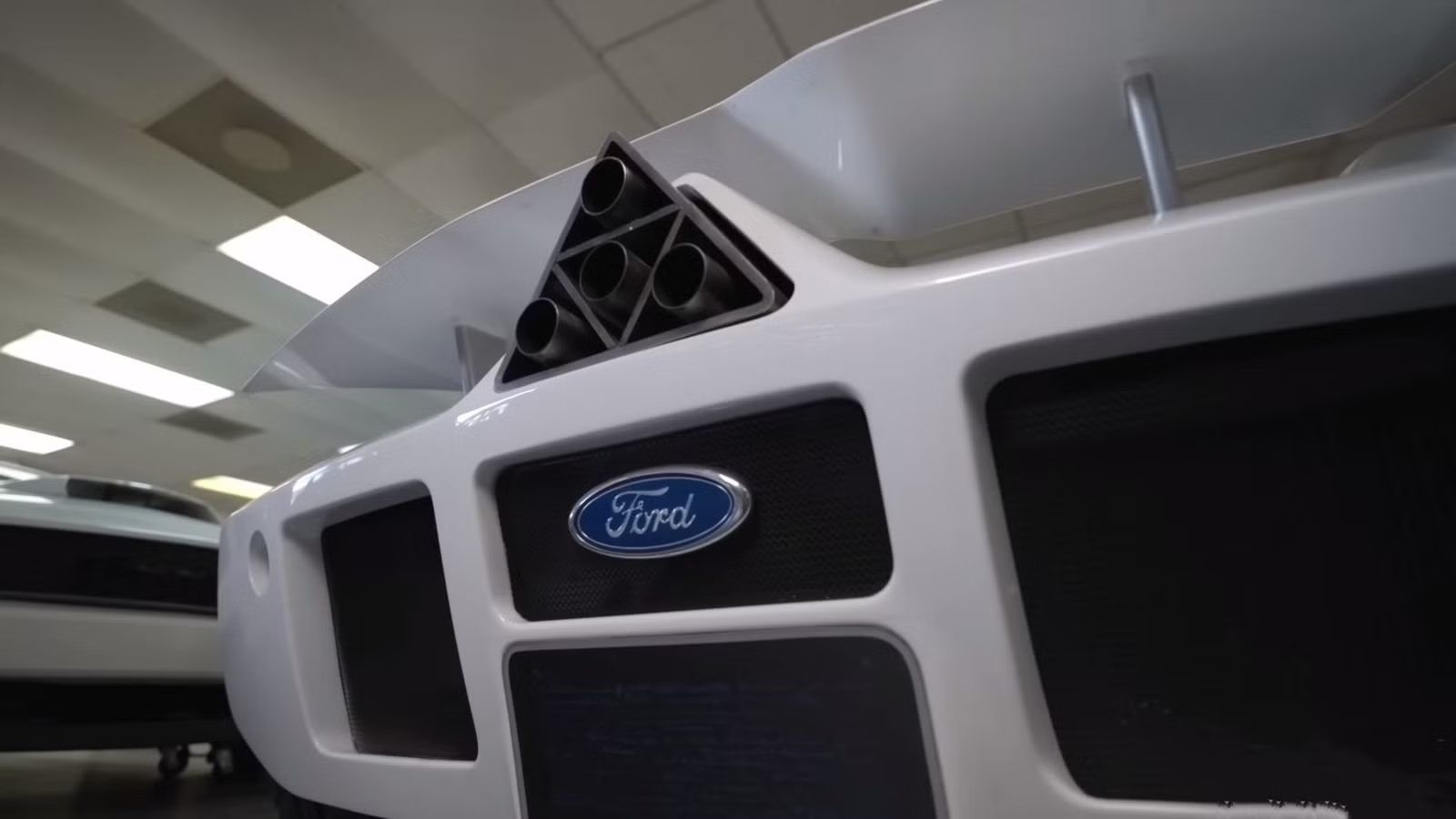
The car had a massive fighter-jet-style tinted glass canopy that offered a clear view of the road, and at the rear, four exhaust tips were tightly packaged under a heat shield. The engine ran so hot that the team at Ford had to install ceramic tiles, virtually identical to the thermal protection tiles used on the NASA space shuttle, just to prevent the exhaust from melting the bodywork due to the sheer amount of raw heat it generated. Despite a fully functioning drivetrain and massive public enthusiasm, the GT90 was never entered into series production.
In reality, it was never planned to be a production car since its inception. It was never intended to be sold to the public. The GT90 was a pure technological showcase — a rolling laboratory designed to test Ford’s capacity to produce an advanced aerodynamic car with furious power. It also served to revitalize Ford’s global image in the performance market. It was an incredibly successful engineering and PR exercise that achieved its objectives.
Turns Out You Can Still Buy A Ford GT From The Factory
Last call: A few Ford GT Mk IV build slots remain. 820-plus hp, huge downforce, track-only thrills. Orders close soon.
The Spirit Of The GT90 Lived On In Ford’s Next Supercar

A decade after the GT90 shook the industry, Ford finally gave enthusiasts what they craved, but it wasn’t what you might expect. 2005 was the official launch of the Ford GT, a mid-engined supercar. It was a beautiful combination of retro-future design, but it presented a different philosophy than the GT90. The 2005 car was a nod to the past, powered by a supercharged 5.4-liter V8 that was more in line with traditional American power than the high-tech, boundary-pushing quad-turbo V12 of the GT90.
Ford GT90 Vs Ford GT
|
1995 Ford GT90 Concept |
2005 Ford GT Production |
|---|---|
|
5.9 L Quad turbo V12 |
5.4 L Supercharged V8 |
|
720 HP |
550 HP |
|
F-117 Fighter Jet Inspired |
1960s Retro Le Mans Design |
|
Pure Technology Test Bed |
Low-Volume Road Car |
It’s a bittersweet feeling to know what could have been and what we lost between 1995 and 2005. The 2005 GT was a look back, whereas the GT90 was a leap into the future. It was a triumph of American design that produced a car more exotic than its European rivals. Today, the single GT90 remains a priceless artifact and revered icon in concept-car history.
It lives on in the memories of those who experienced driving the car — not physically but digitally — through video games such as Gran Turismo 2 and Need for Speed. The GT90 continues to draw massive public attention wherever it is displayed at museum exhibitions, which is itself very rare. It remains an amazing white-and-blue memory of a car that showed Detroit can produce world-beating supercars, even if only as a concept.
Source: NetCarShow.com, Ford Heritage Vault

Related posts





Latest Post


No Comments