
The First Six-Cylinder Motorcycle Was Basically A Honda 500 Four With Two Extra Cylinders
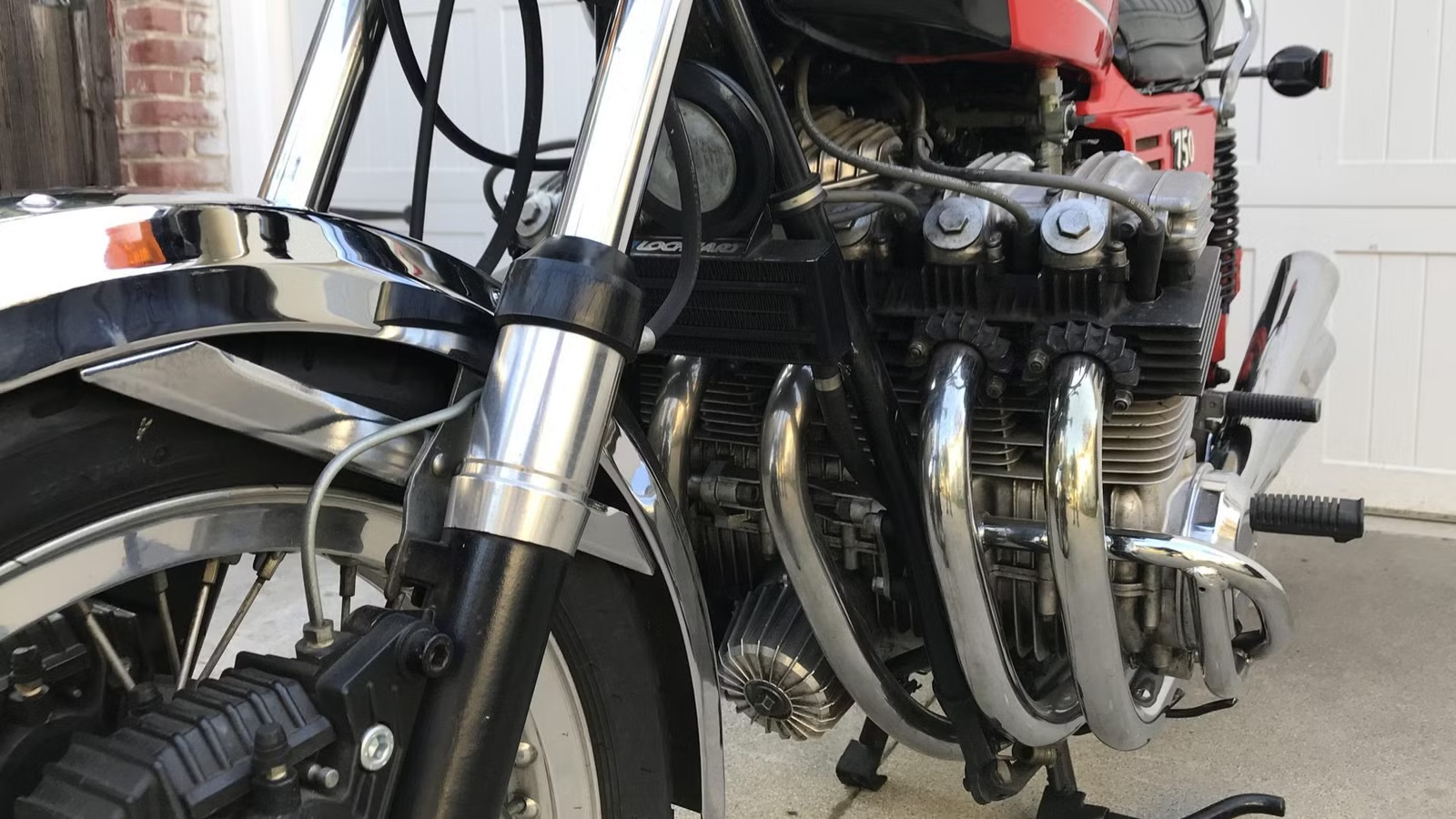
The 1970s were a time when the biggest threat to motorcycle manufacturers was standing still. Every bike needed to be bigger, better, more powerful, and increasingly ambitious. Japanese brands were dominating the market so, in order to stand out, European bikes needed to do something different. While some tried iterating on proven designs or moving into different segments, one manufacturer trialled changing the very thing that powered its bikes. And it’s still talked about today.
Italy Wanted To Prove It Could Take On Japan’s Motorcycle Giants

When Alejandro de Tomaso acquired Benelli in 1971, he had ambitions that far exceeded building “just” another successful motorcycle brand. He wanted to bring Benelli and Italy up to speed with their far more advanced Japanese counterparts of Honda, Suzuki, Kawasaki, and Yamaha. The big four Japanese brands had pushed the industry forwards, combining sophisticated engineering with scalable production, all at a time when Italian brands were prioritizing heritage, styling, and character.
De Tomaso had already had success in the car world with the Vallelunga, the Mangusta, and the Pantera (the latter of which was released that year) and he wanted to bring the same unconventional approach to Benelli to create a flagship bike that would make the world take notice. The answer? Six cylinders.
The Six-Cylinder Arms Race Was About More Than Raw Performance


1969’s Honda CB750 was a catalyst for the motorcycle industry, as riders realized what was possible and manufacturers began competing for who could make the most powerful bike. More cylinders became a symbol of engineering prestige, as the increased power strokes and smaller individual pistons created a smoother engine and ride, giving manufacturers an advantage over others. The CB750 had shown what could be achieved with four cylinders and, for smaller Italian brands who knew they couldn’t compete with the Japanese manufacturers in terms of scale, it meant that offering something different was a route towards recognition. For Benelli, this was an opportunity.
The Benelli 750 Sei Was Italy’s Six-Cylinder Answer To Honda

For Benelli, a six-cylinder engine wasn’t just a new way of powering a bike. It represented a genuine engineering talking point; something that the Japanese brands couldn’t ignore, and which was interesting enough to become a flagship while offering the smoothness and exotic appearance that Italian bikes were known for. The Benelli 750 Sei — the world’s first production six-cylinder bike — was this bike.
The decision to use six cylinders wasn’t simply a case of one-upping (or two-upping in this case) their Japanese counterparts, but a practical one. An inline-six promised incredibly smooth power delivery, a distinctive exhaust note, and a sophistication that few other bikes could match. When it was unveiled to the world in 1972, the Sei (Italian for “six”) represented how far Benelli was prepared to go to challenge the status quo. The only problem was, for some, it was a disappointing effort.
Let’s start with the power. At 71 HP, it wasn’t exactly a world-beater, and its 118 MPH top speed wasn’t much to write home about. For comparison, Honda’s 1969 CB750 made 67 HP and could reach around 125 MPH, despite being a few years older. For a brand that had built its reputation on the racing circuits, it was a somewhat lackluster performance figure. The engine itself was heavily based on that of the Honda CB500, with another couple of cylinders to take it from 500 cc to 747 cc, which, naturally, also drew attention.
Then we have the weight. At 562 lbs wet, the Benelli was a bit of a heifer. A larger engine will naturally weigh more but, when you’re competing against the 513-lb wet CB750, all that heft is noticeable. Despite this though, contemporary reports of the Sei were positive. The engine was smooth, the power was progressive, and the sound was, honestly, symphonic.
The handling was surprisingly nimble as well, especially for a bigger bike. The robustly-designed double-downtube frame reduced flex, while more premium components like Marzocchi suspension made for a smooth ride. The transversely-mounted engine did cause some issues with ground clearance through corners, because it was wider than average on both sides, but it wasn’t necessarily a sports bike for the time. But for all the bike’s positives, it simply wasn’t enough to make the Sei a commercial success.
Exotic Engineering Could Not Solve Benelli’s Biggest Commercial Problems

While six cylinders may have been exotic, exoticness usually comes at a price. In the US, that price was $3,995 new (the equivalent of over $27,000 today). That was an exorbitant price for a bike at the time, especially as the CB750 was just $1,495 new a few years earlier. More than price though was the bike’s limited run, as around 3,200 examples were made as Benelli lacked the manufacturing capability to make them at the scale of Honda or Kawasaki.
Benelli tried to keep the six-cylinder concept alive with the 900 Sei in 1978, which offered more displacement and development on the original design. But the arrival of Honda’s CBX1100, which had its own six-cylinder engine and considerably better performance, made the 900 Sei’s life even harder. The Sei was certainly an impressive feat of engineering, but ambition alone wasn’t enough to make it a success. The Italian marque gamely continued with the six-cylinder layout until 1989, when it finally said enough was enough.
The Benelli Sei’s Legacy Is Bigger Than Its Sales Figures

The importance of the 750 Sei doesn’t lie in its (admittedly low) sales figures, but in what it demonstrated. An ambitious and truly distinctive bike made by a relatively small Italian manufacturer, with the sound and styling you’d expect of a brand from that country, the Sei is one of the most distinctive bikes to come out of the 1970s. The 900 Sei continued the unusual formula, helping to define Benelli’s legacy in motorcycle history. And though the bike was made as an answer to Japan’s best, today it stands on its own in history as an eccentric piece of Italian innovation.
Sources: Motorcycle Specifications, Cycle World, Motorcycle Classics

Related posts

Latest Post


No Comments