
The First Production Car To Break 1,000 Horsepower
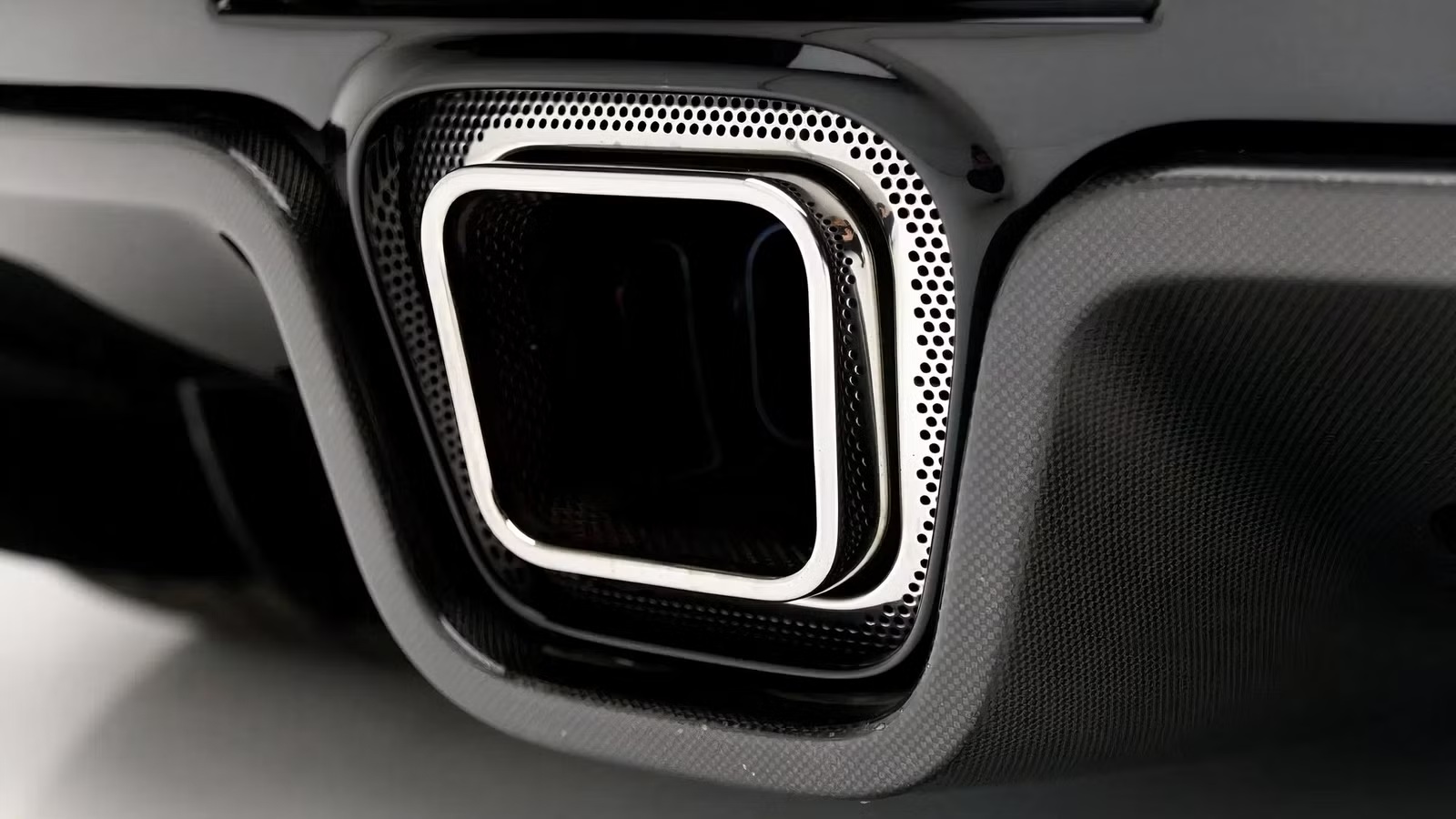
A thousand horsepower. For most of automotive history, that number existed only in the realm of fantasy — a figure thrown around at car shows and debated in enthusiast forums, but never achieved by a car you could actually buy. The supercar era of the 1980s and 1990s pushed performance to extraordinary new heights, with legends such as the Ferrari F40 and the McLaren F1 redefining what a road car could do. Yet even those icons fell short of one defining milestone: 1,000 horsepower from a series-production automobile. What it took to finally cross that threshold — and the engineering obsession behind it — is a story worth telling again.
Before The 1,000 Horsepower Car, There Was Koenigsegg

The Koenigsegg CCR briefly stood at the pinnacle of performance in the early 2000s, earning a reputation as the most powerful production car of its time with over 800 horsepower.
In 2005, it cemented its place in history by setting a new top-speed record of 241 mph, dethroning the long-reigning McLaren F1. However, the CCR’s reign was fleeting — just two months later, another car arrived and shattered that benchmark, ending the CCR’s short but significant moment at the top.
How A Sketch On A Envelope Created The 1,000 HP Target


This 1,000 horsepower barrier finally fell with the launch of theBugattiVeyron 16.4 in 2005. The Veyron entered production with a power output of 1,001 PS and a top speed of 407 km/h (253 mph), making it the first series-production car to exceed both 1,000 PS and 250 mph simultaneously. From its earliest drafts, the Veyron was engineered to demonstrate that extreme speed, genuine luxury, and everyday usability could coexist in a single machine — not just a record-breaking exercise, but a car with no real precedent in the production car world.

Understanding the origins of the Bugatti Veyron 16.4 is essential to grasping the vision behind it. In 1997, Ferdinand Karl Piëch, then Chairman of the Volkswagen Group, sketched what would later become the Veyron on an envelope while riding the Shinkansen between Tokyo and Nagoya. In that very first sketch, Piëch conceptualized an 18-cylinder engine assembled from three VR6 cylinder banks offset at 60 degrees. Though there was no car around it yet, this initial engine concept hinted at the unique character of what a car powered by such a unit could be. Guided by Ettore Bugatti’s philosophy and motto of “if it’s comparable, it’s not a Bugatti,” Piëch set ambitious performance targets for his new project: 1,001 PS and a top speed above 250 mph. Non-negotiables also included real-world usability — specifically, a car refined enough to drive to the racetrack and to the opera on the same day.
While the 1,001 PS metric figure corresponds to an equivalent of 987 hp in mechanical horsepower, the “first 1,000-horsepower production car” label assigned to the Bugatti Veyron has historically been accepted but technically refers to metric PS, not SAE horsepower.
Bringing The Veyron From Concept To Production Stage

Between 1998 and 1999, Bugatti presented a total of four concept cars in rapid succession, each showcasing a version closer to what Piëch had envisioned. The first concept, the EB 118, was a striking two-door luxury coupé designed by Giorgetto Giugiaro, which debuted at the 1998 Paris Motor Show. It was followed by a four-door saloon variant, the EB 218, revealed at the 1999 Geneva Motor Show. A few months later, the EB 18/3 Chiron was unveiled at the Frankfurt Motor Show in September 1999. Last but not least came the EB 18/4 Veyron, just weeks later at the 1999 Tokyo Motor Show. Designed by Jozef Kabaň, this fourth concept established the visual and conceptual DNA of what would eventually become the production car.
As the design evolved, so did the engine. The original W18 layout was set aside in favor of a quad-turbocharged W16 engine. This new configuration offered a more compact package that was also lighter and better suited to forced induction. A near-production-ready Veyron made its public debut at the Paris Motor Show in September 2000. From that carefully developed concept, Bugatti still faced the formidable task of homologating the car for public sale while delivering on every performance promise that had been made.
Why The Veyron Needed Ten Radiators And Four Turbochargers

The Veyron’s 8.0-liter W16 engine is composed of two narrow-angle V8 units joined at 90 degrees, fed by four turbochargers. The W16 produces 1,001 PS and 1,250 Nm of torque (987 horsepower and 922 pound-feet), but achieving those numbers was far from straightforward — the W16’s heat output was severe enough to melt aluminum engine components. The challenges extended well beyond the engine itself, requiring an entire ecosystem of engineering solutions capable of handling the car’s performance. A 7-speed dual-clutch gearbox was developed specifically for the Veyron to manage its extreme torque output and distribute power to all four wheels. Aerodynamics were equally critical: the Veyron was engineered to alter its ride height and aerodynamic profile at high speed, and the rear wing deploys as an air brake under hard braking. Michelin developed a bespoke set of tires capable of handling the Veyron’s top speed, since no existing production tire was up to the task. The development program reflected the sheer scale of the challenge, with 11 prototype cars built to cover several hundred thousand kilometers under extreme conditions.
The Torque Figure Was Just As Impressive

Let’s be real: nobody brags about pound-feet at a local car meet. Torque is like the middle child — it does all the heavy lifting, gets zero recognition, and is constantly overshadowed by its loud, flashy sibling, horsepower. Horsepower is the sexy, high-RPM stat that dominates a spec sheet, and while it’s the focus of this article, the Veyron’s torque achievements deserve equal recognition.
Before the Veyron’s debut in 2005, the “torque king” title belonged to the Mercedes-Benz CL65 and S65 AMG, both of which produced 738 lb-ft from a 6.0-liter twin-turbo V12. The Veyron obliterated those numbers by not only becoming the first production car to break the 800 lb-ft barrier but also pushing past 900 lb-ft. With its 922 lb-ft torque figure, the Veyron came close to also becoming the first production car to generate 1,000 lb-ft. An unlikely manufacturer beat Bugatti to that punch — though the Veyron Super Sport eventually crossed the 1,000 lb-ft mark in 2010.
Who Beat Bugatti To 1000 Lb-Ft?

About a year before the Veyron’s debut, a little-known American company called SSC launched a supercar with European rivals firmly in its sights. The Ultimate Aero was created to establish SSC as a premier supercar manufacturer by capturing the World’s Fastest Production Car title.
As impressive as they were, early iterations of the Ultimate Aero failed to break the 240.1 mph production car speed record set by the McLaren F1 in the 1990s and couldn’t touch the 253.81 mph record the Veyron 16.4 set at its debut in 2005. To beat the Veyron, SSC completely re-engineered the car into the Ultimate Aero TT in 2006, swapping to a twin-turbocharged system that boosted the SSC V8’s output to a monstrous 1,287 hp and 1,094 lb-ft of torque. The Ultimate Aero TT was the first production car to exceed 1,000 lb-ft of torque, which is a significant reason why it recorded a top speed of 256.14 mph and officially dethroned the Bugatti Veyron as the world’s fastest production car.
The Veyron Super Sport Took The Formula To The Next Level

When SSC’s Ultimate Aero TT arrived with more than 1,000 lb-ft of torque and clinched the production car speed record, Bugatti wasn’t about to sit still and watch a relatively unknown American company hold its crown. Knowing there was still room to push the Veyron platform further, Bugatti engineers returned to the drawing board and created the Veyron Super Sport in 2010 with a clear mandate: reclaim the world’s fastest production car title while simultaneously raising the bar for both power and torque.
To create the Super Sport, Bugatti extensively upgraded the 8.0-liter W16. Larger turbos pumped more air into the engine, while bigger intercoolers kept intake temperatures in check. Internal components were strengthened to withstand the additional stress, and the cooling system was revised to handle the immense heat generated by the extra power. Engineers also upgraded the dual-clutch gearbox and driveline to cope with the substantial increase in output. Externally, the Super Sport gained a longer, more aerodynamically efficient rear body section designed to reduce drag and improve high-speed airflow.
The results were staggering. Power jumped to 1,200 PS (1,184 hp) while torque climbed to 1,106 lb-ft, allowing the Super Sport to surpass both 1,000 horsepower and 1,000 lb-ft of torque simultaneously.
The Veyron Super Sport Put Bugatti Back On Top

With 1,200 PS and more than 1,100 lb-ft of torque, the Veyron Super Sport had the firepower to challenge the Ultimate Aero TT and any other production car on the planet. Bugatti proved it on July 4, 2010, at Volkswagen’s Ehra-Lessien proving ground, where official driver Pierre Henri Raphanel recorded an average speed of 267.856 mph across two runs in opposite directions, under the supervision of Guinness World Records and Germany’s TÜV inspection agency.
The result was enough to take the world’s fastest production car title back from the SSC Ultimate Aero TT and establish a new benchmark for road-legal performance. It took nearly seven years for another manufacturer to surpass the Veyron Super Sport’s record, with the Koenigsegg Agera RS setting a new production-car speed record of 277.87 mph on a closed public highway in Nevada in 2017.
How Bugatti Lost Money On Every Veyron Sold

Production of the Veyron 16.4 began in 2005 and fulfilled every one of its promises — at a staggering cost. Over the Veyron’s ten-year production run, Bugatti built a total of 450 units: 300 coupés and 150 roadsters. The development and production program amounted to approximately $1.62 billion. According to a Bloomberg report, Bugatti averaged a transaction price of around $2.6 million per car — yet even with premium pricing on special editions, the brand lost money on every single unit sold.
Two decades on, the Veyron’s legacy matters more than ever. Four-digit power figures have since become far more common, aided by electric powertrains, and 1,000 hp cars such as the Tesla Model S Plaid or the latest Porsche Cayenne Turbo Electric are accessible to a wider audience than ever before. Though the 1,000 hp figure no longer carries the same shock value it once did, the Veyron remains the car that first raised the ceiling — bridging extreme performance with genuine comfort and everyday usability. Every hypercar that followed, including the Chiron, has built on the standard the Veyron set.
The 1,000-HP Club That Followed The Veyron

When the Bugatti Veyron broke the 1,000 PS barrier, it felt like an unreachable peak. For years, no production car came close. But as technology evolved — especially with hybrid systems and advanced forced induction — that once-unthinkable number became the new benchmark for hypercars.
The first wave of challengers came from boutique manufacturers. Swedish automaker Koenigsegg pushed past the mark with models like the Agera RS and later the Jesko, both delivering well over 1,000 horsepower while chasing top speed records of their own. Around the same time, American companies entered the conversation. The SSC Tuatara and Hennessey Venom F5 were both engineered specifically to exceed the Veyron’s limits, with claimed outputs far beyond 1,500 horsepower.
Ferrari, McLaren, and Porsche approached the milestone differently. Rather than relying purely on combustion engines, they introduced hybrid hypercars like the LaFerrari, McLaren P1, and Porsche 918 Spyder. While not all of them crossed the 1,000 hp mark individually, they set the stage for electrification to play a defining role in future performance gains.
That next phase arrived quickly. The Aspark Owl, Rimac Nevera, and Lotus Evija pushed output figures into entirely new territory using fully electric powertrains, in some cases exceeding 2,000 horsepower. Suddenly, the 1,000 hp benchmark that once defined the absolute limit became merely the entry point for the world’s fastest cars.
Even mainstream performance vehicles have begun approaching or surpassing that figure. High-performance EVs and hybrid sedans now deliver four-digit horsepower with relative ease — something unimaginable when the Veyron debuted.
Looking back, the Veyron didn’t just break the 1,000 hp barrier — it opened the floodgates. What was once a singular achievement has become a defining trait of the modern hypercar era, with manufacturers constantly pushing further into extremes that seemed impossible just two decades ago.

Related posts

Latest Post


No Comments