
Enthusiasts Wrote The Perfect MR2 Spec Sheet, But Toyota Is Building Something Else
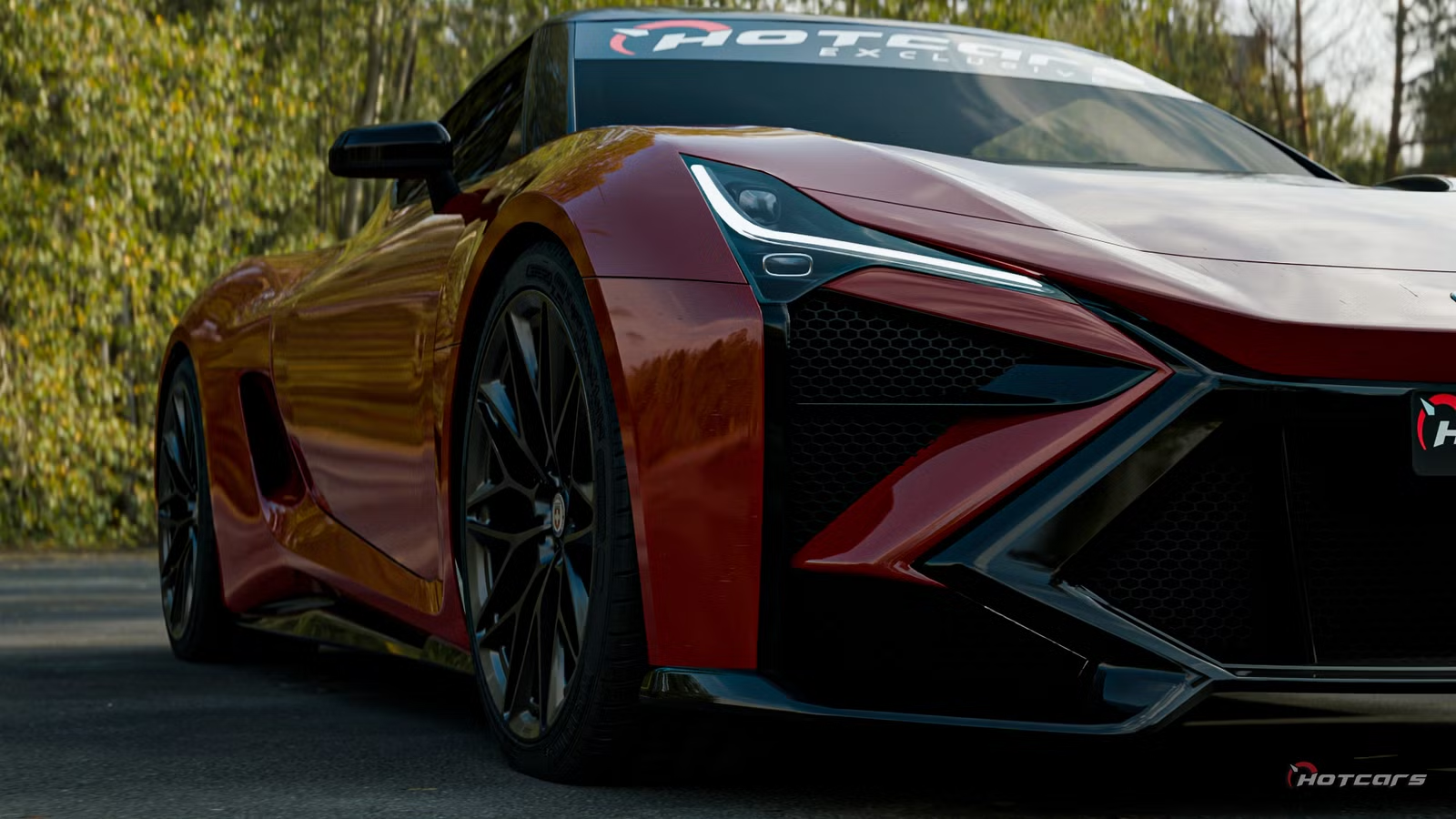
Ten numbered demands, a curb weight ceiling, a base price, and a poll to settle the argument—that is what the MR2 Owners Club posted to their forum. Three years on, Toyota has confirmed it is building the mid-engine car, and a prototype is already turning laps at Fuji Speedway.

The man running the program has since answered the list’s central request with what seems like a flat no. Grading all ten against what Toyota has actually built turns up four clean hits, and four refusals. Here’s what we know so far about the upcoming MR2.
10 Items In The MR2 Owners Club Wishlist
The MR2 Owners Club listed ten things it wanted from the next generation of Toyota’s compact mid-engine sports car. Top of the list is price—a mid-engine two-seater under $50,000 and preferably under $40,000, aimed squarely at the Mazda Miata, Ford Mustang, Volkswagen Golf GTI, and Subaru WRX. Outside of the 718 Cayman and Boxster, that bracket had gone empty.

The engine request is the GR Corolla’s 1.6-liter turbocharged three-cylinder, making 300 horsepower and 273 lb-ft. That choice comes with a pointed comparison attached, because the base 718 Cayman makes exactly 300 hp and starts just shy of $70,000.

The six-speed manual already built for that engine should carry over, with Toyota only needing to adapt it to a mid-engine layout. Rear-wheel drive should stay too, and the list concedes the GR Corolla’s all-wheel-drive system sends 60 percent of power rearward before arguing it still isn’t in the spirit of the badge.
A plug-in hybrid version gets its own entry, built around the RAV4 Prime’s system and its 302 hp combined output with roughly 40 miles of electric range. The same entry then admits a plug-in MR2 would likely be automatic-only, which quietly cancels the manual demanded two spots earlier.
Angular styling echoing the first three generations, bold paint, a convertible roof and the GR Corolla’s triple exhaust tips fill out the middle. The final and most emphatic request is that Toyota build the car itself, rather than borrow it from BMW or Subaru the way the Supra and 86 were borrowed. None of it was written with hard information from Toyota, because in July 2023 there wasn’t any. But there is now.
Toyota’s Mid-Engine Prototype Is Already Lapping Fuji Speedway
A black, camouflage-free prototype lapped Fuji Speedway on July 22, 2026, wearing vertical intakes ahead of the rear wheels and a deep hood vent that only makes sense with an engine behind the seats. The body sits far lower than the GR Yaris M Concept that served as its testbed, with a sloping rear screen and a swan-neck wing.
A roll cage, an air-jack spike and a racing-style fuel delivery system suggest a car being prepared to race rather than a road prototype. The exhaust note on the accompanying video is unmistakably a four-cylinder.

Gazoo Racing president Tomoya Takahashi confirmed that a new mid-engine sports car is in active development, with engineers working through the first of four major development phases. That sequence historically takes four to five years, which puts the earliest realistic arrival around 2030.
The engine is the G20E, a 2.0-liter turbocharged four developed as a joint motorsport and passenger-car unit. Toyota is targeting 394 hp and 369 lb-ft, with a road version detuned closer to 296 hp, and engineers say a bigger turbocharger takes it past 590 hp.
The G20E weighs under 330 pounds, takes up 10 percent less space than the 2.4-liter turbo it replaces and sits lower, which is what makes a mid-mount viable. Takahashi has confirmed the unit will be electrified, with the claimed efficiency gains likely applying only to the hybrid version.

A Toyota patent titled “Monocoque Vehicle Structure” describes a carbon fiber tub with a subframe housing both a battery and an engine, produced by resin transfer molding. GR MR2 was filed with the Japan Patent Office on November 25, 2025, followed by GR MR-S in Australia two days later and further filings across ten more countries.
Four Predictions The Owners Club Got Right

The G20E is Toyota’s own engine, the M Concept is Toyota’s own testbed, and there is no BMW or Subaru anywhere in the program. Item one asked for exactly that, and it is the cleanest hit on the whole list.
Mid-engine placement is confirmed, and Toyota picked it for the reason enthusiasts have always given. A front-engine layout piles load onto the front tires during braking, steering, and acceleration, which speeds up wear and produces understeer once the car reaches its limit.

GR Yaris front tires wore roughly three times as fast as the rears in circuit conditions. Akio Toyoda has described the moment understeer takes control away from a driver as the point where you start praying, and the midship layout was the team’s answer.
Takahashi has confirmed the G20E will be electrified, and Toyota’s patent for a tub with a dedicated battery subframe points the same way. Item six was the boldest call on the list, and the principle behind it landed.

The patented tub resembles Lotus and McLaren monocoques, which can be built as coupes or roadsters. Item three’s convertible survives the engineering even though the running prototype has a fixed roof.
Nothing has been confirmed about the transmission, so item eight sits open rather than dead. Toyota’s insistence on three pedals in the GR86, GR Corolla and Supra keeps it in play.
Four Requests Toyota Has Quietly Refused

Takahashi has said the 300 hp made by the 1.6-liter turbocharged three-cylinder in the GR Yaris and GR Corolla is not enough for a mid-engine car. That is item nine refused outright by the executive running the program.
The list called the same 300 hp enough power for serious fun without going overboard. Toyota is targeting 394 hp and 369 lb-ft from the G20E instead, and reserving up to 600 hp for motorsport.
Item nine wants the GR Corolla’s engine while item seven rejects the rear-biased all-wheel-drive system that engine comes attached to. The two requests are pulling against each other on the same page.

The M Concept runs a prop shaft forward from a rear-mounted transmission at a 30/70 default split, pushing further rearward than the GR Corolla does. Chief engineer Naohiko Saito’s team tried a 70/30 front bias first and found it produced excessive understeer.
The RAV4 Prime’s system is built around the A25A-FXS, an Atkinson-cycle 2.5-liter making around 176 hp on its own. It is tuned for efficiency, mounted transversely in family cars, and left with almost no headroom for more, which makes it the wrong tool for a mid-engine two-seater.
A 2026 GR Supra opens at $58,300, and reports estimate roughly $65,000 to $73,000 for the mid-engine car. The 2027 GR GT is expected above $225,000 through Lexus showrooms, and a carbon fiber monocoque takes sub-$40,000 out of the conversation entirely.
Nobody Is Building A Mid-Engine Car For MR2 Money Anymore

All-wheel drive is the right call, and item seven is the one place where the list defends a weakness rather than a virtue.
MR2 stands for mid-engine, rear-wheel-drive, two-seater, but the rear-drive half of that name built the snap-oversteer reputation. Toyota was already fighting it in period, widening the SW20’s staggered wheel and tire setup in 1993 specifically to calm the car down.
All-wheel drive keeps the low polar moment and the mass behind your shoulders that makes a midship car feel like nothing else on the road. What it removes is the failure mode that put SW20s into barriers.

The real loss is buried in the pricing. The list held up the base 718 Cayman — 300 hp, just shy of $70,000 — as the car a new MR2 should undercut, and current estimates put the mid-engine Toyota at $65,000 to $73,000.
Undercutting the Cayman was never the point of an MR2. The radical act was a mid-engine two-seater for $24,515, and nobody is building that car now.
Enthusiasts finally got Toyota to listen. The list they metaphorically handed over was aimed at a price bracket Toyota has already left.
Sources: Toyota, MR2 Owners Club

Related posts



Latest Post


No Comments