
The Cruiser With Honda Reliability And Big-Twin Character
Heavyweight cruiser riders once seemed forced to choose a side. One path offered the turnkey predictability associated with Japanese motorcycles: clean starts, tidy engineering, and ownership measured mostly in scheduled services. The other delivered the slow pulse, low-end shove, and mechanical theater of an American big twin — but sometimes with more patience required. Despite persistent demand for a heavy, big-twin cruiser in the U.S.A., the American brands could not offer the same level of reliability as some of the Japanese. This, however, has changed over the past few years.
The Great Cruiser Dilemma: Mechanical Soul Vs Japanese Precision
Why Honda Became The Benchmark For “Metric Reliability”

Honda built its reputation with motorcycles that started when asked, held their fluids, tolerated daily use, and generally turned maintenance into a predictable calendar item. That expectation eventually became attached to Japanese motorcycles as a group. There is historical data behind the stereotype. In a Consumer Reports survey covering more than 12,000 motorcycles from the 2008–2014 model years, Yamaha, Suzuki, Honda, and Kawasaki occupied the most reliable group. Honda’s estimated four-year failure rate was 12 percent, while Harley-Davidson’s was 26 percent.
The survey is old and cannot be used today, but it helps explain why American riders still use “Honda reliability” as shorthand for low-drama ownership. That turnkey predictability changed expectations. A heavyweight cruiser could no longer excuse poor starting, rough fueling, or repeated workshop visits simply because it looked good. Riders wanted character, but they also wanted to press the starter on Sunday without negotiating with the machine first.
American Riders Still Vouch For A Big Twin

Reliability, however, is only one reason people become attached to motorcycles. A traditional 45-degree V-twin offers sensations that a perfectly smooth engine can struggle to reproduce: the uneven cadence at idle, the pulse through the chassis, and the immediate shove created by a heavy crank and abundant torque. That explains why Harley owner satisfaction has historically remained strong even when older reliability surveys placed the brand behind Japanese manufacturers.

In the same Consumer Reports research, 72 percent of Harley-Davidson owners said they would buy the same brand again, slightly ahead of Honda’s 70 percent. Mechanical emotion mattered enough that many riders accepted compromises to keep it. The question isn’t whether riders want both — it’s whether any manufacturer has actually delivered it. The answer, surprisingly, may have been sitting in Harley’s lineup all along.
How A Fat Boy In 2026 Actually Rides Compared To The Old Reputation
What $22,599 Buys: A Fully Equipped Cruiser That No Longer Asks For Patience

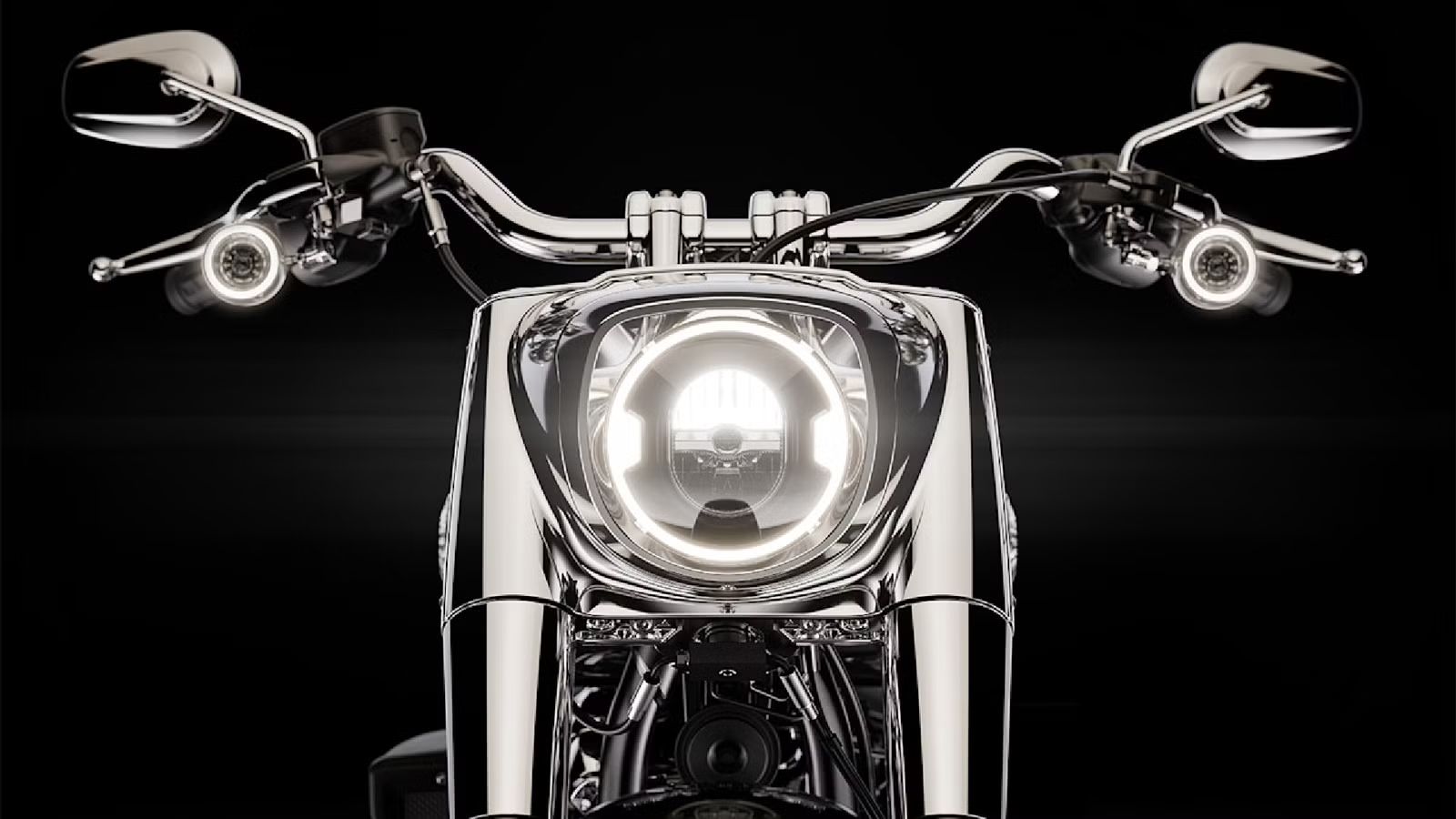
The 2026 Harley-Davidson Fat Boy starts at $22,599 in the United States. Its current specification is built around the 117-cubic-inch Milwaukee-Eight Custom V-twin, rated at 103 horsepower and 126 pound-feet of torque. It also comes with a six-speed transmission, belt final drive, a five-gallon fuel tank, cruise control, LED lighting, selectable ride modes, and a full package of cornering-aware rider aids.
Calling it a Harley with “Honda reliability” is not a statistical claim that both brands have identical failure rates; no current model-specific dataset proves that. It describes how far the experience has moved. Modern injection, self-adjusting hydraulic lifters, improved cooling, and mature engine management make the Fat Boy far more turnkey than the old stereotype suggests.
Breaking Legacy Stereotypes Through Modern Manufacturing

The present Fat Boy is not an old Softail wearing new paint. Its underlying platform arrived through Harley-Davidson’s largest product-development program at the time. The redesigned frame used fewer components and welds, was claimed to be 65 percent stiffer than the previous Softail frame, and contributed to motorcycles up to 35 pounds lighter than their predecessors.
The engine was rigid-mounted, while internal balancing controlled unwanted vibration. That engineering shift is evident in the controls. Reviews describe the throttle, clutch, and shifter as refined and precise while retaining a substantial Harley feel, with convincing fit and finish from the first mile.
Milwaukee-Eight Muscle Meets Bulletproof Engineering
Big-Twin Soul: Torque, Sound, And Counter-Balanced Grunt

All of that engineering discipline would mean nothing if the engine lost what makes a Harley a Harley — so here’s what the Milwaukee-Eight 117 Custom actually delivers when the throttle opens. The Fat Boy’s 1,923cc Milwaukee-Eight 117 Custom produces its peak 126 pound-feet at just 3,000 rpm, with 103 horsepower arriving at 4,800 rpm. Those numbers tell only part of the story. The engine is designed to pull hard without demanding high revs, so normal riding becomes a sequence of short shifts and muscular roll-ons rather than frantic trips toward the redline.
Dual internal counter-balancers suppress the harsh shaking that could make a rigid-mounted 45-degree twin tiring without erasing its cadence. The rider still gets a low-frequency pulse, intake throb, and two-into-two exhaust note. Harley describes the system as reducing vibration while retaining the familiar feel and sound.
Engineered For Longevity: Thermal Efficiency And Precision Tolerances

The current 117 Custom is air/oil-cooled rather than conventionally liquid-cooled. Oil circulates through passages around the cylinder-head hot spots and through a frame-mounted cooler, helping manage exhaust valve area temperatures without adding a full coolant system. The engine also uses Electronic Sequential Port Fuel Injection, four valves per cylinder, electronic temperature management, and redesigned combustion chambers and intake ports.
Hydraulic lifters automatically compensate for expansion and valvetrain wear, eliminating routine valve-clearance adjustment. That does not make the engine neglect-proof — oil quality, belt condition, tires, brakes, and scheduled service still matter — but it reduces one familiar piece of long-term maintenance overhead. Heat has not disappeared; this remains a huge air/oil-cooled engine. Still, rear-cylinder management, precise injection, and improved oil cooling make summer traffic less dramatic than old big-twin folklore suggests. Its broad torque also means freeway speed rarely requires hard work.
Steamroller Looks, Hidden Technology, And The Electronics No One Expects On A Fat Boy
Lakester Wheels And Substantial Footprint

The Fat Boy’s visual identity begins with its machined Lakester cast-aluminum wheels and unusually broad Michelin Scorcher 11 tires: a 160/60R18 front and 240/40R18 rear. The front is wider than the rear tires fitted to some middleweight motorcycles. Together they produce the low, squared-off stance that makes the Fat Boy recognizable from half a block away.
That rubber creates stability and presence, not sport bike agility. The Fat Boy requires deliberate steering input, and its 25.6-degree lean-angle limit means the floorboards eventually announce when enthusiasm has exceeded the chassis’ intended mission. Still, modern tire construction and the rigid Softail frame are meant to prevent it from feeling like a loose collection of chrome parts.
Modern Softail Architecture: Vintage Looks, Contemporary Handling

The hidden rear mono-shock is the trick beneath the classic silhouette. Harley preserved the visual line of a rigid-frame custom while giving the rider real suspension movement, hydraulic preload adjustment, and a far more controlled relationship between the rear wheel and chassis. Up front, a 49mm dual-bending-valve fork manages the Fat Boy’s considerable mass. As a result, comfort is cruiser-specific rather than touring-bike plush. The 25.9-inch laden seat, broad handlebar, and floorboards create a relaxed posture, but there is no windscreen and rear travel is modest at 3.4 inches.
Cornering ABS And Drag-Torque Control Hidden Beneath The Chrome And Analog Speedometer

Under the chrome and analog speedometer sits more electronic protection than the styling suggests. Standard systems include cornering ABS, cornering traction control, drag-torque slip control, tire-pressure monitoring, and selectable ride modes. Full LED lighting improves visibility, while cruise control reduces wrist fatigue when the road straightens. The five-gallon tank and Harley’s estimated 47 mpg produce a theoretical range of roughly 235 miles. Real conditions, speed, load, and reserve strategy will reduce that figure, but 200-mile interstate legs are realistic for many riders.
To sum up, the modern Harley-Davidson Fat Boy fits the title. It does not imitate a Honda. It preserves the weight, pulse, sound, and visual excess that make an American big twin desirable. What has changed is the surrounding experience: cleaner fueling, mature engine management, reduced maintenance complexity, a rigid chassis, meaningful safety technology, and everyday starting confidence. It is Harley character with far less of the old uncertainty.
Source: Harley-Davidson

Related posts

Latest Post


No Comments