
The Cruiser That Could Make Harley Loyalists Rethink Their Next Bike
Harley-Davidson is quintessentially the definition of the American V-twin cruiser, and over a century of manufacturing experience offers an advantage that goes well beyond the badge recognition. Riders buy into an identity, to become a part of the brand’s legacy, as well as to live the V-twin cruising experience. So convincing one of those buyers to look elsewhere takes a rival that understands the same priorities.

The challenge has become harder as Harley’s own cruisers have grown more capable and diverse. Riders can now get genuinely strong chassis hardware, useful touring equipment, and substantial performance without stepping up to a heavyweight bagger. There’s only one manufacturer with just as much history behind it to follow that same logic, albeit packaging it differently enough to make the comparison uncomfortable for the Milwaukee loyalists.
Today’s Performance Cruisers Have To Do More Than Accelerate Hard
The cruiser segment has changed considerably from the days when a big engine and aggressive stance were enough to earn the performance-cruiser label. With the wide variety of options on offer, a distinct sub-genre has come up where the cruiser buyer wants a dollop of performance without having to give up on their leather jackets and denims in exchange for knee sliders. This distinct niche of cruiser buyers now expects stronger brakes, better-controlled suspension, and enough comfort to spend several hours in the saddle.


Again, Harley-Davidson has been central to this shift in taste and category of cruisers. The Low Rider S sharpened the traditional Softail formula with more serious chassis hardware and increasingly potent Milwaukee-Eight engines, while the Low Rider ST added a frame-mounted fairing and hard luggage without losing the compact proportions that established the platform.

This is a combination that creates a useful middle ground between a stripped cruiser and a 900-plus-pound distance-touring bagger. Riders still get the low seat stance, punchy V-twin performance, and muscular proportions they expect, but with enough wind protection and luggage capacity to make longer trips realistic, while keeping things manageable for urban use at the same time.

It also raises the standard for any challenger. Matching Harley’s displacement or torque output is only part of the job. A serious alternative now has to deliver comparable chassis control, touring usefulness, comfort, and factory integration while still feeling like an American V-twin cruiser rather than a touring bike wearing less bodywork. And Indian Motorcycle is the only rival that can rise to the occasion to answer with an equally traditional outlook mixed with a performance twist.
The 2026 Indian Sport Chief RT Is The Most Complete Sport Chief Yet

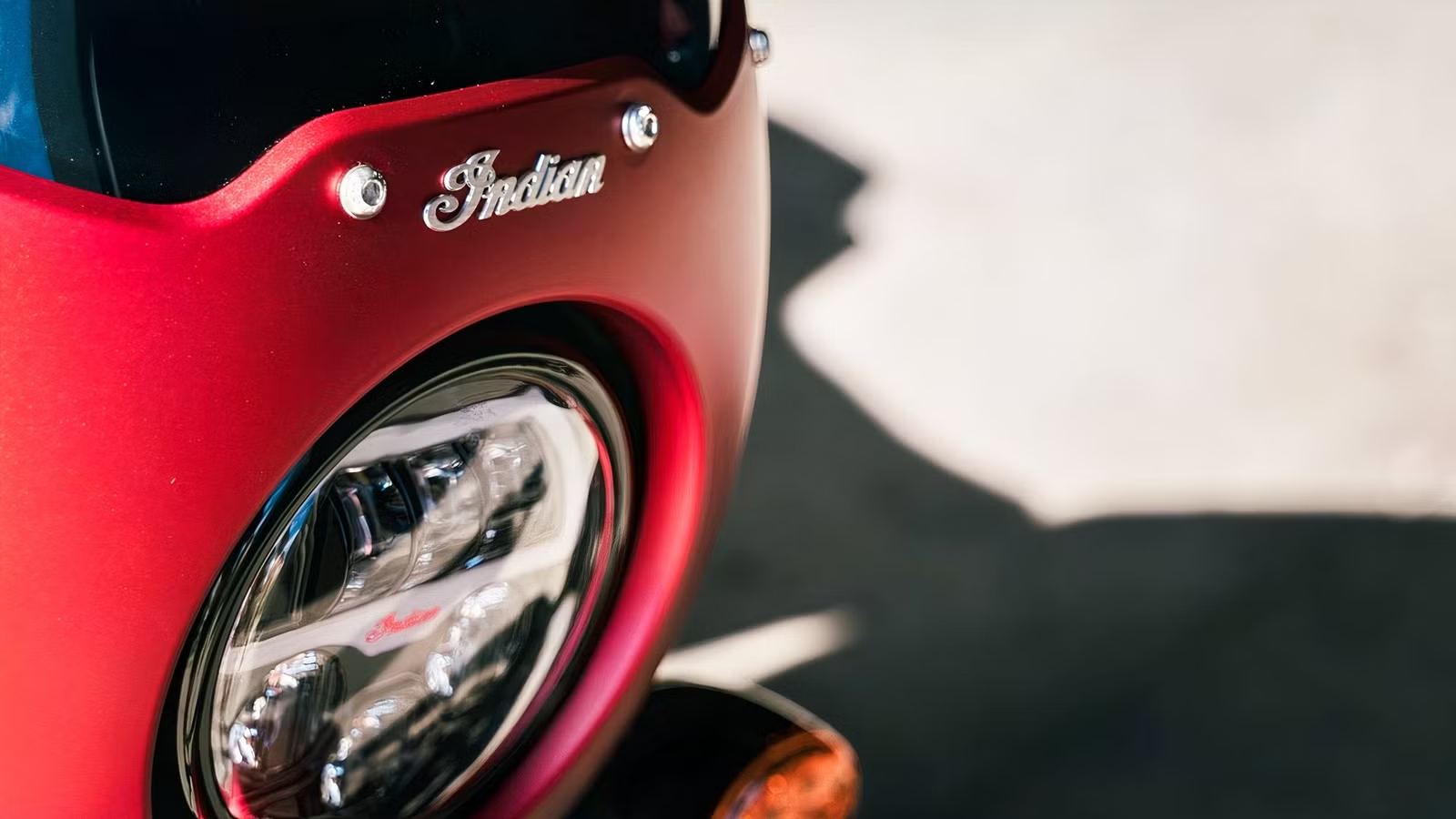
The Indian Sport Chief RT is the touring-oriented evolution of the Chief family’s performance model. Indian introduced the Sport Chief in 2023 by giving its compact Chief platform more serious suspension, brakes, and club-style ergonomics. In 2025, the RT carried that idea further with factory luggage, passenger accommodation, and audio inclusions. For 2026, it remains the version aimed at riders who want the Sport Chief’s performance bias without having to build its touring capability through bulkier accessories.
The Thunderstroke 116 Keeps The Traditional V-Twin Character Intact

Indian hasn’t simply chased Harley by abandoning the old-school formula entirely. The 1,890cc Thunderstroke 116 remains an air-cooled, pushrod V-twin, producing 120 pound-feet of torque at just 2,900 rpm. It transfers that power through a six-speed transmission and belt final drive, so the fundamentals will feel reassuringly familiar to somebody accustomed to a similar Harley. What changes the experience is the influence of the electronics underneath.

Three ride modes, Sport, Standard, and Tour, alter throttle response without fundamentally changing that lazy, large-capacity V-twin character. But thoughtful engineering touches like rear-cylinder deactivation help manage heat from an air-cooled engine when stationary. The electronic assistance remains relatively discreet while adding features that the modern rider appreciates. Cruise control, anti-lock braking, keyless ignition, full LED lighting, and USB-enabled 12-volt charging are standard.
Some Serious Hardware Lies Under The Traditional Bodywork

The Sport Chief RT’s chassis specification goes considerably beyond cruiser convention. A 43mm inverted KYB fork provides 5.1 inches of travel, while the rear uses Fox piggyback shocks with 4.0 inches of travel and 23-click adjustment. Braking hardware boasts twin 320mm semi-floating front rotors, which are grabbed by four-piston Brembo calipers, with a 298mm disc at the rear.

Metzeler Cruisetec tires wrap a 19-inch front and 16-inch rear wheel combination, and they all tie together to make the Sport Chief RT relatively agile for a cruiser. Indian quoting 32 degrees of lean angle is another hint of the RT’s positioning, giving riders considerably more room to use that chassis before the hard parts begin scraping the pavement. It’s still a 714-pound cruiser, of course, but it does afford ample engine and chassis control to let riders use the performance.
The Sport Chief RT’s Touring Equipment Makes The Bigger Difference

The regular Sport Chief already provides essentially the same silhouette and core performance package for $19,999. The RT’s $22,499 step-up pays for the equipment that makes the concept considerably easier to live with. Its color-matched locking hard saddlebags provide 10 gallons of storage, while the two-up high-bolster seat adds proper passenger accommodation and gives the rider more support under acceleration. The quarter fairing, despite being primarily stylistic, still effectively deflects wind blast from the rider.

The 2026 Indian Sport Chief RT uses a 4-inch circular touchscreen TFT display.
There’s also a definitive equipment gap beside the Low Rider ST. Indian’s four-inch Ride Command touchscreen brings integrated GPS navigation, Bluetooth connectivity, ride data, and connected functions, while Harley’s similarly sized display remains an analog speedometer with a digital information screen. The broader standard-equipment advantage is what makes the RT more than a dressed-up Sport Chief. It also puts the Indian directly against the Low Rider ST on value, which is where the comparison becomes especially interesting.
The Low Rider ST Shows Where Indian Has Found A New Customer Base

Milwaukee has strengthened the 2026 Harley-Davidson Low Rider ST considerably. Power comes from the High Output variant of the Milwaukee-Eight 117, which produces 114 horsepower and 128 pound-feet of torque, giving the Harley a clear output advantage. And both weigh virtually the same in running order, with the Harley at 712 pounds and the Indian at 714.
Harley also equips the Low Rider ST with a larger 5-gallon fuel tank against the Indian’s 4 gallons and 15 gallons of luggage capacity, alongside similar 31.3 degrees of lean angle. Its $23,999 starting MSRP is $1,500 higher; however, the Indian includes its touchscreen navigation and 90-watt audio system as standard—both missing on the Harley and unavailable even as options.

That makes the Sport Chief RT interesting for a very specific reason. It doesn’t ask a Harley rider to give up the air-cooled pushrod V-twin experience, or the sporty-muscular proportions of a performance cruiser, or even the core traditional American-cruiser experience they already like. It simply approaches the same performance-touring specifics with better-integrated infotainment, premium chassis hardware, and a lower starting price — just about the right things to attract a buyer away from a similarly specced bike. Brand loyalty may still decide the eventual purchase, but the motorcycle itself now gives riders a genuine reason to question the decision.
Source: Indian Motorcycle

Related posts


Latest Post


No Comments