
The Cruiser Harley Loyalists Quietly Switch To After 50,000 Miles
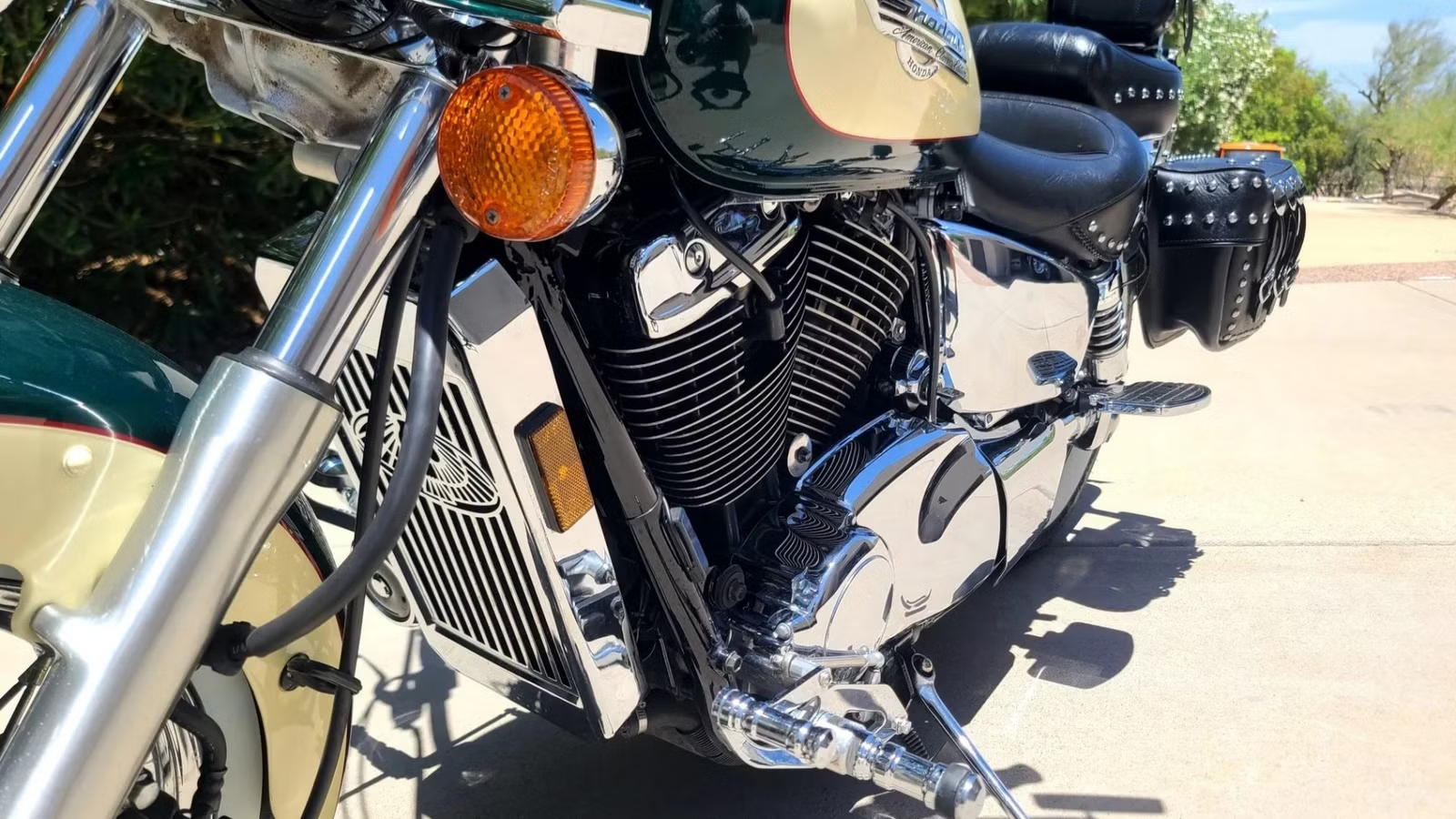
There is a quiet conversation that happens in cruiser circles, usually around the time an odometer rolls past 50,000 miles. Riders who have spent years swearing allegiance to one brand start asking questions — not loudly, not publicly, but honestly. And more often than not, those questions lead them to a Honda with a V-twin, a shaft drive, and a rumble that feels more familiar than it has any right to. The Honda Shadow ACE 1100 has been pulling Harley loyalists into its orbit for decades, and the reasons why are worth understanding.

The cruiser owner is a loyalist. You will not find owners as loyal to brands in other segments — for example, with basic motorcycles — because in that segment value takes priority over all else. But with a big cruiser, the brand matters, the experience matters, and definitely the brotherhood matters. Cruisers are also near-luxury items, and with the financial freedom that a big profit margin allows, it is possible for manufacturers to create products that are quite different from those of other brands — which is another reason cruiser owners tend to stick to a particular marque.
Why Harley Loyalists Remain Loyal To The Brand
Harley-Davidson’s products generate a cult following. The owners are a tightly-knit group. You don’t just purchase a motorcycle — you’re buying into a lifestyle. Harley is one of the pioneers of the ‘merchandise movement’, meaning it profits greatly from branded gear and apparel as well. As a Harley rider, you are buying into experiences rather than just a motorcycle. That is not something you can easily get with other brands, although many are now trying to replicate Harley-Davidson’s success in this area. Still, it isn’t easy to replicate the heritage Harley has — over a century of continuous production and products distinctive even by their sound alone. It is little wonder that Harley-Davidson commands the cult following it does.
The Roots Matter, As Do The Vibes


Of course, none of this would hold up if the products themselves weren’t good. And Harley-Davidsons, for all that those who dislike them have to say, are good products. Motorcycles are about emotion, not just numbers on a spec sheet. And somehow, Harley-Davidson manages to evoke all the right emotions when you swing your leg over one. They might be slow, carry antiquated technology relative to sport bikes, and come with high maintenance costs — but the emotions they evoke are so strong that owners are willing to overlook those drawbacks far more readily than riders of other brands would. That is why competitors try to replicate Harley’s success by mimicking the products, but don’t always manage to capture the formula.
The Honda Shadow Ace 1100 Was Never A Direct Competitor – Or So We Thought

The Shadow series was designed to be Honda’s answer to Harley-Davidson’s lineup, but Honda’s obsession with smoothness and usability meant the Shadow, more often than not, lacked the soul present in Harley-Davidsons. With the Shadow Ace 1100, Honda took a slightly different tack and more closely mimicked full-size Harley-Davidsons. This set up an interesting problem for the Harley loyalist, because here was a Honda that suddenly had a lot of the same feel as a Harley-Davidson — but with Honda’s well-known strengths, like reliability.
It Has Its Own Reasons For Being A Cult Motorcycle

The Shadow clearly drew inspiration from Harley-Davidson, but the Ace 1100 had a number of differences that made it stand out from the Harleys of its era. For one, it was considerably cheaper, retailing for under $10,000 new when equivalent Harleys cost at least $2,000 more. Then there was the liquid-cooled engine and shaft drive. Together, these meant more consistent performance — especially on long rides. The enclosed shaft drive required no real maintenance beyond periodic oil changes, which could be handled at home with some transmission oil and the right tools. Honda didn’t skimp on quality either: the two-tone paint job looked sharp, there was generous chrome work, spoke wheels, and well-proportioned fenders that appealed to the traditional cruiser aficionado.
The Shadow’s V-Twin Marches To A Different Drummer But Has A Similar Soundtrack

The Shadow is powered by a V-twin engine, but the Shadow 1100 is the most interesting variant. Traditional Shadows have always had two different crank journals, one for each connecting rod. This was done so that the cylinders’ firing order was 90 degrees apart, giving the engine a much smoother feel than a Harley-Davidson. However, cruiser riders did not warm to the anodyne character that this refinement produced. And so for the ACE — the American Classic Edition — Honda changed to a single crank journal, much the same arrangement that Harley-Davidsons use for their connecting rods.
This Honda engine displaces 1,099cc from two cylinders arranged in a 45-degree V, with a relatively relaxed compression ratio of 8.5:1. It is fed through two 36mm Keihin carburetors and produced 52.3 horsepower at 5,500 RPM and 67 pound-feet of torque at 2,700 RPM when new. Power is sent through a five-speed transmission and an enclosed shaft drive to the rear wheel. Power figures vary across the Shadow range — even among models with similar displacement — because some used the single-pin crank while others retained the dual-pin unit.
While it echoed the Harley-Davidson engines of the time (both the Twin Cam and Evolution units were air-cooled), the Shadow’s engine was liquid-cooled despite its traditional appearance — which meant more consistent performance across conditions. Better thermal management translates directly to less wear over time, and the Shadow’s longevity reflects that.
The Performance Is Better Than The Spec Sheet Conveys

A shade over 50 horsepower and under 70 pound-feet don’t make for eye-catching figures on paper, but in the real world the Shadow delivered perfectly adequate performance. Look at the RPM at which peak torque arrives and it becomes clear: this engine was built around usable, accessible grunt. All you had to do was roll on the throttle and the Shadow responded willingly. With peak torque arriving so low in the rev range, you rarely needed to work the gearbox hard. In top gear, the Shadow 1100 would cruise comfortably at 70 mph all day without feeling strained. Other versions of the VT1100 produce more power due to their different engine configurations.
Conventional Chassis, But The Handling Is Enjoyable

Honda kept the Shadow simple because nothing more was required. It uses a traditional double-cradle steel frame with 41mm telescopic forks and twin rear shocks with preload adjustment. Wheel travel is a respectable 5.9 inches at the front and 3.9 inches at the rear.
The ACE rolls on an 18-inch front wheel and a 15-inch rear, both fitted with spoked rims. The one area where the Shadow could have used improvement is braking: the front gets a single 316mm disc with a two-piston floating caliper, while the rear relies on a 276mm disc with a single-piston caliper — adequate, but not the setup’s strongest suit.
The Dimensions Make It Easier To Manage Than Harleys
The Shadow is not a light motorcycle, tipping the scales at 620 pounds. But Honda engineered it to keep that mass centered and low — a philosophy you also see in the smaller Honda Shadow 750. It looks like a big bike to look at, but feels like a smaller one to ride. The seat height of 28.7 inches makes it accessible even to shorter riders, and Honda paid attention to handlebar reach and seat width as well. This is something Shadow riders consistently comment on: at low speeds, the ACE 1100 feels noticeably more nimble than a comparable Harley.
Why Harley Loyalists Respect The Shadow Ace 1100

Honda may not have the brand mystique or the fiercely loyal following that Harley-Davidson commands. But it has earned genuine respect from Harley riders through one simple virtue: the ability to cover an impossible number of miles without complaint. Fifty thousand miles is not much for a Honda Shadow. Features like the shaft drive make high-mileage ownership genuinely easy, even for riders who prefer to do their own maintenance at home.
Where The Shadow Gets Better After 50,000 Miles

There is a fundamental difference between the Twin Cam and Evolution engines Harley used during this era and the Shadow’s V-twin: liquid cooling. The importance of this goes beyond consistent performance. Managing engine temperature also means managing thermal expansion — liquid-cooled engines don’t overheat, and they don’t heat unevenly across different areas of the block. The result is less wear over the long haul, and the Shadow’s reputation for longevity is a direct consequence.

Add to that the enclosed shaft drive, which demands only a bare minimum of mechanical knowledge and the correct oil. At 50,000 miles on a Harley, you are looking at at least one belt replacement — a job that requires expertise and care. Getting the belt off, fitting the new one, and tensioning it correctly is not something a first-timer can do easily.
Finally, because the Shadow is known to be a reliable motorcycle, a healthy number of them are still on the road. That means there are plenty of sources for spares when you need them. So if you intend to keep your American-style cruiser beyond 50,000 miles, buying Japanese makes a compelling case — something high-mileage Harley owners have quietly come to appreciate through experience. We’re not saying Harleys can’t go the distance; plenty will hit 100,000 miles without major work. It’s just that getting there is easier with a Shadow.
Can The Shadow Be Improved?

The answer is yes. The Shadow Ace was in production for only a few years during the latter half of the 1990s, but owners have put serious miles on these bikes. Little wonder, then, that the aftermarket has solutions for virtually every shortcoming. Two common complaints are rear ride quality and braking performance. Aftermarket shock absorbers from several suppliers address the first issue directly — they can be tuned to your weight and riding style, though don’t expect dramatically more travel given the constraints of the driveshaft layout.
The brakes respond well to better pads. Sintered pads up front paired with a braided steel line improve both feel and stopping power, according to owners. And if you plan to spend long hours in the saddle, a seat upgrade is well worth considering. For multi-day touring, there is a dedicated touring version of the Shadow Ace worth seeking out — though that variant uses the dual-pin crankshaft common to the rest of the Shadow range.
The Honda Shadow ACE 1100 Is Affordable, Too

When new, the Shadow ACE 1100 wasn’t exactly cheap — it was simply around $2,000 less than an equivalent Harley of its time. But as an older metric cruiser, the Honda Shadow Ace 1100 has depreciated into a remarkable bargain on the used market. Values vary by condition and model year, but well-maintained examples can be found at prices that represent strong value compared to any current big twin. Even excellent-condition late-production models typically trade for significantly less than a new entry-level Harley-Davidson — or even a new Shadow Phantom, when Honda was still offering one.
Of course, listed values are just a starting point. You may need to negotiate with a seller, or you might get lucky and find a clean example for less than the going rate. Either way, the price-to-experience ratio is difficult to argue with.
The Shadow Ace 1100 Can Only Be Had Used Now – But That’s Okay

The last new Shadow Ace 1100 probably rolled out of a Honda showroom in the early 2000s. But even though any example you find today will be well over two decades old, the age of the Honda Shadow Ace 1100 is not a deal-breaker. It was engineered to be a low-stress, high-mileage motorcycle from the outset, so a well-kept example at a fair price is absolutely worth buying.
A fair price for an older Japanese cruiser does not mean the same thing as a fair price for an American cruiser, because the latter tend to hold their value much better — thanks to nostalgia, and the fact that keeping one in good condition requires considerably more time and money. Japanese cruisers are simply easier and cheaper to maintain at high mileage. The Shadow Ace 1100 offers the best of both worlds: the feel and offbeat rumble of an American-style V-twin, backed by the durability of Japanese engineering.
Source: Honda PowerSports, Honda Global, J.D. Power

Related posts
Latest Post


No Comments