
The Craziest And Funniest Automotive Lawsuits
Lawsuits are part and parcel of any kind of corporate activity anywhere. That’s certainly the case when it comes to the car industry. There have been so many automotive-themed lawsuits that you can do a serious deep dive into the whole thing. What we’ve decided to focus on here are the ones that are absolutely crazy. That could be because of why the lawsuits were initiated, who the lawsuits were happening between, or what the outcome of the lawsuits was.

As you look further down this list, you might see a bit of an over-representation of a certain Italian brand. It’s no secret that Ferrari loves to be a little litigious, almost to the point of it being a running joke among gearheads. But it’s far from the only brand that’s engaged in some crazy lawsuits. In fact, some of its lawsuits are fairly small fry compared to what some of the other brands on here have gone up against!
10
Audi vs Auto China
The lawsuit between the legendary German brand Audi and the German specialist import firm Auto China is one of the most recent automotive lawsuits. In fact, it’s so recent, the suit actually hasn’t been resolved yet! But it is worth talking about right now, because it has very strange origins. It started in a joint venture Audi has with Chinese mega-manufacturer SAIC, where they developed and manufacture luxurious electric cars for the Chinese market. These are branded as “AUDI”, and don’t have the famous Audi roundels on them.

The problems with Auto China started when it decided to import these “AUDI” models into Europe. Audi wasn’t happy with this, and for very good reason. The arrangement it had with SAIC over these cars was for the Chinese market only. It doesn’t want them to be sold elsewhere at all. So, as reported in the German media, Audi decided to press charges against Auto China.

It does seem wild on the surface that Audi is suing over something to do with an offshoot of its own operations. But, when you consider that these cars would be directly competing with Audi’s European-market models (and potentially at much cheaper prices), Audi’s feelings on it are completely understandable.
9
Ferrari vs Deadmau5

Ferrari appears so much on this list that it could have its own article dedicated to how litigious it is. The case between Ferrari and superstar DJ and music producer Deadmau5 (real name Joel Zimmerman) has to be one of the most well-known lawsuits it’s engaged in. A lot of that is due to frankly how crazy it is. After buying a brand-new Ferrari 458 Italia, Zimmerman decided to give it some distinctive customization that paid homage to internet culture. That homage was to the Nyan Cat meme. Not only did the car (which he now called the “Purrari”) have a Nyan Cat-themed wrap, but other visual parts of the car were Nyan-ified. This included the badges, and that’s where Ferrari started to get upset. Ferrari’s badges are legally trademarked, and Ferrari does have the legal right to object over somebody modifying the design without permission. So, Zimmerman was sued.
As you might expect, Zimmerman got very upset with this. He actually got so annoyed that, after a settlement was reached where he agreed to take the customisation off the car, he sold it as soon as that process was done and swore off Ferrari forever. He had actually already listed the car for sale in its Nyan-ified state, breaking another Ferrari no-no as he’d only owned the car for less than a year. He transferred the Nyan Cat aesthetic over to the “Purracan”, a Lamborghini Huracan that he bought as the Ferrari’s replacement. Unlike Ferrari, Lamborghini didn’t mind what Zimmerman did to his Huracan at all.
8
Ferrari vs Mansory
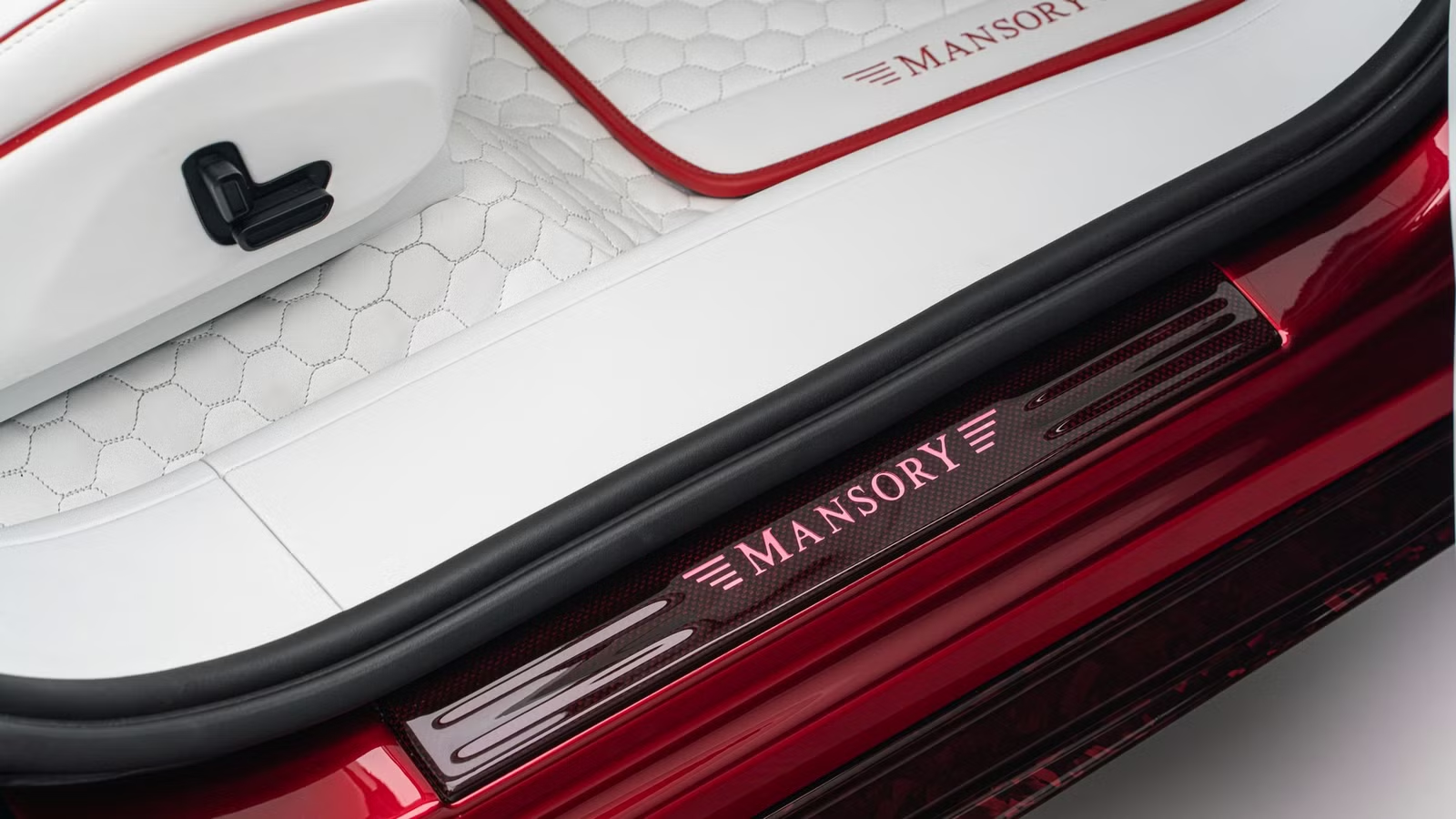
Another case of Ferrari getting angry over mods that weren’t to its taste is the lawsuit it filed against the controversial German tuner Mansory. This is a striking conversion of the Ferrari 488, available in coupe or spider form. It has performance upgrades for the twin-turbocharged V8, uprated suspension and some new aerodynamic components. This includes a rear diffuser that’s very similar to the one you’d find on the track-only Ferrari FXX K. As a result, Ferrari sued Mansory for copying the FXX K’s rear diffuser, claiming that it’s a patented design that Mansory should have asked permission for. Ferrari won the case, and it actually caused some changes in how much European tuner firms are allowed to modify cars as a result.

Those issues don’t seem to have ruined things between Ferrari and Mansory too much, though. It later created the Pugnator, an ultra-exclusive conversion based on the Purosangue SUV (we’ll be talking about that car again a bit later) that was limited to 7 units worldwide. Of course, whether you like the Pugnator or not is entirely down to personal taste. But nobody can deny that it looks striking!
7
Ferrari vs Jean Beurlys
The third in a series of “Ferrari getting angry about unauthorized mods”, this one involves billionaire Jean Blaton (known in the racing world as Jean Beurlys) and a special version of the Ferrari F40 he created for himself. Known as the Ferrari F40 LM Barchetta, this was a more substantial reworking of the basic F40 design than just lopping the roof off and fitting a roll cage. For a start, Beurlys based this car on an example of the super-rare F40 LM race car that was built for IMSA. As well as the aforementioned modifications, Beurlys had the suspension changed to a setup that included pushrod coilovers and shortened the exhaust system so it exited just ahead of the rear wheels.
The result of those changes added up to such a significant difference to the standard F40 (or even the standard F40 LM) that Ferrari hit Beurlys with a lawsuit. Maranello demanded that Beurlys take all the Ferrari badging off the car, and banned him from taking it to official Ferrari track days. Beurlys actually wasn’t that bothered about this. He decided to comply with Ferrari’s requests to take the badging off, and decided to just enjoy it himself anyway. He ended up selling the car some years later, and its current owner still makes sure it gets to stretch its legs.
6
Ford vs John Cena

Deadmau5 isn’t the only public figure to come under fire from an automaker on this list for doing something they weren’t supposed to. In one of the few cases like this that doesn’t come from Ferrari, Ford sued actor, former professional wrestler and well-known gearhead John Cena over him flipping his 2017 Ford GT for a profit. Why? Because he contractually wasn’t allowed to do that. When he purchased the car, the purchase agreement stated that he had to keep hold of the car for at least 24 months. But, he had sold it well before that time was up.

After a lot of legal to-ing and fro-ing (which included Ford suing the dealership that re-sold the car, as well as Big Match John himself) Ford and Cena eventually came to a settlement. This included a statement Jalopnik obtained from his legal team, where Cena himself apologized for everything. Cena paid Ford an undisclosed amount of money, Ford donated that money to a charity of its choice, and the whole affair was never mentioned again.
5
Ferrari vs Phillipp Plein
This example is yet another one of Ferrari being incredibly litigious over what a celebrity has done with their cars. But, instead of modifying them in a way that Ferrari doesn’t find tasteful, instead Ferrari was mad about how its cars were used in a way that they deemed wasn’t tasteful. Controversial German fashion designer Phillipp Plein is a huge Ferrari fan. He frequently shows off his Ferraris on his personal social media. He has also, in some instances, used his Ferraris to help promote his brand and its products. This is where Ferrari took umbrage with Plein. Plein was posting images of his Ferraris with his own brand’s sneakers on top of them. He also posted promotional shots that involved scantily-clad women posing with those Ferraris. Ferrari used this to argue that he was using Ferrari’s cars for promotional use, and in a way that was “totally inconsistent with its brand perception” (according to Ferrari’s own legal counsel at the time). Ferrari ended up winning the case, and Plein had to pay €300,000 (around $340,070) in damages and €25,000 (around $28,339) in legal fees.
Even after all of this, Plein seems to remain a dedicated Ferrari enthusiast. He utterly refuses to stop using his Ferraris as part of both his personal image and his brand’s image. He’s even kept buying brand-new Ferrari models, despite all the legal trouble Maranello’s given him. Clearly, his love of the prancing horse transcends all, and he’s got absolutely no shame in acting in the way he does with his Ferraris. It’s that, perhaps, that makes Ferrari’s lawsuit against him so silly. If he can’t feel ashamed over the whole thing, any attempts Ferrari makes to legally stop him end up being fruitless.
4
Ferrari vs Miami Vice
The TV show Miami Vice was an absolute hit in the 1980s. That hit status is something that ended up causing some problems once Ferrari knew about it. That’s because Crockett’s black Ferrari Daytona wasn’t actually a Ferrari at all. It was a replica that just looked like one, and that included using Ferrari badges. Of course, Ferrari filed a lawsuit, and it won. As part of the terms of the settlement, the replica had to be shown being destroyed on screen. This is something that the production company were happy to oblige, creating an iconic scene in the process!

Miami Vice had no more problems with Ferrari after the suit was settled. It even continued on having a Ferrari as a star of the show – this time, it was a white Testarossa. All of that just came at the expense of the original black Daytona replica.
3
Ferrari vs The Purosangue Foundation

The following case we’re about to talk about is one that even some of Ferrari’s most ardent followers might struggle to defend. To secure the name “Purosangue” for its first-ever SUV, Ferrari ended up suing a non-profit that works against doping in sports. The Purosangue Foundation had registered “purosangue” as a trademark for use on clothing and merchandise all the way back in 2013, and that trademark applied in Europe. When Ferrari applied to trademark that name for itself, the non-profit blocked the application from happening. So, Ferrari did what Ferrari does, and went for the legal option.

As you’ll have no doubt gathered considering what the SUV is called, Ferrari won its legal case against the Purosangue Foundation. But, the fact that they sued a non-profit that was actively using the “purosangue” trademark both for itself and in collaboration with commercial brands like Adidas really did leave a sour taste in people’s mouths. It’s not only yet another example of Ferrari being unnecessarily litigious, but also being pretty unfeeling. Yikes.

Much like the case we discussed just earlier, this piece of typical Ferrari litigation is also really hard to defend by even the brand’s most ardent fans. In the past, it was pretty difficult to find diagrams or technical drawings related to vintage Ferraris. That’s especially an issue when it comes to things like electrical components. So, a Ferrari enthusiast founded two websites (FerrariWiring.com and FerrariDiagrams.com) so he could scan the original drawings in and upload them onto the internet for anyone to access. Ferrari viewed this as a violation of its intellectual property, and filed a lawsuit.

If Ferrari wanted to take the whole operation down with the lawsuit, it didn’t work. The websites are still online, and still fulfilling their intended purpose. They just now make it very clear that they’re not affiliated with the actual Ferrari company. That seems to have protected them against further litigation, at least for now.
1
Jaguar Land Rover vs Jiangling Motor Corporation

Copycat cars happen quite frequently in the automotive industry. There have always been automakers who like the design of a well-known car, and just copy it as blatantly as they can get away with. At one stage, this was absolutely rampant among the Chinese manufacturers. Perhaps the most well-known piece of blatant copycatting in China was done by the Jiangling Motor Corporation (JMC). Its Landwind X7 was incredibly similar to Range Rover’s Evoque. In fact, from certain angles, it genuinely was a bit difficult to tell the two cars apart from each other. It’s not surprising, then, that Jaguar Land Rover (JLR) filed a lawsuit against JMC.
JLR’s lawsuit against JMC over the Landwind X7 was a resounding success for JLR, and indeed for the car industry as a whole. Not only did it successfully kill the X7 stone dead, but it forced Chinese automakers to wake up to the fact that they couldn’t get away with being design copycats. The big western automakers were watching, and they would take action if they saw any copycatting going on. Chinese manufacturers still do attempt the odd copycat job now and again, but it happens a lot less thanks to JLR winning this case.
Sources: Automobilewoche, Jalopnik, Trademark Lawyer Magazine

Related posts




Latest Post


No Comments