
The Chevy V8 That Went From 142 Engines To 15,000 In One Year
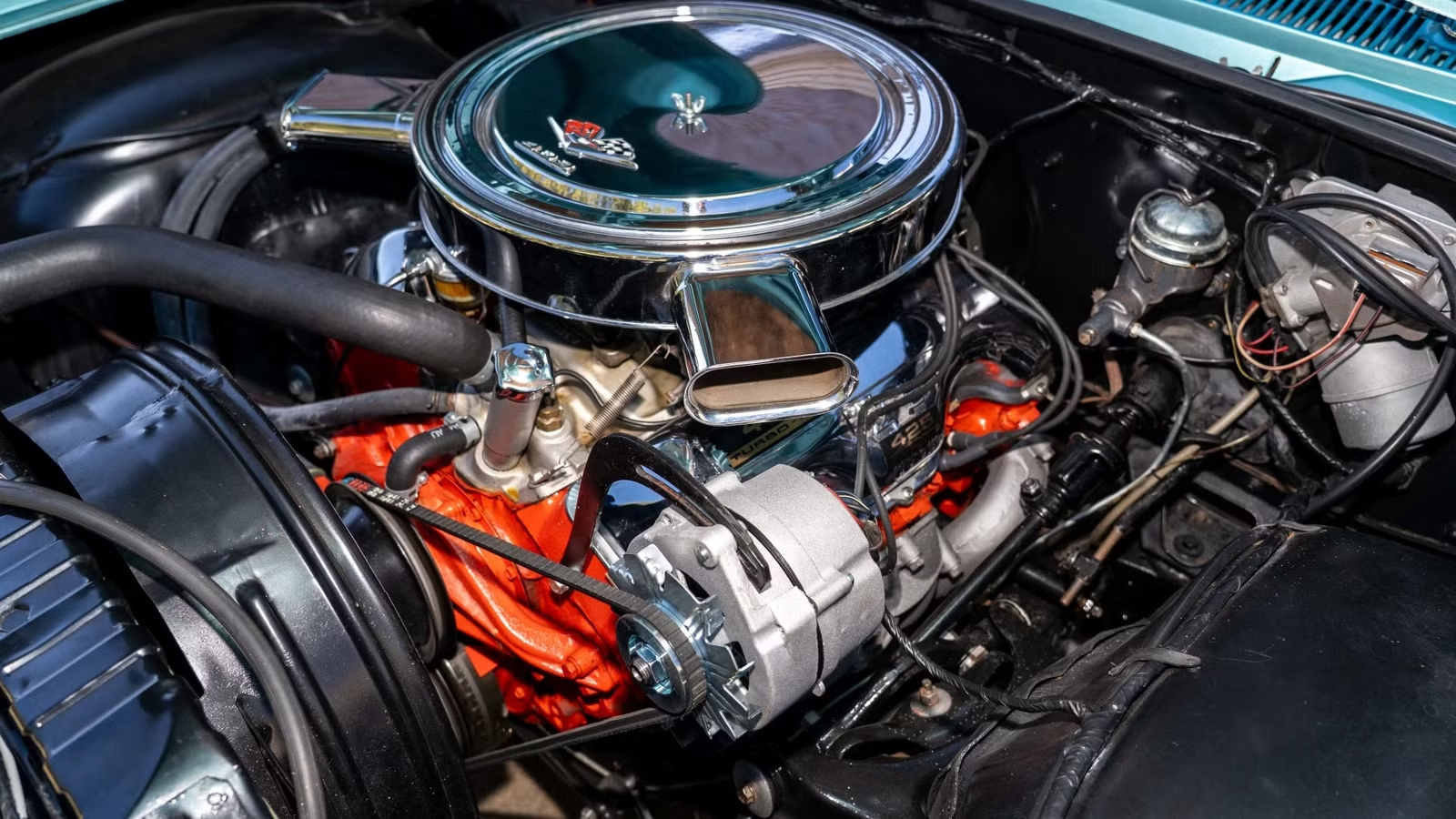
The great muscle car renaissance wasn’t a spur-of-the-moment event that began with the Pontiac GTO in autumn of ’63. That’s the CliffsNotes version, granted; but the reality is it was a slow, gradual development in the American auto industry that took decades to unfold. One of the most overlooked steps to the muscle car years happened in the time between 1961 and ‘62, during the formative years of the Chevy big block.
The Big Block: A Legend in the Making Since 1958

You might’ve heard that Chevrolet struggles to find a brand identity in 2026, that the magic that once made it a desirable OEM has been slowly lost as other brands foreign and domestic have eaten away at its market share over the decades. Well, in the mid-to-late 1950s, the opposite was the case. On the back of the firecracker launch of the small block V8 in 1954, Chevy was riding a wave of momentum that saw an ostensibly entry-level brand become truly aspirational.
The small block, or the Turbo-Fire as it was known at first, was beefy, power dense, and went from blueprint drawing to production in just over three months. Yet, the engine had absolute limits in its early years. Namely, its physical capacity for displacement. Put simply, America’s full-size cars were getting big. Well, more like, they were getting massive year after year. In dimensions and in curb weight. Chevy’s solution came in 1958 via the first-generation big block engine. Dubbed the W-series, its initial 348-cubic-inch configuration was rock-simple. With mechanical lifters, two-bolt main bearing caps, side oiling lubrication, a heavy cast-iron block, the W-series was built to accommodate commercial trucks just as easily as full-size family cars.

The 348 big block was a great engine for the time. High in power thanks to a choice of triple two-barrel carbs or a single four-barrel, and thanks to W-shaped valve covers, where underneath, the combustion chamber was entirely inside the top of the block, it was compact for how big and heavy it was. The engine made its debut under the hood of the Task Force series truck, and full-size icons like the Impala, Biscayne, and the Bel Air. Critics praised its stump-pulling torque, but hot rodders were skeptical whether the bump in weight over a small block was worth it. In time, all would become clear, but not before a major refresh.

Turning a Work Horse into a Proto Muscle Engine

By the turn of the ‘60s, Chevy understood it couldn’t rely on the 348 alone to dominate the escalating horsepower wars of the early 1960s. In any case, it was time for a refresh by most automotive development timeframes. Engineers answered the call by taking that rugged W-series architecture and boring and stroking it to its absolute mechanical limits. For starters, they widened the bore to a massive 4.3125 inches and stretched the stroke to 3.50 inches.
To accommodate the valves needed for high-rpm breathing, they retained the unique W-series layout where the combustion chamber was sculpted within the block itself instead of in the cylinder head. A steep 74-degree deck angle and angled piston crowns beneath relatively flat heads kept the engine compact for its size and weight. Deep inside the engine, the cast-iron crankshaft of old was replaced with a forged steel unit, along with forged steel connecting rods and main caps made from high-strength nodular iron.

At the top end, the new solid-lifter camshaft was given stiffer valve springs to prevent valve float at high RPMs, something hot rodders and tuners of the day appreciated to no end. Speaking of hot rodding, the 11.0:1 compression ratio and Carter four-barrel carburetor were absolute assets. It was all topped off by a lightweight aluminum intake manifold. The resulting engine was profoundly different from the old 348, and when it hit production in late 1960, Chevy wound up creating automotive perfection. Then again, in very small quantities at first.
The 409 Big Block: An Iconic Engine, A Pop Culture Icon

Produced in just 142 examples in its introductory 1961 model year, America at large wouldn’t become acquainted with the glory of the 409 big block for at least a few months after it commenced. Meanwhile, the 409 was gaining a fearsome reputation off the street. Namely, on the drag strip, where legends of the sport like Junior Johnson and “Dyno Don” Nicholson quickly thrashed the Chevy big block’s rep as a truck motor, replacing it with a status as a notorious track weapon.
By 1962, the engineering stopgap went the 1960s equivalent of viral, as production figures exploded from 142 units to roughly 15,000 engines rolling off the line. Customers had the tempting choice of a single four-barrel carburetor pushing 380 hp and 420 lb-ft of torque in icons like the Impala SS, or in rarer cases, twin Carter carburetors that pushed power up to 409 hp, or one horsepower per cubic inch.

In a move that very nearly predicted the big block market of today, many of those engines rolled off the line not under the hood of a car, but packed into a crate and sold to fleet managers and hot rodders alike to soup up their hot rods and commercial vehicles. For all of its racing dominance and street credibility, the big block’s place in the American zeitgeist came not from its exploits in NASCAR Grand National or NHRA Super Stock racing, but from a mention in a piece of pop culture history.
A Pop Culture Myth With the Wrong Exhaust

The engine achieved true cultural immortality when Gary Usher and Brian Wilson penned the hit Beach Boys anthem “409,” transforming the W-series big block into the ultimate shorthand for early-60s American muscle.
Ironically, the roaring exhaust recorded at 2 a.m. to open the track wasn’t even the legendary V8; conflicting lore suggests the audio actually came from a smaller 348 or 326, proving that automotive legend sometimes outshines the engineering itself.
Source: American Songwriter

Related posts




Latest Post


No Comments