The Cadillac Sport Sedan That Out-Accelerated The F80 M3
8 minutes reading
Thursday, 27 Aug 2026 14:00 0 43 autotech
For decades, the benchmark for the high-performance compact sedan remained effectively unchallenged. To automobile enthusiasts and industry journalists alike, the formula for track-ready four-door perfection was written exclusively in High German. Winning in this arena did not merely require building a fast automobile; it demanded dethroning an institution.
When the fifth-generation F80 BMW M3 arrived for the 2015 model year, it brought a radical shift to the iconic nameplate. Swapping out its predecessor’s high-revving, naturally aspirated V8 for a twin-turbocharged inline-six, the F80 delivered monumental low-end torque and lightning-quick acceleration figures. For a time, it seemed Munich had extended its reign indefinitely. Yet, thousands of miles away in Detroit, General Motors was quietly engineering a direct response: a razor-sharp chassis paired with formidable twin-turbo firepower, designed specifically to take aim at the German titan and ultimately beat it at its own game.
The German Standard: Understanding The F80 M3’s Dominance
The F80’s Turbocharged Revolution
The front 3/4 view of a blue 2016 BMW M3 Sedan.BMW
The arrival of the F80 M3 represented both a mechanical departure and a continuation of dominance. By fitting the chassis with the S55 twin-turbocharged 3.0-liter inline-six, BMW handed the M3 a muscular 425 horsepower and 406 pound-feet of torque. More importantly, that power arrived early and stayed late, allowing the sedan to launch from zero to 60 mph in a blistering 3.9 seconds when equipped with the dual-clutch transmission.
Beyond sheer straight-line speed, the M3 carried a decades-long legacy of dual-purpose excellence. It was the quintessential daily-driver track weapon, a vehicle capable of dropping kids off at school during the week and tearing down lap times on Sunday. This untouchable reputation created a formidable halo effect, making any attempt by an outsider to encroach on its territory seem entirely futile.
Why Muscle-Car Brute Force Kept Failing Against The M3
The rear 3/4 view of a blue 2016 BMW M3 Sedan.BMW
For years, American attempts to counter the M3 relied primarily on brute-force straight-line muscle while compromising on vehicle dynamics. General Motors recognized that to build a true rival, muscle alone would fail. Detroit required a ground-up performance platform built with light weight, telepathic steering, and world-class chassis tuning at its core.
The goal was nolonger to build a fast American sedan; it was to build a vehicle that could out-handle, out-stop, and out-accelerate the quintessential sport sedan on any road, anywhere in the world. Achieving this meant moving away from soft, traditional luxury credentials and committing fully to an uncompromising track-focused philosophy. What GM built next would either validate that ambition — or expose it as hubris.
Revealing The Contender: The Cadillac ATS-V Enters The Arena
How Cadillac’s Titanium-Loaded Twin-Turbo V6 Quietly Out-Gunned The M3
2019 Cadillac ATS-V engine shotCadillac
In 2015, Detroit finally unveiled its high-performance weapon: the Cadillac ATS-V. Rather than deploying a traditional V8, Cadillac matched BMW’s turbocharged strategy by fitting the ATS-V with a 3.6-liter LF4 twin-turbocharged V6. The powerplant boasted titanium-aluminide turbine wheels and titanium connecting rods, generating an astonishing 464 horsepower and 445 pound-feet of torque—comfortably out-gunning the baseline F80 M3 on paper.
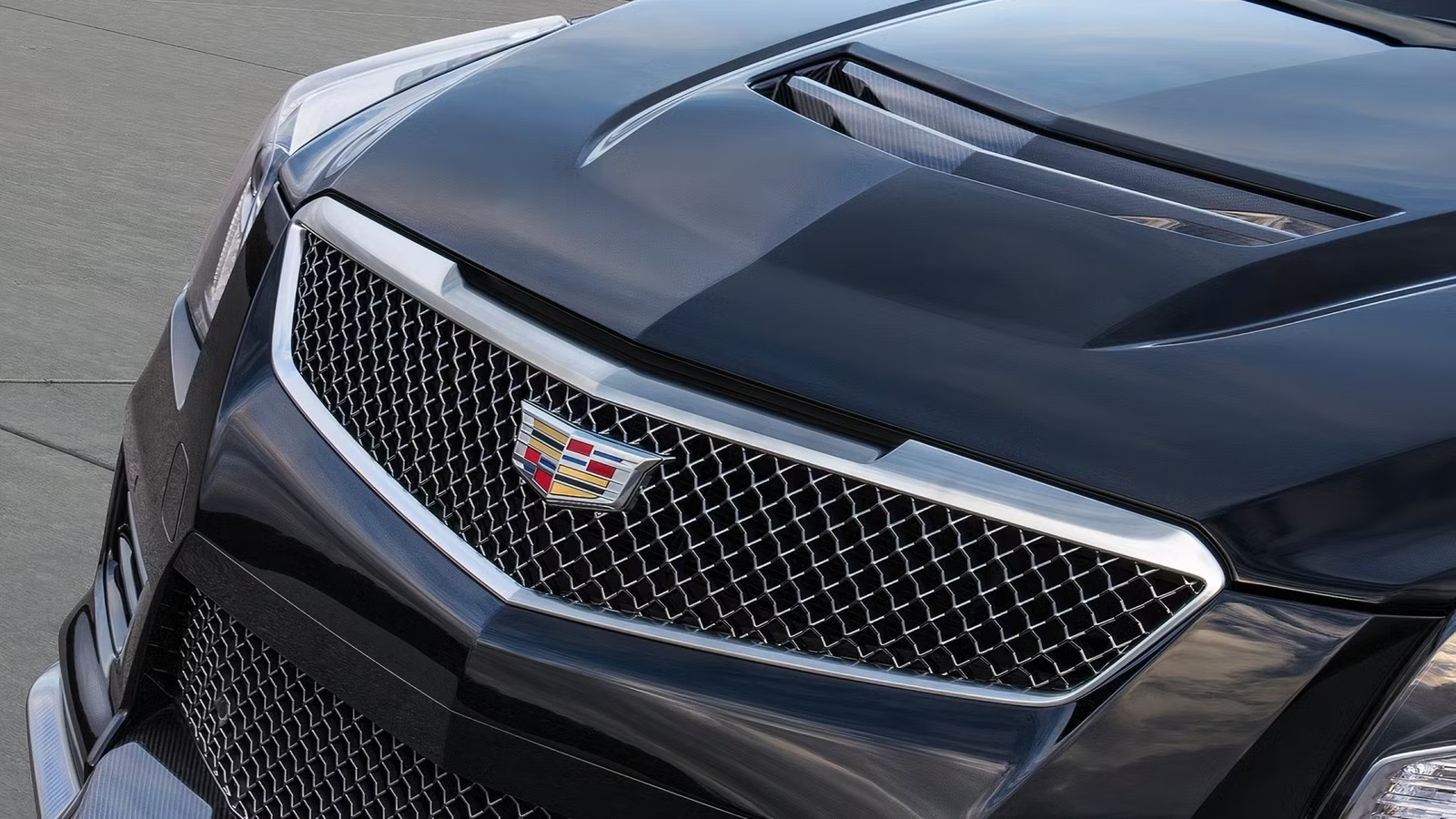
Power was routed to the rear wheels through either a notch-positive six-speed manual featuring active rev-matching and no-lift-shift technology, or a fast-shifting Hydra-Matic eight-speed automatic. It was a statement of intent wrapped in aggressive, functional aerodynamics, featuring a carbon-fiber hood vent, widened fenders, and a substantial rear spoiler.
Dethroning The King In Straight-Line Speed
Front and side view of a 2017 Cadillac ATS-VCadillac
The headline performance metric arrived when MotorTrend strapped its test gear to an eight-speed automatic ATS-V sedan and recorded a zero-to-60 mph launch in just 3.7 seconds. That figure instantly caught the automotive world off guard, out-accelerating the factory claims and initial instrumented tests of the F80 M3. In a straight quarter-mile drag, the ATS-V crossed the line in 12.1 seconds at 116.2 mph.
To maintain an honest view of the match-up, it should be noted that real-world test results vary across conditions, surface preparation, and media outlets. Across broader aggregate automotive testing, the ATS-V often averaged around four seconds to 60 mph, placing it in a dead heat with, or slightly behind, certain dual-clutch M3 runs. Yet, the fact that a Cadillac sedan could drop a verified 3.7-second sprint on an instrumented track proved that Munich’s straight-line invincibility was officially over. But beating the M3 in a drag race is one thing. The real question was whether a Cadillac could match it where the M3’s legend was truly built — on a demanding road course.
How GM’s Alpha Platform Gave The ATS-V Handling The M3 Had To Respect
The Chassis That Made Critics Forget They Were Driving A Cadillac
2016 Cadillac ATS-V, front profileCadillac
The true genius of the ATS-V lay not merely under its hood, but underneath its floorpans. Built upon GM’s legendary rear-wheel-drive Alpha platform, the ATS-V featured structural bracing that increased overall body stiffness by 25 percent over the standard ATS. Paired with third-generation Magnetic Ride Control (MRC) dampers, the suspension adjusted damping rates every millisecond, reacting instantly to surface changes and driver inputs.
While BMW transitioned the F80 M3 to an electric power steering system that critics frequently called numb, Cadillac collaborated with ZF to engineer an electric steering setup rich in feedback and precision. The chassis communicated limits with transparent clarity, giving drivers total confidence to lean heavily on the car’s mechanical grip.
Six-Piston Brembos And A 99-Foot Stop: Where The ATS-V Embarrassed Its German Rivals
Front 3/4 shot of a 2016 Cadillac ATS-V Sedan on a race trackCadillac
Where the ATS-V truly established chassis supremacy was in its braking hardware and track endurance. Massive six-piston front and four-piston rear Brembo calipers clamped down on two-piece steel rotors, bringing the sedan from 60 to zero mph in a world-class 99 feet, out-stopping its German rivals and resisting fade over prolonged track sessions.
Complemented by an Electronic Limited-Slip Differential (eLSD) and GM’s multi-mode Performance Traction Management (PTM), the ATS-V allowed drivers to meter out its twin-turbo torque with surgically precise throttle control on corner exit.
Flawed Cabin, Flawless Chassis: Why The ATS-V Holds Its Value Against The M3 Today
Pushing The European Elite To New Heights
To evaluate the ATS-V fairly, one must acknowledge its flaws alongside its triumphs. Cadillac’s attempt to challenge the M3 was marred by a divisive interior execution. The notorious CUE infotainment system, with its laggy touch response and capacitive-touch dash buttons, drew widespread criticism, while the cabin’s rear-seat legroom and interior trim materials fell short of the polished standard set by BMW and Mercedes-AMG.
Yet, for pure driving purists, these cabin shortcomings pale in comparison to the mechanical masterclass underneath. The ATS-V proved that an American manufacturer could build a chassis that blended track-day aggression with daily damping compliance in superior fashion. It forced European rivals to rethink their chassis setups for subsequent generations, elevating the performance envelope for the entire compact sport sedan market.
Why The ATS-V Is Worth Seeking Out Today
2019 Cadillac ATS-V rear 3/4 shotCarBuzz
For enthusiasts shopping the pre-owned market today, the ATS-V represents exceptional driver’s-car value rather than a cheap wannabe. Auction and sales data reveal near-price parity between well-kept ATS-Vs and F80 M3s, with both models commanding solid residual values.
What elevates the Cadillac today is its combination of equal market standing and relative rarity. Because far fewer ATS-Vs were produced compared to the ubiquitous M3, owning one offers a distinct, driver-focused alternative that stands out at any track day or car gathering. Furthermore, the dynamic lessons learned from the ATS-V laid the direct groundwork for Cadillac’s current crown jewel: the CT4-V Blackwing.
2019 Cadillac ATS-V front seatsCarBuzz
The story of the Cadillac ATS-V is the narrative of a bold underdog breaking down a long-standing dynasty. By pairing a high-output twin-turbo V6 with the dynamic perfection of the Alpha platform, General Motors produced a vehicle that did not simply emulate the competition; it legitimately out-accelerated and out-handled the iconic F80 BMW M3 on some of the world’s most demanding proving grounds.
While its interior ergonomics kept it from achieving complete market dominance, its underlying engineering remains a triumph. The ATS-V stands as a permanent reminder of the era when Detroit went directly after Munich’s finest, proving that given the right platform and passion, American engineering could conquer the sport sedan world.
Base Trim Engine
3.6L Turbo V6 Gas
Base Trim Transmission
6-Speed Manual
Base Trim Drivetrain
Rear-Wheel Drive
Base Trim Horsepower
464 hp
Base Trim Torque
445 lb-ft @ 3500 rpm
Fuel Economy
16/23 MPG
Make
Cadillac
Model
ATS-V Sedan
Segment
Compact Luxury Sedan
Infotainment & Features
5 /10
Sources: Cadillac, Car and Driver, MotorTrend, Classic.com









No Comments