
The Bulletproof Diesel That Outlasts Everything
Automakers now redesign their engines every few years, chasing tighter emissions targets, higher outputs, and deeper electronic control. Most engines serve a single product cycle and quietly disappear, replaced before anyone has time to miss them. Longevity has stopped being a design goal for most engine families.

One diesel ignored that trend entirely, entering production in 1990 and continuing today essentially unchanged while dozens of newer designs came and went around it. Aid agencies, militaries, and outback farmers still order it new, because in the places they work, nothing else has earned the same level of trust.
You Can Still Buy This 35-Year-Old Engine New Today
Most engine architectures survive between eight and twelve years before a clean-sheet replacement pushes them aside. The diesel in question predates the internet era and nearly every current safety regulation, yet it still leaves the factory in brand-new vehicles in 2026. Nothing on its specification sheet explains the survival, because on paper it looks hopelessly outdated.

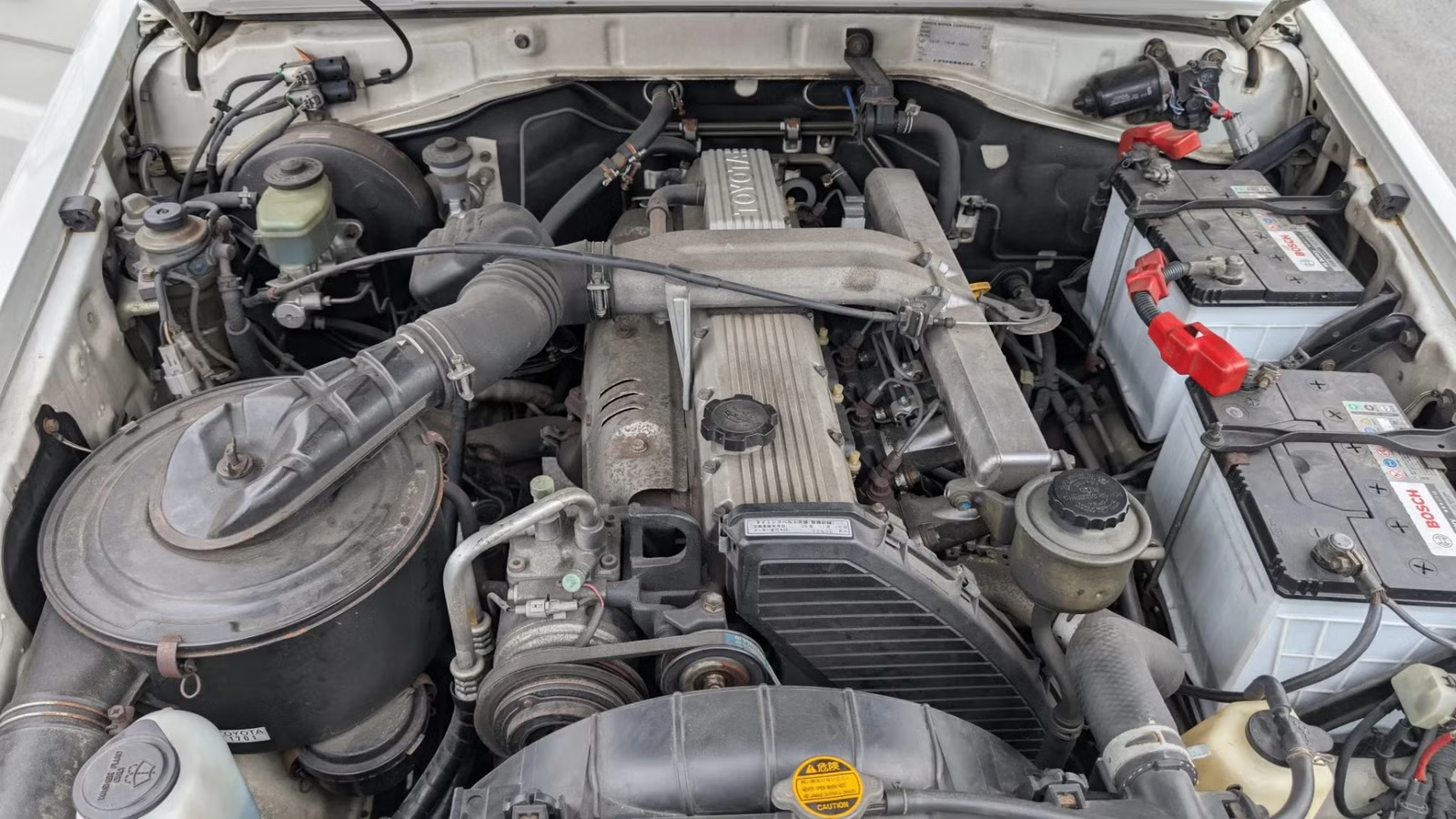
The engine is a naturally aspirated diesel inline-six with a fully mechanical fuel system. There is no turbocharger, no common-rail injection, and no engine control unit standing between the driver and combustion. A set of hand tools and a working knowledge of diesels is enough to keep one running almost anywhere on Earth.
Its working life plays out in Australian mining country, across African savannahs, and through remote Middle Eastern deserts, where it routinely outlasts the chassis built around it. Operators in those regions replace rusted bodywork and worn suspensions long before the engine underneath gives any sign of quitting. Fleet managers keep specifying it for new vehicles precisely because they already know how the story ends.
The badge on the valve cover belongs to the company most synonymous with reliability, and this engine may be the purest expression of that reputation ever built.
The Toyota 1HZ Was Built For Punishment

The engine is the 4.2-liter 1HZ diesel inline-six from Toyota that debuted in 1990 as the heart of the Land Cruiser 70 Series. Toyota developed it to replace the aging 2H diesel, and the brief asked for more torque, better drivability, and the same indifference to harsh climates that made its predecessor a fixture of the developing world. Engineers answered with a conservative tune, big displacement, and a fuel system containing no electronics at all.
The 1HZ displaces 4,164 cc across six cylinders, breathes through a single overhead camshaft and 12 valves, and relies on indirect injection with no turbocharger anywhere in sight, a specification that reads like a deliberate rejection of every trend that followed. Output stands at 129 hp and roughly 210 lb-ft of torque, delivered low in the rev range where working vehicles actually need it.

The 1HZ launched in the 75 Series pickups and Troop Carriers, then filtered through the wider 70 Series family, powering short-wheelbase wagons, long-wheelbase Troop Carriers, and single and double cab utes. Any Land Cruiser wearing an HZJ70, HZJ73, HZJ75, HZJ76, HZJ78, or HZJ79 model code carries this engine, and the 80 Series wagon used it as a key diesel option through the 1990s.

The Coaster bus completed the family, running the 1HZ through its B20 generation from 1990 to 1993 and the B40 that followed until 2003. Across all of those applications, Toyota changed almost nothing. Electronic fuel control and an EGR valve arrived around 2002 to satisfy tightening emissions rules, and the core architecture has otherwise stayed untouched for more than three decades.
How The 1HZ Runs Past 400,000 Miles Without Complaint

A cast-iron block, a cast-iron head, and a forged crankshaft riding on seven main bearings form the 1HZ’s foundation, with every rotating component operating far below its stress limit. Internals built with that much margin rarely fail, and the 1HZ’s almost never do.
A mechanical inline injection pump feeds indirect-injection pre-chambers, an arrangement that tolerates dirty or inconsistent diesel far better than modern high-pressure systems. Every component in the circuit can be serviced with hand tools, and no diagnostic computer is required to find a fault.

The absence of a turbocharger removes an entire category of failure. There is no heat-soaked bearing to cook, no boost leak to chase, and no intercooler plumbing to split on a corrugated road. Mechanics can rebuild the engine in a remote workshop, let it idle for hours, or feed it low-grade fuel, and it starts again the next morning.
The toothed timing belt driving the camshaft is the one component owners cannot ignore, needing replacement roughly every 62,000 miles, and skipping that service is the fastest way to destroy an otherwise unkillable engine. Glow plugs wear out as the most common minor item, while injection pumps typically need attention somewhere past 300,000 miles.

Well-maintained 1HZ engines routinely pass 310,000 miles before needing serious internal work, and documented fleet units have run closer to 435,000 miles with only routine servicing. Those numbers come with real trade-offs, because modest output, the lower thermal efficiency of indirect injection, and a leisurely highway pace are the price of the endurance. The 1HZ never pretended otherwise, and the people who buy it have never asked it to.
The United Nations Still Orders This Engine By The Hundreds

Humanitarian fleets provide the clearest proof of the 1HZ’s standing. Toyota Gibraltar Stockholdings, the automaker’s officially appointed supplier of 4x4s and spare parts to aid organizations, has delivered more than 80,000 vehicles to over 100 countries since its founding in 1996. The operation holds more than 2,000 general-specification vehicles in stock and modifies around 650 vehicles per month for the United Nations and other agencies.

UN agencies, Doctors Without Borders, the Red Cross, and the World Food Program all source 1HZ-powered Land Cruisers through TGS, and the International Organization for Migration has run procurement programs specifically for HZJ78, HZJ76, and HZJ79 models. The TGS conversion workshop turns those platforms into ambulances, mobile mother-and-baby clinics, blood transfusion units, and mobile laboratories before they ship.

A vehicle deployed to sub-Saharan Africa or a remote corner of the Middle East cannot depend on a dealership diagnostic laptop, and the 1HZ never asks for one, which makes the reasoning behind those orders ruthlessly practical. There are no fragile sensors to fail hundreds of miles from the nearest town, and parts remain available in roadside workshops across the developing world. The mechanical pump keeps running on whatever diesel the local supply chain delivers, and a stranded truck can usually be repaired with the tools already hanging on a village workshop wall.

Hagerty has documented the 70 Series’ role as a mining workhorse across the Australian outback, where 1HZ-powered trucks handle station work, underground fleets, and farm duty far from any service network. Toyota’s continued support for the 70 Series platform keeps parts supply and service knowledge alive, which helps explain why the 1HZ remains among the oldest passenger-vehicle engines still in production anywhere.
Even Its Replacement Couldn’t Kill It

Toyota finally built the 1HZ’s successor in 2023, when TGS introduced the GDJ76, a Land Cruiser 70 wagon powered by the 1GD-FTV.
The newcomer is a 2.8-liter turbodiesel four-cylinder paired with a six-speed automatic, the same engine that serves in the Toyota Hilux, including a higher-output version in the Hilux GR Sport. The GDJ76 itself is essentially the Land Cruiser 70 WorkMate that Toyota sells in Australia, stripped of its remaining comforts for fleet duty.

The 1GD-FTV cuts fuel consumption by 30%, lifts output from 129 hp to 201 hp, and reduces emissions by 30%, enough to clear Euro 4 standards the older engine cannot meet. On paper, the newcomer wins every measurable comparison.
The HZJ76 with the 1HZ remained on sale alongside the new model, because aid organizations trusted the older engine too deeply to abandon it on the strength of a spec sheet. The replacement never actually replaced anything; instead, it joined the catalog beside the engine it was meant to retire.
The 1HZ’s obituary has been drafted many times across 35 years, and the people who depend on it keep declining to sign. For an engine built to outlast everything, that may be the most fitting tribute of all.
Sources: Toyota, Toyota Gibraltar Holdings, Hagerty, IOM

Related posts



Latest Post


No Comments