
The ’70s Muscle Car That Slipped Through The Cracks
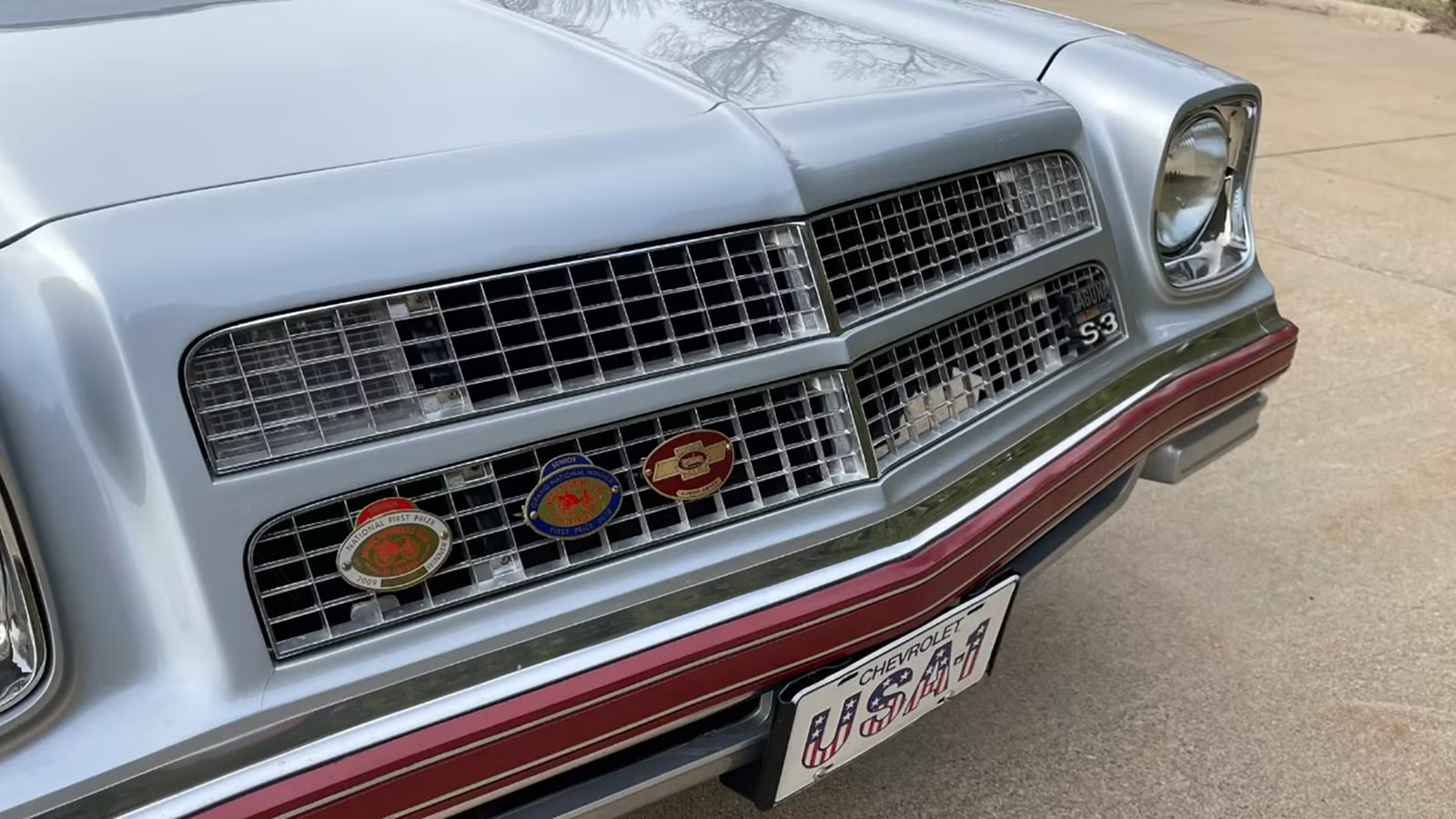
The muscle car era didn’t die the moment the calendar flipped to 1970 — it just got a lot harder to find. Between tightening emissions standards, the shockwave of the 1973 Oil Embargo, and a federal regulatory environment that seemed determined to strangle performance, the decade earned its “Malaise Era” nickname fair and square. Yet scattered among the smog-pump-equipped survivors and economy-minded compacts were a handful of machines that genuinely tried to keep the performance flame alive. Most of them never got the recognition they deserved — and none more so than the Chevrolet Laguna S-3.

Even amid this admittedly Malaise-drenched time, a few cars did try to serve up much-needed performance, though some of them remain relatively obscure footnotes in the chronicles of domestic performance machines, and were often overlooked by buyers of the era.
The Laguna S-3 Was An Overlooked Piece Of ’70s Muscle Car History
The Chevrolet Laguna S-3 was one such muscle car that slipped through the cracks. Largely seen as a spiritual successor to the Chevy Malibu SS, the Laguna S-3 combined a reliable chassis with small- and big-block V8 power, aerodynamic design, trendy graphics, and plenty of options for later customization.

Overall, only 8,236 units ever left the factory for the 1976 model year, making it a notably rare muscle car. The reason for those low numbers certainly wasn’t a lack of muscle. When it hit the market in 1974, it offered the massive Chevy 454 LS5 big-block V8 and packed respectable — albeit already emissions-choked — power. Something else was missing from the overall recipe, something a little less obvious and more difficult to pin down, even with half a century of hindsight.

The origin story of this muscle machine is a little unusual for those familiar with the typical development cycles of the prior decade. The Laguna S-3 evolved from the “Colonnade” A-body after GM had eliminated convertibles and pillarless hardtops in one fell swoop. Descending from the third-generation Chevelle lineage in 1973, the early Laguna models featured upright front fascias, chunky bumpers, and body-color noses, with the model targeting a more upscale but not necessarily performance-focused buyer among Chevy’s mid-size offerings.
But almost immediately, in 1974, the Laguna was handed the additional task of being the performance-flavored model in the sprawling Chevelle lineup, keeping its distinctive front fascia while kicking things off with a 350-cubic-inch two-barrel small-block good for 145 hp in base form. Beefier options were also on the menu, including the 454-cubic-inch big-block V8 that pumped out 235 hp, with the top variant offering the choice of an automatic or a four-speed manual transmission.
The S-3 sold well enough during its first year of availability, and the addition of a new slanted urethane nosepiece early in 1975 gave the Laguna S-3 a far more distinctive and aerodynamic look. But the Laguna S-3 left the stage as suddenly as it appeared, bowing out after 1976 due to shifting priorities at GM, rapidly changing emissions regulations, and a corporate focus that was pivoting hard toward smaller family cars.
V8 Options In The Era Of Downsizing

Quite a few engines were on the menu for 1975 as well, ranging from a modest two-barrel 350 good for 145 hp to the four-barrel 400 V8 with 175 hp on tap. But the main event was still the 454-cubic-inch big-block LS5 V8, rated at 235 hp — though it would not appear on the options sheet again after 1975.
With up to 235 hp and 360 lb-ft of torque on tap courtesy of a 454-cubic-inch (7.4-liter) big-block V8 during its short three-model-year run, the Laguna Type S-3 could still hold its own against an admittedly limited cast of competitors, while also offering a futuristic exterior thanks to its aerodynamic NASCAR-homologated nosepiece.
In top form, the 454-cubic-inch V8 could serve up 0–60 launches in the 7.5-to-8.5-second range, with quarter-mile times in the mid-15-second bracket. These weren’t hair-raising figures by the standards of the greater muscle car universe, but they were respectable enough for the era to earn the Laguna S-3 a nod from performance enthusiasts.
1976 was the year things got a little interesting, with the base engine swapped out for a 305-cubic-inch small-block V8 good for 140 hp. A 400-cubic-inch V8 was also available, offering 175 hp and 305 lb-ft of torque at 2,000 rpm, but it was paired solely with a three-speed automatic. So some meaningful trade-offs occurred between the 1975 and 1976 model years, making the latter just a bit less exciting from a performance standpoint.
The NASCAR Connection

|
Engine |
Power |
Torque |
Transmissions |
1/4 times |
|---|---|---|---|---|
|
305 V8 |
140 hp |
245 lb-ft |
3-speed auto |
18.5-19.0s |
|
350 V8 (2-bbl) |
145 hp |
250 lb-ft |
3-speed auto/3-speed manual |
17.8-18.5s |
|
350 V8 (4-bbl) |
160-175 hp |
260 lb-ft |
3-speed auto/4-speed manual |
16.8-17.5s |
|
400 V8 (4-bbl) |
150-180 hp |
305 lb-ft |
3-speed auto |
16.7-17.2s |
|
454 V8 LS4 |
215-235 hp |
360 lb-ft |
3-speed auto/4-speed manual |
15.5-16.2s |
What makes the last two years of the Laguna S-3 so cool and unique is the NASCAR connection, with this model serving as the homologation car for Chevy’s racing efforts. From 1975 through 1977, the Laguna S-3 became Chevrolet’s primary NASCAR weapon after rule changes emphasized aerodynamics over sheer horsepower.
Teams like Junior Johnson & Associates and drivers including Cale Yarborough and Darrell Waltrip campaigned the slant-nose Laguna with considerable success. The smooth urethane front clip reduced drag significantly compared to the standard Colonnade Chevelle body, and NASCAR-spec cars received race-tuned suspensions, reinforced chassis components, stripped interiors, and purpose-built small-block V8s far removed from showroom trim. The aerodynamic advantage proved real: Yarborough captured multiple wins and remained highly competitive during the mid-’70s transition period, helping Chevy stay relevant as Ford and Dodge regrouped.
But coupled with the relative scarcity of the S-3 in any configuration — especially the top 454-engined manual-transmission cars — the Laguna S-3 largely sailed under the radar of most buyers, except those who appreciated the NASCAR-style look first and foremost.
Picking the Right One

If there are any sour notes to the three-year Laguna run, it’s the fact that not all years offered the beefy 454-cubic-inch V8, and that the manual transmission option disappeared after 1975. The very top-performing variants — equipped with manual transmissions — are rare in a sea of automatics, remain more sought-after today, and the top engine was absent entirely in the final model year.
The flip side, of course, is that more easygoing automatic examples from 1976 can be obtained as relative bargains, requiring only a modest budget if redlining a Laguna S-3 on your morning commute isn’t a priority. And given the broad interchangeability of engines and transmissions across Chevys of this era, it’s not too difficult to mix and match the top powerplant with the desirable four-speed manual if originality isn’t a concern. This makes choosing years and transmissions a bit tricky, and the right answer depends entirely on your priorities: do you want the Laguna S-3 as a chill weekend cruiser, or a machine to take to the drag strip for some retro fun?

Concours-grade examples of the 1976 Laguna S-3 are somewhat rare to begin with, so it’s difficult to find yourself in a position where you’d be overpaying for an example too nice to drive and enjoy — quite a few surviving cars are driver-grade or club-concours quality at best.
Cooler Than The Competition

|
Model |
Engine |
Power |
0-60 MPH |
Est. Top Speed |
|
Chevrolet Laguna S-3 454 |
7.4-liter V8 |
235 hp |
7.5-8.5 sec |
~125 MPH |
|
Oldsmobile Cutlass 442 |
7.4-liter V8 |
190-200 hp |
~8.0 sec |
~120 mph |
|
Pontiac LeMans (400) |
6.6-liter V8 |
~180 hp |
~9.0 sec |
~115 mph |
|
Ford Gran Torino |
7.5-liter V8 |
~202 hp |
~8.0 sec |
~120 mph |
Even though the Laguna S-3 arrived at a seemingly barren point in the muscle car world, it still faced a few scattered competitors, including GM’s own Olds Cutlass 442 and Pontiac LeMans, in addition to Ford’s Gran Torino.
In direct comparison, the Laguna S-3 stacked up respectably against its rivals. The Oldsmobile Cutlass 442 leaned more into torque-rich V8 cruising comfort, the Pontiac LeMans emphasized budget muscle with modest output, and the Ford Gran Torino offered size and highway presence but carried extra weight. The Laguna’s combination of aerodynamic design and available big-block torque gave it a slight edge in mid-range punch and visual distinctiveness.
But the Laguna mainly stood out thanks to its aerodynamic shape, and as these are the 1970s we’re talking about, Chevy went heavy on the appearance of the Laguna S-3, serving up a generous helping of stripes, badges, and the color-keyed urethane front fascia — quite a new look for cars of the time. Swivel-bucket seats were also an option, for those buyers who cared about luxury fads, but even in bone-stock form the Laguna offered tidy road manners and a well-balanced chassis. With power discs up front and drums in the rear, the coupe could also be persuaded to stop in a hurry.
The Laguna S-3 also had a well-sorted chassis going for it against rivals of the day, as well as plenty of torque in the top engines. And in those admittedly dark times, that was enough to secure it a spot in the increasingly rare muscle car category, even if overall production numbers meant you’d rarely spot one on your evening commute or waiting to challenge you at a stoplight.
Current Values

For an overlooked muscle car from the 1970s, the Laguna S-3 is a rare bird that also qualifies as a bargain classic. According to Hagerty’s valuation tool, 1976 examples optioned with the 305-cubic-inch powerplant and automatic transmission can be found in good condition at relatively modest prices by muscle car standards — check current listings for up-to-date figures, as the market shifts regularly. Big-block cars with manuals will command a premium, though well-priced examples do surface for patient shoppers.
A 1974 Laguna S-3 optioned with the 454 V8 and a three-speed automatic sold for just $18,000 on Bring a Trailer, so the price of entry into the Laguna S-3 universe has historically been reasonable even for the top powerplant option. The Laguna S-3 was ultimately overlooked due to its mixture of luxury and sport features, which confused shoppers in both camps, in addition to being a bit pricey for a Chevelle derivative. The design was also polarizing in some respects, and even though it was certainly aerodynamic, it didn’t convey obvious performance intentions to traditional muscle car buyers.
Despite its aggressive looks and muscle car credentials, the Laguna S-3 was ultimately upstaged at launch by models including the Pontiac Firebird Trans Am, Olds Cutlass Supreme, Dodge Charger, and Chevrolet’s own Camaro, lest we forget. Today, this cool piece of ’70s muscle remains little more than a footnote in the long history of American performance cars — and a surprisingly rare one at that.
Sources: Hemmings, MotorWeek, Motogallery, Hagerty.

Related posts

Latest Post


No Comments