
The $4,360 Question Behind Toyota’s Affordable Hybrid SUV
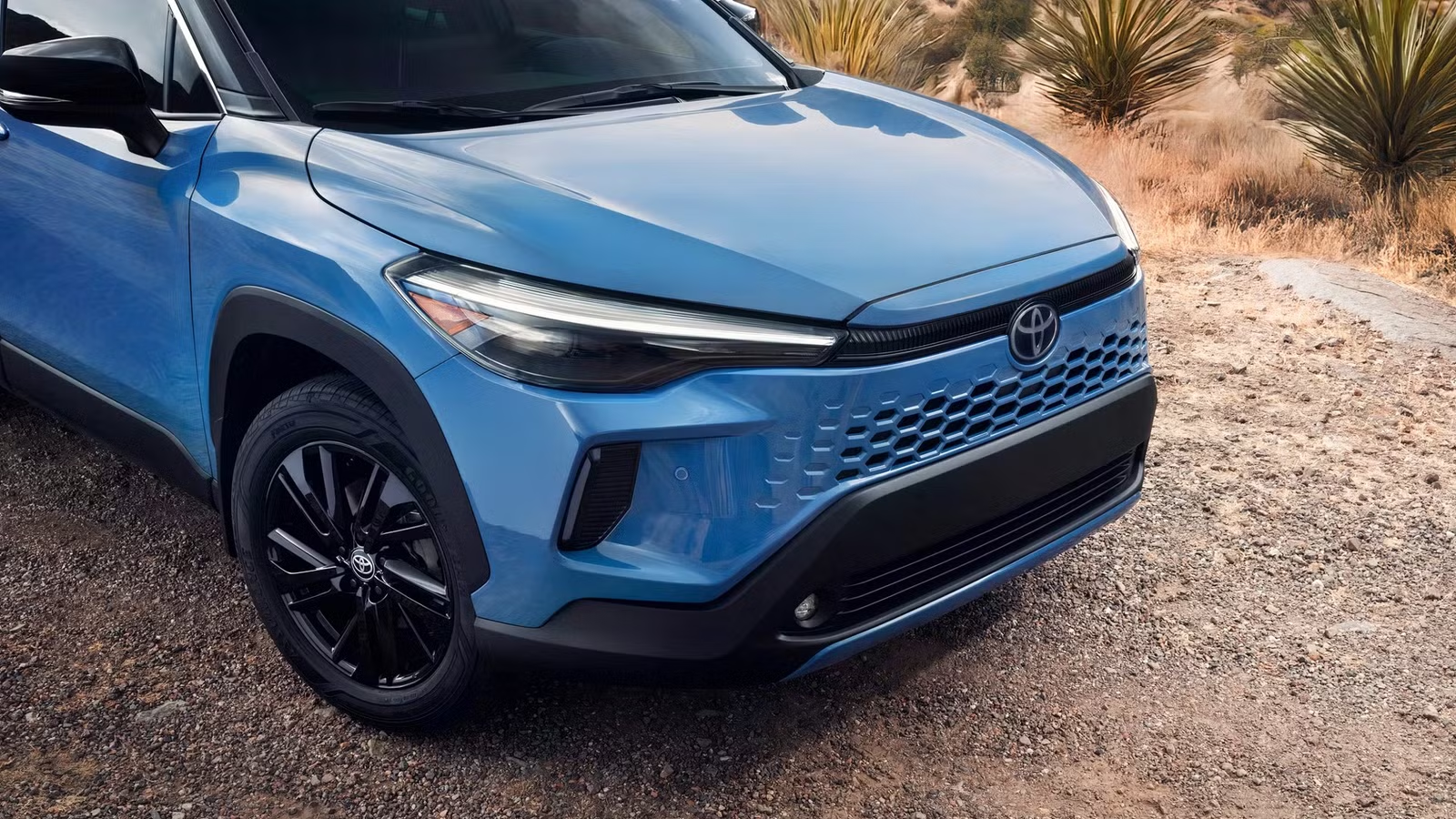
On paper, stepping up from a $24,635 gasoline compact SUV to its $28,995 electrified sibling looks like a steep $4,360 jump to save money at the pump. In reality, because every hybrid trim includes standard all-wheel-drive, a $1,300 option on the gas model, the true powertrain surcharge shrinks to $3,060.

At today’s national average gas price of $3.72 per gallon, an average American driver covering 13,500 miles a year recoups that spec-adjusted premium in 6.4 years, or just 4.3 years for a 20,000-mile-per-year commuter. Whether the hybrid version of Toyota’s entry-level SUV makes financial sense hinges on three variables: how many miles you log annually, whether all-wheel drive is already on your must-have list, and how much of your driving happens in stop-and-go traffic.
Unveiling The 2026 Toyota Corolla Cross Lineup
Pricing, Powertrains, And Key 2026 Updates
Assembled in Huntsville, Alabama, the 2026 Toyota Corolla Cross and Corolla Cross Hybrid arrive refreshed with two distinct front-end identities comprising a rugged, wide-mouthed grille on gas grades versus a sleeker, body-colored grille on hybrid trims. Gas models, spanning the L, LE, and XLE grades, run on a 2.0-liter four-cylinder producing 169 horsepower, paired with a continuously variable transmission (CVT) and front-wheel drive (FWD) as standard. That setup earns EPA-estimated ratings of 31 mpg city, 33 highway, and 32 mpg combined.

In contrast, the Corolla Cross Hybrid, available in S, SE, and XSE trims, pairs that 2.0-liter engine with three electric motors for a net 196 horsepower and an eCVT, returning an EPA-estimated 46 mpg city, 39 highway, and 42 mpg combined. Across the board, every 2026 trim includes Toyota Safety Sense 3.0, wireless Apple CarPlay and Android Auto, and ToyotaCare, maintaining safety and tech parity from the entry level up.
Deconstructing The $4,360 Price Gap
Comparing the $24,635 base gas L FWD grade against the $28,995 base Hybrid S AWD is an apples-to-oranges exercise. Beyond an electrified powertrain that is simultaneously more powerful and far more efficient, every 2026 Corolla Cross Hybrid ships standard with Electronic On-Demand All-Wheel Drive. Adding Dynamic Torque Control AWD to the entry-level gas L trim adds $1,300 (bringing it to $25,935 before the $1,495 delivery, processing, and handling fee) while dropping fuel economy to 29 mpg city, 31 mpg highway, and 30 combined.
Once you adjust for drivetrain parity, the true hybrid premium drops from $4,360 to $3,060 ($28,995 minus $25,935). Factor in the Hybrid S trim’s sport-tuned suspension and upgraded wheel styling over the base L’s steel wheels, and the net hardware surcharge shrinks even further. Both the gas-powered and hybrid variants offer an official 1,500-pound maximum towing rating.
Spec-Adjusted Hybrid Premium: $28,995 – $25,935 + $3,060
Fuel Economy Math Across Annual Mileage Scenarios


Using AAA’s November 2026 national average of $3.72 per gallon for regular unleaded, the efficiency gap translates into substantial annual savings over every 10,000 miles driven. The efficiency gap translates into substantial annual savings over every 10,000 miles driven. The Hybrid AWD (42 mpg combined) consumes roughly 238.1 gallons of gas, equating to an estimated $885.71 over 10,000 miles.
The gas-powered FWD and AWD models’ 32 mpg and 30 mpg combined fuel consumption figures translate to 312.5 gallons and 333.3 gallons of gasoline, costing $1,162.50 and $1,240 per 10,000 miles, respectively. The Hybrid saves 74.4 gallons or $276.79 over the Gas FWD, and 95.2 gallons or $354.29 over the Gas AWD model per 10,000 miles.
Break-Even Timelines For Low-, Average-, And High-Mileage Drivers


Dividing the upfront price delta by annual fuel savings reveals how quickly each driver profile reaches the break-even point at $3.72 per gallon. While low-mileage drivers face a decade or more to recoup the upfront cost, average and high-mileage buyers who already want all-wheel drive break even in just 4.3 to 6.4 years once the $1,300 AWD option is factored out of the price gap.
Real-World Driving Variables That Shift The Equation
City Stop-And-Go Vs. Highway Cruising

Combined MPG figures mask where the hybrid truly earns its keep. In urban traffic, regenerative braking pushes the Hybrid to 46 mpg city versus 31 mpg for the Gas FWD and 29 mpg city for the Gas AWD, a massive 15-to-17 mpg advantage. At 70 mph on the interstate, the gap narrows considerably to 39 mpg (Hybrid) against 33 mpg (Gas FWD) and 31 mpg (Gas AWD). Consequently, an urban rideshare driver or suburban commuter will beat the combined break-even timeline by well over a year, while an interstate cruiser will need longer.
Regional Fuel Prices And Ownership Horizon

Regional fuel volatility also moves the needle. At $4.75 per gallon in California and the Pacific Northwest, the 13,500-mile AWD-adjusted payback drops from 6.4 years to just five years ($3,060 divided by $610.71 in annual savings). Conversely, in Gulf Coast states hovering near $3.15 per gallon, it stretches to 7.6 years. Buyers who trade in every three to four years won’t recover the upfront cost purely at the pump, though Toyota hybrids historically command stronger residual values on the used market, recouping a meaningful slice of that delta at trade-in.
Beyond The Pump: Performance, Utility, And Trade-Offs
What The Hybrid Gains In Daily Drivability

The Corolla Cross Hybrid represents more than just an economy play. Its 27-horsepower advantage trims 0-60 mph acceleration to roughly 8.0 seconds, largely eliminating the noisy engine drone the 169-horsepower gas CVT exhibits during highway merges. Meanwhile, the rear-mounted electric motor engages seamlessly without a mechanical driveshaft, improving both low-speed quietness and traction in rain or snow.
Where The Gas Model Still Holds An Edge

For a low-mileage buyer living in a mild, snow-free climate, or someone who simply wants the lowest possible monthly payment without financing an extra $3,060 to $4,360, the base gas model is genuinely the smarter financial play. It is also worth noting the Hybrid is equipped with a smaller 10.6-gallon fuel tank compared to the 12.4 and 13.2-gallon capacity on gas models. Although, the Hybrid’s superior 42 mpg rating still yields a longer 445-mile cruising range.
The Gas FWD Corolla Cross is the model of choice for owners who drive under 10,000 miles a year or live where snow is a factor. The Hybrid AWD Corolla Cross is the obvious choice for buyers who want all-wheel drive and cover at least 12,000 miles annually, especially in city traffic. Once you strip out the $1,300 AWD cost, the $3,060 difference pays for itself well within a typical ownership cycle while delivering a faster, quieter SUV from day one.
Sources: Toyota, AAA, Edmunds

Related posts






Latest Post


No Comments