
The 330-HP Plymouth Built Before Chrysler’s Cancellation Memo Reached The Assembly Line
Detroit’s muscle-car era didn’t end overnight. Tougher emissions rules, changing fuel requirements, and rising insurance costs gradually pushed big engines out of showrooms. But Chrysler‘s most controversial performance V8 managed one last appearance in 1972, even though the company supposedly never built a production car with it. For decades, its existence remained a mystery until a $150 salvage-yard discovery challenged the official story.
The 440 Six-Pack Was Too Powerful For Chrysler’s 1972 Plans

By 1972, Detroit’s horsepower race was losing momentum. Stricter federal emissions standards forced automakers to lower compression ratios and develop cleaner engines. Plymouth had already dropped the legendary 426 Hemi, while other big-block options faced uncertain futures. The switch from gross to net horsepower ratings also made performance figures look less impressive. While muscle cars weren’t dead, their glory days were fading fast.
Chrysler’s proposed 440 Six-Pack was an awkward holdout. Known as the Six-Barrel at Plymouth, the 440-cubic-inch V8 featured three two-barrel Holley carburetors and produced 330 net horsepower. Its 10.3:1 compression ratio demanded premium gasoline, even as Chrysler advertised its other 1972 Plymouth engines as suitable for low-lead regular. The V-code engine reportedly failed to meet emissions-certification requirements, prompting Chrysler to cancel it. Selling uncertified engines could expose the company to federal penalties and other compliance problems. Unfortunately for Chrysler, several cars may have already escaped.
A Brief Production Window Left Chrysler With An Awkward Mystery


The story traces back to Chrysler’s St. Louis assembly plant in early August 1971, when production of the 1972 models was beginning. Enthusiast accounts suggest workers assembled a handful of V-code cars during a window lasting roughly one week. The Six-Pack had appeared in early ordering materials, and some customers apparently managed to secure the combination before Chrysler withdrew it.
A cancellation notice reportedly reached dealers on October 28, 1971, well after those early vehicles had been assembled. The gap doesn’t establish when Chrysler first halted production, but it raises an obvious question: how many cars made it through? Rumors suggest as many as seven were ordered or built, although no verified factory production total supports that number. For years, many enthusiasts believed the 1972 Six-Pack never reached production. Authentic VIN codes, fender tags, and dealership records would eventually challenge that assumption, separating genuine factory cars from later conversions.
A $150 Plymouth Road Runner GTX Exposed The V-Code Secret

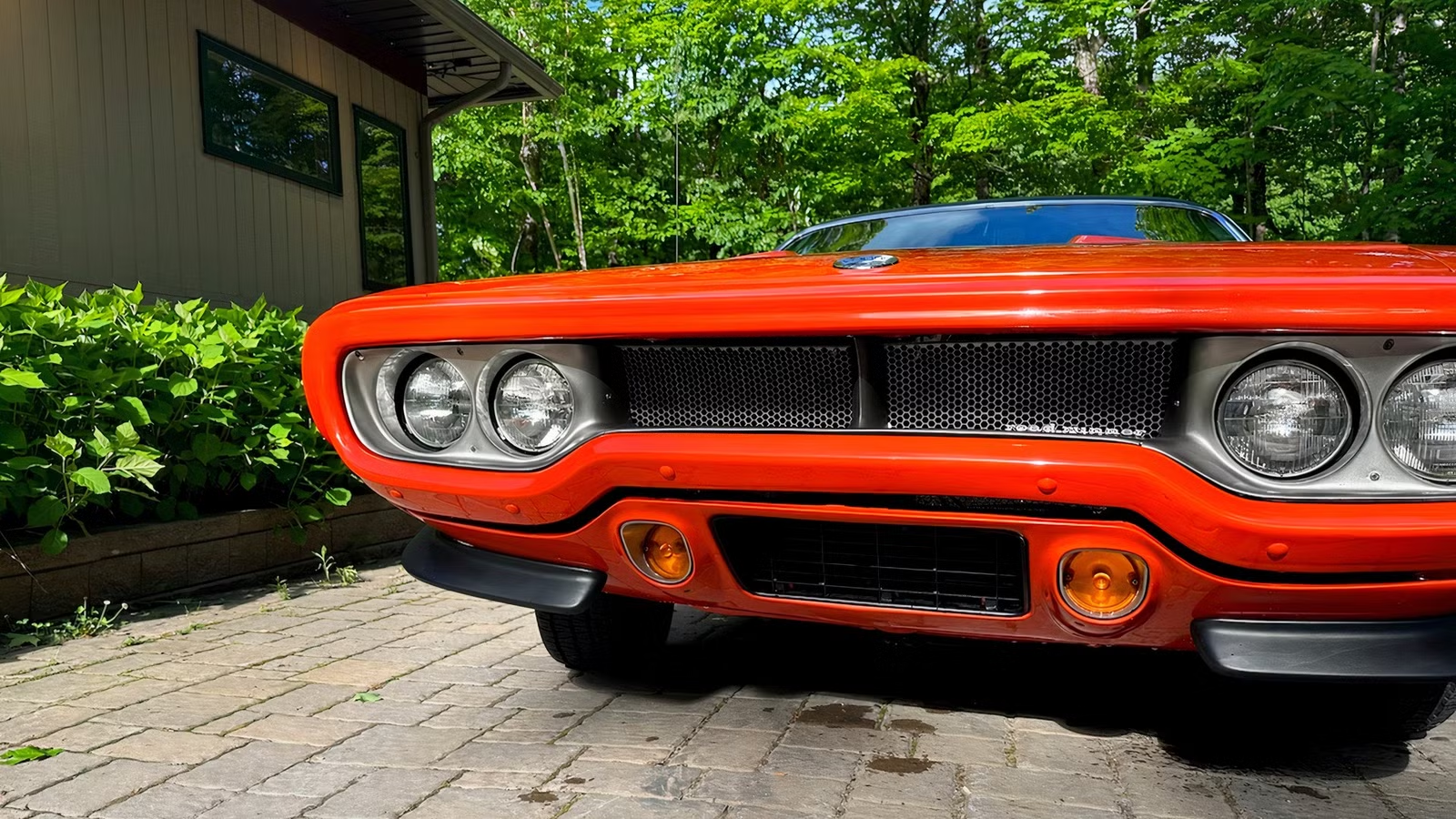
In the early 1980s, North Carolina Mopar enthusiast Russell Morgan discovered a neglected Rallye Red 1972 Plymouth Road Runner GTX in an Effingham, South Carolina, salvage yard. Missing several parts and looking thoroughly disposable, the car hardly screamed collector’s item. Morgan initially purchased its Air Grabber hood for $150. After someone at a Charlotte swap meet showed unusual interest in the hood’s former home, Morgan returned and bought the entire Plymouth for another $150. That second purchase would prove far more important.
The secret appeared in its VIN, which began RM23V2G. The fifth character, V, identified Chrysler’s 440 Six-Barrel engine, while the following characters confirmed the 1972 model year and St. Louis assembly plant. Its factory specifications included a numbers-matching 440 Six-Barrel V8 rated at 330 net horsepower, a three-speed TorqueFlite automatic transmission, and a rare electric sunroof. Rallye Red paint, an Air Grabber hood, 15-inch Rallye wheels, and a Sure-Grip rear axle with 3.55 gears completed the performance package.
Someone had clearly ordered a serious muscle car, complete with a sunroof for enjoying the weather while burning premium gas.

The GTX name also deserves clarification. Plymouth discontinued the standalone GTX after 1971, making GTX a designation for 440-equipped Road Runners in 1972. Morgan’s discovery therefore represented an authentic factory combination that supposedly never existed. He sold the car in 1995, and Magnum Auto Restoration later restored it to factory-correct condition. It eventually joined the Brothers Collection, trading its salvage-yard surroundings for collector-car prestige. More importantly, two Dodge Chargers would prove that the Plymouth wasn’t alone.
Two Dodge Charger Rallyes Proved The Plymouth Wasn’t Alone

The first Dodge survivor was a Top Banana Yellow 1972 Charger Rallye reportedly associated with a Chrysler executive. After leaving company service, the car eventually became a drag racer, losing its original Six-Pack engine along the way. It remained with the same family for decades and spent approximately 40 years stored in a garage near Detroit. Automotive researcher Ryan Brutt documented the Charger in 2015. Despite its missing engine, surviving identification and documentation helped establish its unusual factory origins.

Another 1972 Charger Rallye, finished in Rallye Red, was associated with Ron Slobe of R&R Salvage, adding another piece to the puzzle. Together, the two Chargers and Morgan’s Plymouth represent three currently known surviving V-code cars from Chrysler’s short-lived 1972 program. Their factory identification makes the engine’s production history difficult to dismiss as a brochure error or abandoned prototype. However, three survivors don’t establish the total number built. The frequently repeated figure of seven cars remains unverified at this point.
Chrysler Canceled The Six-Pack, But Couldn’t Erase The Evidence

Chrysler removed the 440 Six-Pack from its 1972 lineup, leaving the 280-net-horsepower 440 four-barrel as the top widely available engine, but a handful of factory-identifiable V-code cars had already entered production. The reported emissions-certification problem offers a reasonable explanation for the cancellation and Chrysler’s possible reluctance to acknowledge the cars. However, speculation about a deliberate corporate cover-up remains unproven. The surviving vehicles tell a stronger story than the rumors surrounding them.
Morgan’s Plymouth captures that story perfectly. A neglected muscle car purchased for $150 eventually became a restored collector’s prize, while two Dodge Chargers strengthened the case for an almost-forgotten production run. The exact number built may never become clear, but their existence challenges decades of accepted history. Chrysler could cancel the engine, remove it from ordering sheets, and move toward cleaner performance cars. What it couldn’t do was erase the machines that had already rolled off the line.
Source: Chrysler, Plymouth, Dodge

Related posts



Latest Post


No Comments