
10 Cars That Are Perfect For The Fourth Of July Weekend Road Trip
Road trips and the 4th of July go hand in hand, whether it’s a trip to a historic site or monument, or just packing up the kids, the cooler, the Coleman, and the lawn chairs for a weekend at the campsite, a day at the beach, or an evening at the park for the fireworks display. For many, the holiday is less about the destination than the ritual of getting there, windows down, friends or family chattering, playlist queued up … Americans plan for such days in their vehicle choices, and now’s the weekend to take advantage.

The vehicle of choice makes a long drive feel shorter, carries the gear you need, and leaves enough energy for the water, the hike, the barbecue or the parade. A good 4th of July road-trip vehicle needs range, comfort, and usable people and cargo space. And if it provides enough character, then it just makes the weekend more memorable. The examples are many—mainstream and luxury, wagon and sedan, EV and V-8. Some are quiet highway cruisers, some are practical haulers, some are convertibles, and they all get you to that place where memories are made.
2020 Lincoln Continental
The Last Traditional Land Yacht
For nearly a century, the Lincoln Continental was purpose-built for long drives. Its soft ride, quiet cabin, and smooth, powerful engines have always combined to cover highway miles effortlessly. The wide seats are among the plushest ever found in a luxury sedan, the rear offers limousine-like space in what was essentially a big, affordable flagship luxury car, and the trunk will swallow up whatever is needed for a fireworks celebration, a beach day, or a resort stay close to a historic site. The 2020 Lincoln Continental is tailor-made to settle into a highway rhythm and play the tune for hours.


After a decade and a half, Lincoln resurrected the Continental for the 2017 model year, aiming to reestablish the model as a serious luxury contender. But then luxury buyers’ tastes shifted to crossover SUVs, and 2020 represented the last drive for the car, in what many regard as the most polished version ever. The front-drive 2020 Lincoln Continental is available with AWD and a choice of V-6 engines (two turbocharged), and its suspension still leans into luxurious cruising comfort rather than the aggressive sportiness of its contemporaries.
2023 Chrysler 300
Last Of The American V-8 RWD Luxury Cruisers

The 2023 Chrysler 300 was one of the last traditional American full-size sedans, but with a European flair that allowed it to shine on a road trip. Though its proportions make it look smaller than it really is, the cabin is spacious, and the trunk is enormous. Befitting a touring sedan, the ride is tuned more for long, straight highway stretches rather than tight backroads, though, when pushed, it handles them well, too. Smooth V-6 and V-8 engines and available AWD provide effortless, sure-footed power for passing on long high-speed stretches or for the winding final mile to the beach or vacation resort.

A historicnameplate, the Chrysler 300 saw its biggestadvances after it was resurrected under the DaimlerChrysler merger of equals in 2005 (derived, but not adapted, from the Mercedes-Benz E-Class). It quickly became an instantly recognizable American sedan in looks and feel, leaving the inherent Mercedes sportiness to its sportier Dodge Charger cousin. The 2023 model was the final year for the comfortable cruiser with a broad range of personalities, but it remains one of the most comfortable, distinctive, and affordable American touring cars.
2008 Dodge Magnum
Last Of The American Full-Size Cruising Wagons

The wagon version of the Dodge Charger/Chrysler 300 siblings, the Dodge Magnum adds wagon practicality to the muscle-car vibe, making it an even better 4th of July road-trip companion. Its long roof creates a huge cargo area that can swallow up camping gear, beach chairs, coolers, golf bags, luggage and totes, and even the family pet. Rear-wheel drive and Hemi V-8 power add the distinctly American Thunder personality, while the long wheelbase helps smooth out undulating highway pavement.

The Magnum name was resurrected from the 1980s Dodge model bin in the 2005 model year, sharing much of its RWD architecture with the Chrysler 300, but also the versatility of the long-departed family station wagon that had created so many road-trip memories over its century in the auto industry. Like its family members, it comes in efficient V-6 or muscle-bound V-8 personas, up to an SRT8 that is only a step away from a Hellcat. It lasted only three model years, becoming one of the victims of Chrysler’s Great Recession downsizing in 2008, but that was enough to acquire cult status.
2007 Chevrolet Malibu Maxx
Last Of The Efficient Midsize Cruising Wagons

The Chevrolet Malibu Maxx approaches the American touring wagon from a different angle, and as such, it’s mostly overlooked. Its midsize sedan appeal would make it an ideal road-trip car, eating up miles in comfort without spending a lot to keep it moving. Its hatchback-like profile provides far more usable cargo space than its sedan variant, and a sliding rear seat gives priority to either passenger room or luggage capacity. The engine is efficient, the ride is comfortable, visibility is excellent, and the smaller footprint makes parking easier on streets parallel to the parade route or near the beachfront.

Like the Dodge Magnum, the Chevrolet Malibu Maxx didn’t last long (2004–2007), also falling victim to increased buyer interest in compact crossovers and SUVs. The Maxx’s main claim to fame came from its clever packaging and everyday utility that went beyond that of the identically-sized sedan. It was also one of the first vehicles to use a full glass roof, with a fixed panel over the rear seat and a tilting/retracting sunroof up front.
2020 Buick Regal TourX
Last Of The American Station Wagons

The American touring wagon actually made it to the 2020s, in the Buick Regal TourX (now widely acknowledged as the last American station wagon). Based on the still-going-strong European touring wagon, the AWD TourX has all the qualities of a great family road-trip car—touring suspension, V-6 highway efficiency combined with turbocharged passing power, a solid platform for a quiet cabin, and plenty of cargo room for tents, chairs, coolers, bikes, and/or luggage, with a low load floor to make packing easier than in comparably sized SUVs.

The AWD-only Buick Regal TourX arrived for the 2018 model year with a distinctly international flavor to Buick showrooms, but only lasted two more model years before Buick gave up on the crossover alternative and went to an SUV-only lineup. A definitive driver’s car, it was perhaps out of its element as a Buick, but it fit right in with its understated styling and long-distance comfort. The last Regals are still admired for their upscale driving manners, and the TourX adds the extra desirability of the two-box bodystyle without the SUV bulk.
2025 Jeep Wagoneer
Full-Size Room And Power For Loading Up And Towing

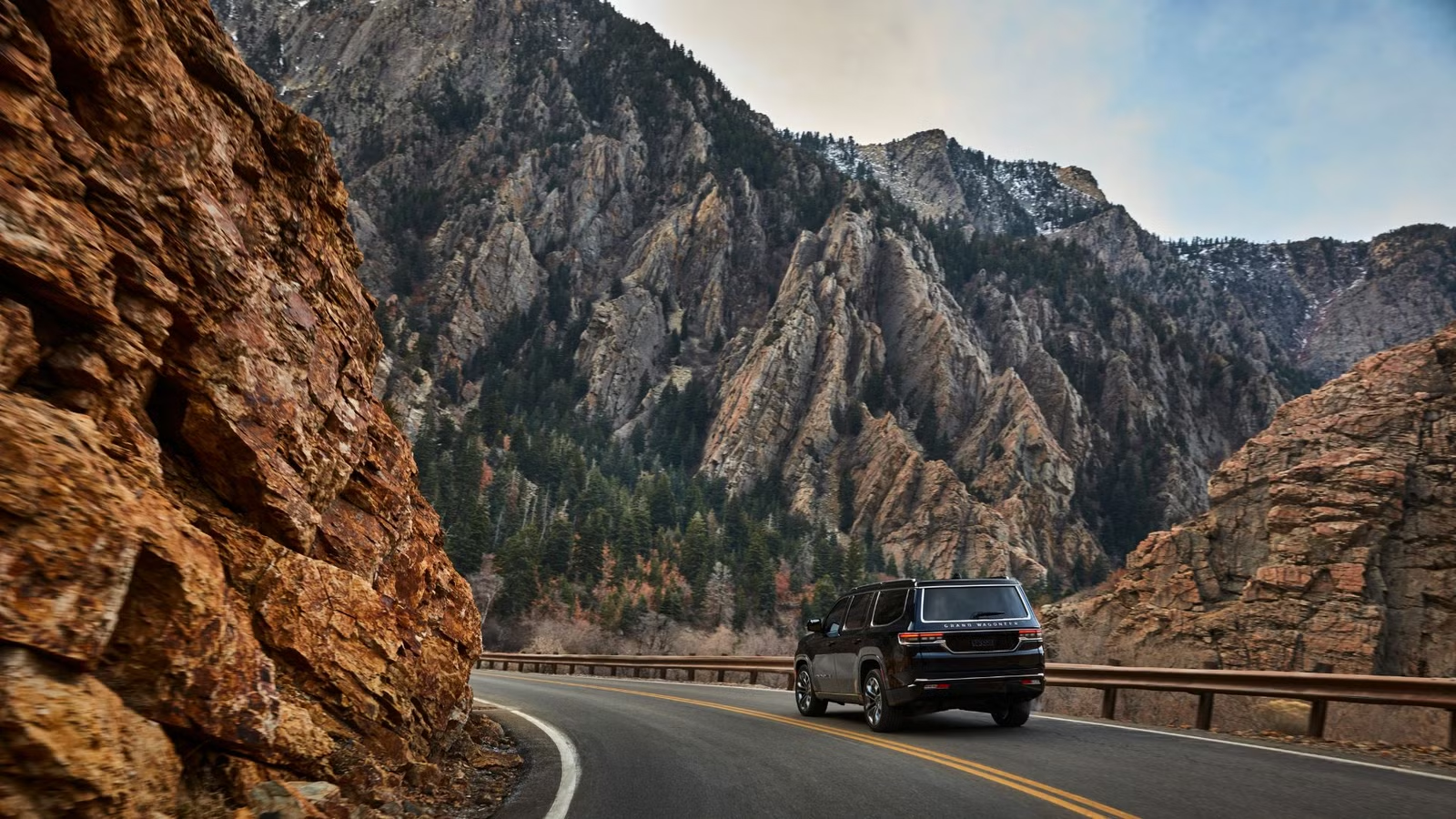
If you’re one of those families that can never have enough 4th of July road-trip space, the 2025 Jeep Wagoneer takes a different approach to the holiday road trip … bring everything. Its full-size cabin offers abundant space for passengers, pets, coolers, sports equipment, camping gear, and luggage, and the powerful turbocharged inline-six enables towing a pop-up camper trailer, boat, dirt bikes, or a racecar. Its elevated seating position provides a commanding view over traffic and grants a better view of the passing scenery.

The Jeep Wagoneer returned to the Jeep lineup for 2022, after four decades (not counting Grand Wagoneers), and has since transitioned to an all-electric model, leaving the ICE variants to the Grand Wagoneer. It has all the size, space and luxury attributes of a flagship vehicle, and can serve as a rolling vacation headquarters for weekend road-trippers. Today’s Wagoneer is much larger than the classic, but carries on the legacy of combining rugged utility with family-leaning luxury and comfort.
2026 Lucid Air
A New Breed Of American Luxury Cruiser

Still another take on the large luxury cruiser, the 2026 Lucid Air turns a long drive into a surprisingly serene experience, but you have to be comfortable navigating the charging grid. Its 400-mile range makes that easier (it can top 500 in the Grand Touring model), and fast-charging speeds make quick work of getting back on the road. The interior is airy, spacious, and comfortable, and there’s plenty of room for take-alongs front and rear, belying its sleek exterior.

The Lucid Air was the company’s first production vehicle, in 2021, aiming directly at the premium electric-sedan market mostly dominated at the time by the Tesla Model S. From the start, it made its reputation for remarkable acceleration and record-setting ranges. The Lucid Air lineup has since expanded from efficient tourers to mind-blowing performers, and has spun off a crossover in the Gravity. Over its short lifespan, it has shown that EVs are viable long-distance trippers.
2026 Tesla Model Y
Quiet Long-Distance Cruising Wagon

If you want a little bit more versatility from your EV, and are comfortable mapping out your route, the 2026 Tesla Model Y excels at efficient holiday driving. Its hatchback layout, flat floor, and fold-flat rear seats can handle coolers, beach gear, camping equipment and luggage, but not all together. Electric propulsion and a small footprint mean less stress in stop-and-go traffic downtown or when entering parking areas at the beach or a historic site. It can also go upwards of 300 miles on a full charge, with quick charging breaks at Tesla’s extensive charging network.

Tesla introduced the Model Y for the 2020 model year as a crossover companion to the Model 3 and redesigned it for 2026. It quickly became one of the company’s, and the world’s, best-sellers for its blend of range, performance, and practicality. Today, the Model Y is one of the most common EVs on American roads thanks to its compact crossover desirability, useful cargo space, strong acceleration, and enough range to make road trips a routine element of EV ownership.
2026 Cadillac CT5
Long-Distance American Luxury Cruiser

There’s something about the name Cadillac that evokes memories of plush road trips, but the 2026 Cadillac CT5 is far removed from the land-yachts of old that served in that capacity, though it still aptly enables a satisfying road trip with its comfortable highway ride, and responsive country switchback handling. The interior is all about modern comfort with supportive seating and fatigue-reducing driving aids. Though not comparable to a 1977 Fleetwood 75, the CT5 trunk can hold a usable amount of luggage, beach chairs and picnic baskets.

The Cadillac CT5 was introduced in 2020 as a replacement for the CTS (yes, designers just squared up the top curve of the S), as a prime contender against midsize European sedans from Audi, BMW, and Mercedes, without abandoning the distinctly American slant on luxury space and comfort. Over the half-decade, it evolved into a Cadillac core model, steering clear of the industry slide into crossovers, upgraded its interior, refined its technology, and pushed the performance envelope with a V-Series high-performance model.
2026 Ford Mustang Convertible
The Ultimate Iconic Road-Trip Car

There’s arguably nothing sensible about the 2026 Ford Mustang Convertible as a holiday getaway car—its suspension is stiff, it hardly has room for a water bottle, and under a blazing summer sun, it has the breezy airflow of a convection oven—but it is the iconic road-trip car, made culturally relevant in film, song, and parades. It epitomizes the road trip as a memorable journey, as opposed to a journey to a memorable destination. Its rear seat is tight, its trunk is small, but driving it to the beach, a lakeside fireworks display or along a scenic coastal highway transforms the ordinary into the memorable.

The Ford Mustang was introduced as a convertible 60-some years ago, and has held that charm around the world since (though its coupe models have struggled with fans at various times). The current model’s profile still holds the classic proportions, and refrains from the modern trend to make convertible hardtops that make winter driving more bearable. Today, it continues to occupy a unique place in the American market, as an affordable performance-oriented convertible that captures the spirit of the road trip.
Sources: OEMs, Kelley Blue Book, Edmunds

Related posts






Latest Post


No Comments