
The 1969 Charger Half-Breed More Rare Than The Daytona
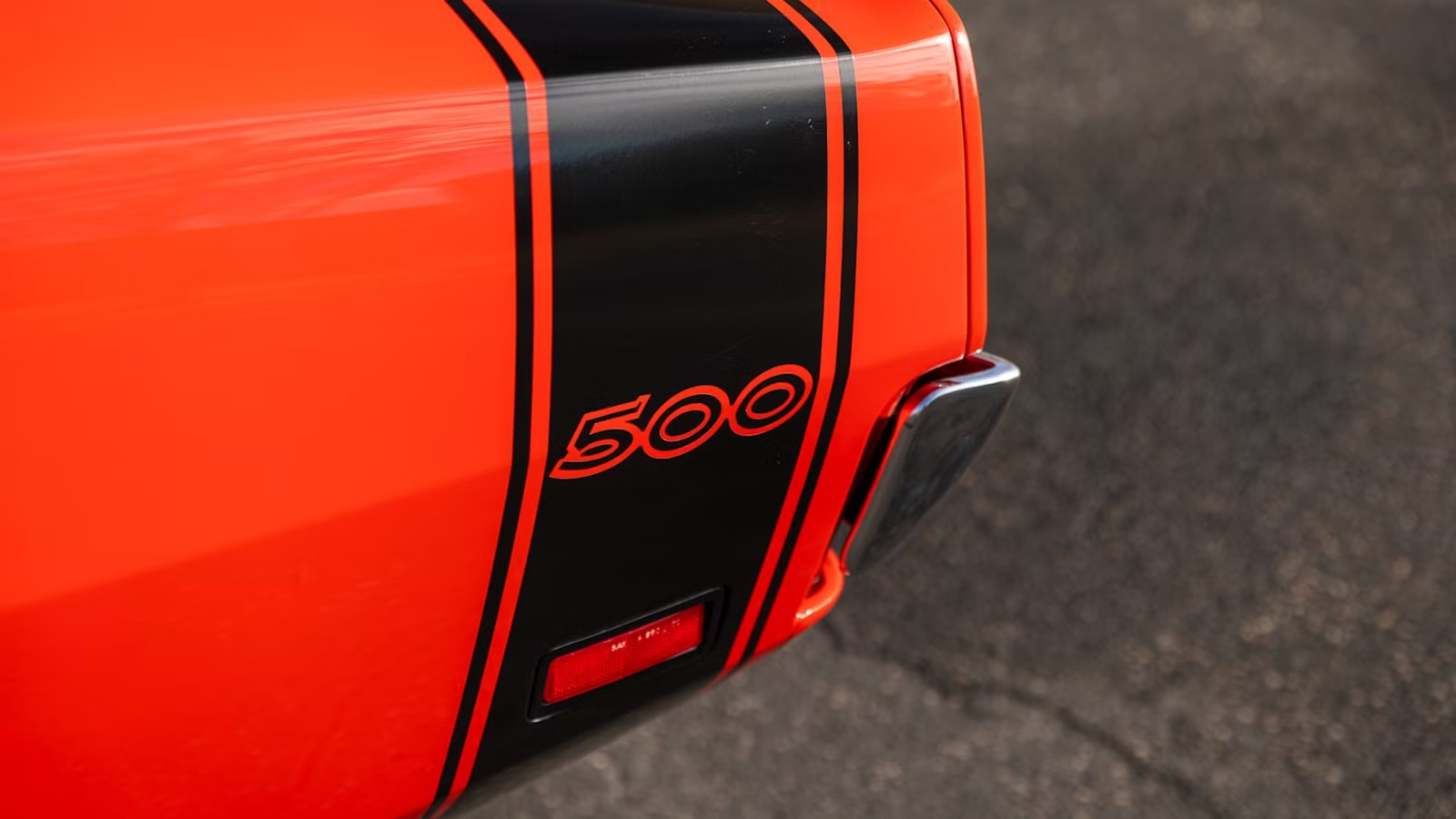
Because of the popularity of The Dukes of Hazzard and Fast & Furious, a lot of folks are under the impression that the second-gen Dodge Charger is a fairly common ride, but in reality it is quite rare, at least in pure muscle car form. Dodge designated the R/T as the Charger’s muscle car trim, which started with a 440 Magnum V8 and went up to the ultimate Golden Age engine with the 426 Street Hemi. To put things into perspective, Dodge built 47,978 Charger R/Ts between 1968 and 1970, while during the same time period, Chevy cranked out 206,274 Chevelle SS cars. Another misconception is that the 1969 Daytona aerocar is the rarest of the second-gen Chargers, but there is one that was kind of Frankensteined together that is far more elusive.
First-Gen Charger Glass Slipper

The boxy Dodge Coronet and Plymouth Belvedere of the mid-1960s were dominant NASCAR champs and so Chrysler figured if they built a more aerodynamic car it would crush it even harder. That was the mindset that went into the design of the first-gen 1966 Dodge Charger with a long sweeping roofline and decklid. It turned out that the Charger’s fastback style caused a low pressure zone over the rear axle that resulted in lift at high speeds. Drivers described it as speeding over ice or driving on glass, which is obviously terrifying. Now here’s where things get weird: David Pearson won the 1966 NASCAR championship driving a Charger, taking 15 out of 49 races and finishing with 35,638 points. Dodge came up with a fairly easy fix to the lift issue by installing a small spoiler on the Charger’s trunk, and apparently that did the trick.
Second-Gen Is The Wrong Kind Of Drag Car

Having fixed the issues with the first-gen Charger, Dodge sought to fix it even more with the second-gen in 1968, but somehow made things much worse. With sexy Coke bottle curves and a bold, aggressive stance, the second-gen Charger was the defining ride of the Golden Age of American Muscle, but all that style was kind of a drag, literally. The ’68 Charger’s deeply recessed front grille with hidden headlights looked aggressive on the street, but on the track it acted as a dam that had air piling up in it, which added both drag and front-end lift. The Charger’s “flying buttress” rear window that was recessed between side pillars, trapped turbulent air that also caused drag and lift. Top speeds were impossible with this design and, adding insult to injury, the car wanted to go straight into the turns, and it was a chore to keep it off the walls.
Third Time Is Not The Charm

The 426 Hemi V8 was so dominant when it was introduced in 1964 that Ford complained to NASCAR, which temporarily banned it until it could be homologated. Despite this ferocious power, the Hemi couldn’t do anything for the Charger because of its design flaws. In 1969, Dodge addressed the issues with the Charger 500, which used the flush grille from the Coronet and smoothed out the back window for a far more aerodynamic ride. While the Charger 500 wasn’t bad, and it did win some NASCAR races, it wasn’t the dominant performer Dodge was hoping for. Ford also developed the super-aerodynamic Torino Talladega, which David Pearson—who had defected to Ford—drove to the ’69 championship.

’69 Dodge Charger 500 Homologation Unicorn

Back when NASCAR was still more or less a stock car racing series, in order to qualify for competition, a car had to be a regular production model that was sold to the public. In 1969, the requirement was at least 500 cars, which is actually where the Charger 500 gets its name from, but in a strange twist, NASCAR allowed it to compete before it came close to that level of production. There is actually no good explanation as to why the Charger 500 was allowed on the track before meeting homologation requirements, but maybe NASCAR was treating it as a trim of the second-gen Charger, rather than an entirely different car. One rumor out there is that NASCAR was looking to involve as many cars and automakers as possible to help grow the sport, and weren’t particularly strict about the rules.
Production Falls Short of 500

Many enthusiasts assume that the Charger 500 was named after NASCAR’s marquee race, the Daytona 500, and considering that it was replaced by a car literally named the Daytona, that’s a reasonable take. As we already mentioned, it was actually dubbed the 500 due to its homologation requirements, but it realistically fell well short of that. The Charger 500 went into production in late 1968, but by early Spring 1969, Dodge shifted focus to the Daytona, after only 392 cars had been built. That seems like a number with a purpose, given that the Chrysler FirePower 392 V8 was the first legendary Hemi engine, back in 1957, but it’s probably just a coincidence. The 1970 Plymouth Hemi ‘Cuda, which was the most wicked Golden Age muscle car, had a production run of 666 units, which again seems intentional, but is probably just some awesomely evil serendipity.
The 500 is the Hemi Holy Grail

The Chrysler 426 Street Hemi V8 was introduced in 1966 and was available to all Dodge and Plymouth intermediate models. In 1968, Chrysler decided that this dynamo had no business under the hoods of family rides and mandated that it only be equipped in designated muscle cars. For Dodge, that meant the Charger and Coronet R/Ts, as well as the Super Bee. The Charger 500, which was obviously not an R/T or Bee, got a pass, and it ended up being the rarest Hemi Mopar of the classic era. With a mere 60 Hemi Charger 500s produced, it’s beyond a unicorn and flirting with Holy Grail status. The next closest is the ’69 Daytona with 70 Hemis, but there is a possibility that the 500’s replacement may have been equipped with the Hemi only 41 times. Officially, the Daytona is considered a 70 Hemi nameplate, so until concrete proof of the contrary emerges, the 500 is the rarest Hemi Mopar there is.
Charger 500 On The Road And Track

The 426 Race Hemi and Street Hemi are two different engines, but both are officially rated at 425 horsepower and 490 pound-feet of torque. While there’s a zero percent chance that either of those ratings is accurate and a 100 percent chance that they are woefully underrated, that’s Chrysler’s cover story and they’re sticking to it. On the NASCAR circuit, the Hemi-equipped 500 won somewhere between 9 and 19 races in 1969. The discrepancy comes from the fact that often a winner was identified only as driving a Dodge, and at some point in ’69 the dominant Daytona made its debut, which accounted for some of those checkered flags. On the streets, the Charger 500 could hit 0-60 in five seconds flat and blast a quarter-mile in 13.48 seconds. This was among the quickest Mopars of the year, but more importantly, it represented devastating acceleration for Ford and GM muscle cars that were stuck in the 14s.
Replaced By A Winged Warrior

The reason why the Charger 500’s production was cut short is because Dodge was developing the 1969 Daytona aerocar, which put it and all other race cars to shame. With an 18-inch nose cone and 23-inch rear wing, this car could cut through the wind like a ballistic missile and had remarkable stability at top speeds, which reached 200 MPH for the first time. The ’69 Daytona dominated NASCAR’s 1970 season with Bobby Isaac taking the championship that year behind the wheel of one. To homologate the Daytona—which, strangely, wasn’t an issue since it was racing before a single car was ever sold to the public—Dodge needed to move 500 of them, but the brand topped that with a 503-unit run. 70 (maybe) of those were equipped with a 426 Hemi, with the rest shipping with 440 Magnum V8s. The 392 Charger 500s produced are far rarer, as are the 60 Hemi cars, but as you will soon see, it doesn’t make them more valuable.
’69 Charger 500 Prices and Values

A Hemi-equipped 1969 Dodge Charger Daytona is a multi-million-dollar ride with a top sale of $3.36 million at Mecum Monterey 2024. A much rarer ’69 Charger 500 doesn’t even come close with a Hagerty Concours condition value of $276,000. Now, that’s a significant sum of money, but nothing compared to the Daytona, and that disparity can be chalked up to the fact that the aerocar was a visual spectacle, as well as a NASCAR winner. In real world sales, the 500 hasn’t quite lived up to the Hagerty value with a high bid of $270,000 but no sales. Two 500s, including that F8 Green one pictured above, have sold for exactly $231,000, which makes it one of the priciest second-gen Chargers, but we feel like the sheer rarity of this classic Mopar demands a higher price. The 500s packing 440s are relatively attainable muscle cars, with a top condition value of $146,000 and super-clean examples selling for as low as $53,900.
Sources: Hagerty, Mecum, Dodge

Related posts




Latest Post


No Comments