
The 1969 Cadillac Custom Wagon Built for the Indy 500
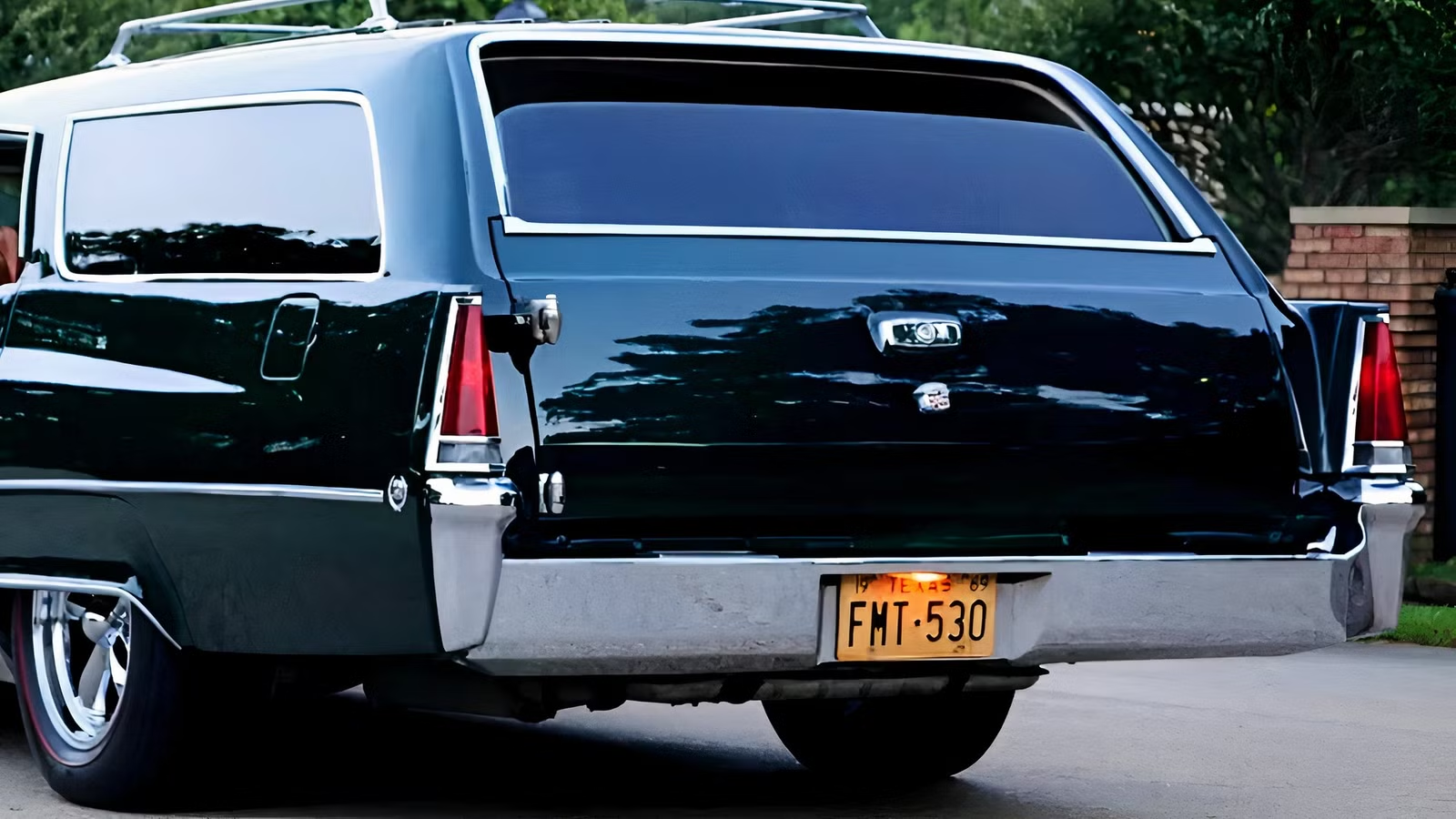
Cadillac never needed to build a station wagon. Put simply, if you were wealthy enough to afford one, you could also afford to have things delivered to your front door, or even send your kids to school in another Cadillac. At its core, the purpose of a wagon and a flagship Cadillac are somewhat ideologically opposed. Yet, that didn’t stop a handful of Caddy wagons from sneaking their way onto the scene, with or without help from the OEM. Yes, even Cadillac at the height of its influence occasionally made exceptions to hard-and-fast rules when it served its interests. The results? Well, they were nothing short of stunning.
Cadillac Wagons: Ethereal Beings of the Car World
Cadillac spent nearly the first four decades of its existence doing anything but building wagons. Back in the primordial days of the American auto industry, the differences between a four-door sedan and something we might identify today as a wagon were pretty minute to begin with. With how boxy cars of the period tended to be, this is understandable. The first American company to offer a turnkey approximation of what we’d now call a wagon was the Durant Motors Company, the Star. Coincidentally, Durant Motors itself was founded by the one and only William C. Durant, the same man that founded General Motors in 1908, and purchased Cadillac the following year.
Meanwhile, the closest you could come to owning a genuine Cadillac wagon was to commission one yourself. Several third-party coach builders and even a few DIY man-in-shed operations took on the task of converting normal Cadillac sedans into wagons. Most notably, an Ohio firm called Hess & Eisenhardt, famous for fabricating armored limos for American presidents, took a heavily modified Series 62 chassis and running gear, constructed a wood-paneled wagon body to mount on top of it, and called it the View Master. Only seven View Masters left that Cincinnati production line in 1956, but it did at least prove that building a well-sorted, proper Cadillac wagon was possible.

Not that Cadillac would even consider building something similar at the arguable height of its prestige in the market. Even then, such an endeavor was seen as beneath its standing. In the minds of General Motors executives, it would’ve been no different from Bentley or Rolls-Royce trying to build a wagon, an almost impossible notion to imagine. Yet, at least once, Cadillac did manage to be persuaded into building an incredibly small run of wagons in the 1960s. Of course, it wasn’t for any ordinary client, but one so massive and influential that even Caddy had to take notice.

The 1969 Indy 500 VIP Fleet

The mid-to-late 1960s is commonly seen as the cultural zenith of the Indy 500, a time when not only America’s finest open-wheel drivers flocked to Indianapolis to test their mettle in the country’s biggest race, but also a contingent of European drivers imported from Formula 1. It was a time of great change for the sport, marked by the transition from front- to mid-rear-mounted engines, and even experimentation with gas-turbine powerplants.
The 1969 race saw close to 300,000 people in attendance, at a time when media blackouts were largely thought to boost in-person attendance numbers. All the while, GM’s Chevrolet division supplied its Camaro as the race’s pace car, and needed a novel way to transport its corporate executives, sponsors, and VIP guests to and from the venue, and around the Indianapolis Motor Speedway grounds. The group certainly could’ve used an Oldsmobile Vista Cruiser or Chevy Kingswood in theory. And yet, ferrying around bona fide celebrities like Dean Martin and Joe Louis in common family haulers seemed a little undignified.

As such, and for the first time in history up to that point, Cadillac was called upon to produce a tiny production run of first-party, OEM-built luxury wagons to transport GM’s honored guests for the duration of the event. Hardly anyone remembers it now, and it would be the last time a Cadillac executive even thought about producing a wagon until the mid-to-late 2000s. In doing so, they accidentally created one of the most obscure and one of the most wonderfully unique Cadillacs of the 1960s. The only problem was, well, they only ever built five of them.
1969 Cadillac Custom Wagon: The Wagon You Never Knew You Wanted

To make it happen, Cadillac took five 1969 Sedan DeVilles, re-engineered the back portion to mimic contemporary GM wagons while keeping the pillarless side profile, as well as everything else that made it a quintessential late ‘60s Cadillac. So the story goes, Cadillac contracted the heavy lifting to a firm called National Coaches in Knightstown, Indiana. The company dates back to 1946, when a former foreman named Vernon Z. Perry assumed control of a derelict funeral car factory, dedicating it to coach built hearses, ambulances, and specialty VIP transport vehicles for just such an occasion as the Indy 500.
Under the hood was the same 472-cubic-inch Cadillac V8 from the standard DeVille, a whopping 7.7-liter plant with 375 gross hp and 525 lb-ft of torque on tap. Believe it or not, this wasn’t even the largest motor Cadillac would build, as the same block had provisions for further expansion up to a massive 500 cubic inches or 8.2 liters. In the case of the ultra-rare Caddy wagon, it would need every one of those cubic inches to push all that extra metal and glass around. Official weight figures were never floated, and given how few of these Caddy wagons existed, how could you blame them? Yet, if a stock 1969 Sedan DeVille weighed somewhere in the vicinity of 4,700 lbs, it’s fair to say these wagons safely crossed over the 5,000 lb threshold.

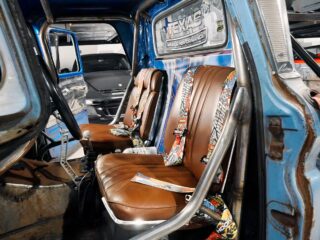
In the modern day, where the average electric three-row SUV weighs that much, it might not sound like an insane figure. Yet, by the standards of the late 1960s, the only way to drive something heavier would have been to buy a tractor-trailer. Even by ’60s luxury land barge logic, the Caddy Wagon was an utterly impractical vehicle, but at least you rode around in acres of leather lining every surface you could see, touch, or smell. Like any Cadillac of the day, it was more sublime to drive than anything short of the above-mentioned Rolls or Bentley. After the 1969 Indy 500 concluded, following Mario Andretti’s historic win, all five Caddy Wagons were shipped off to a dealership in Dallas where they were sold to private owners.
Proving the CTS Formula Decades Early

Today, the VIP Caddy Wagon is a curiosity, one that seldom shows up on public auction forums but sells for in excess of $30,000 when it does. Meanwhile, it’d take decades for Cadillac to try and sell a production-spec wagon to the American public. It only happened after the Cadillac CTS Sport Wagon hit the scene in 2010 for the 2011 model year.
Cadillac even put the 6.2-liter supercharged LSA V8 derived from the C6 Corvette ZR1 under its hood and called it the CTS-V Sport Wagon for a time. It makes you wonder what might’ve been had Cadillac given a genuine mass production effort towards a wagon platform all that time ago. If you ask us, it probably would’ve been utter fireworks.
Source: Bring a Trailer, Indycar Series Photo Gallery, Cadillac

Related posts
Latest Post



No Comments