
Tesla Underperformed Major Rivals In The Largest EV Battery Study Ever Conducted
A study published this week by AVILOO, an Austrian battery diagnostics firm, has delivered the most comprehensive look yet at how EV batteries age in the real world — and Tesla’s results stand out for the wrong reasons. Drawing on more than 500,000 individual battery tests conducted between 2022 and 2026 across five continents, the report covers 20 popular EV models at three mileage milestones: 50,000 km (31,068 miles), 100,000 km (62,137 miles), and 150,000 km (93,205 miles).

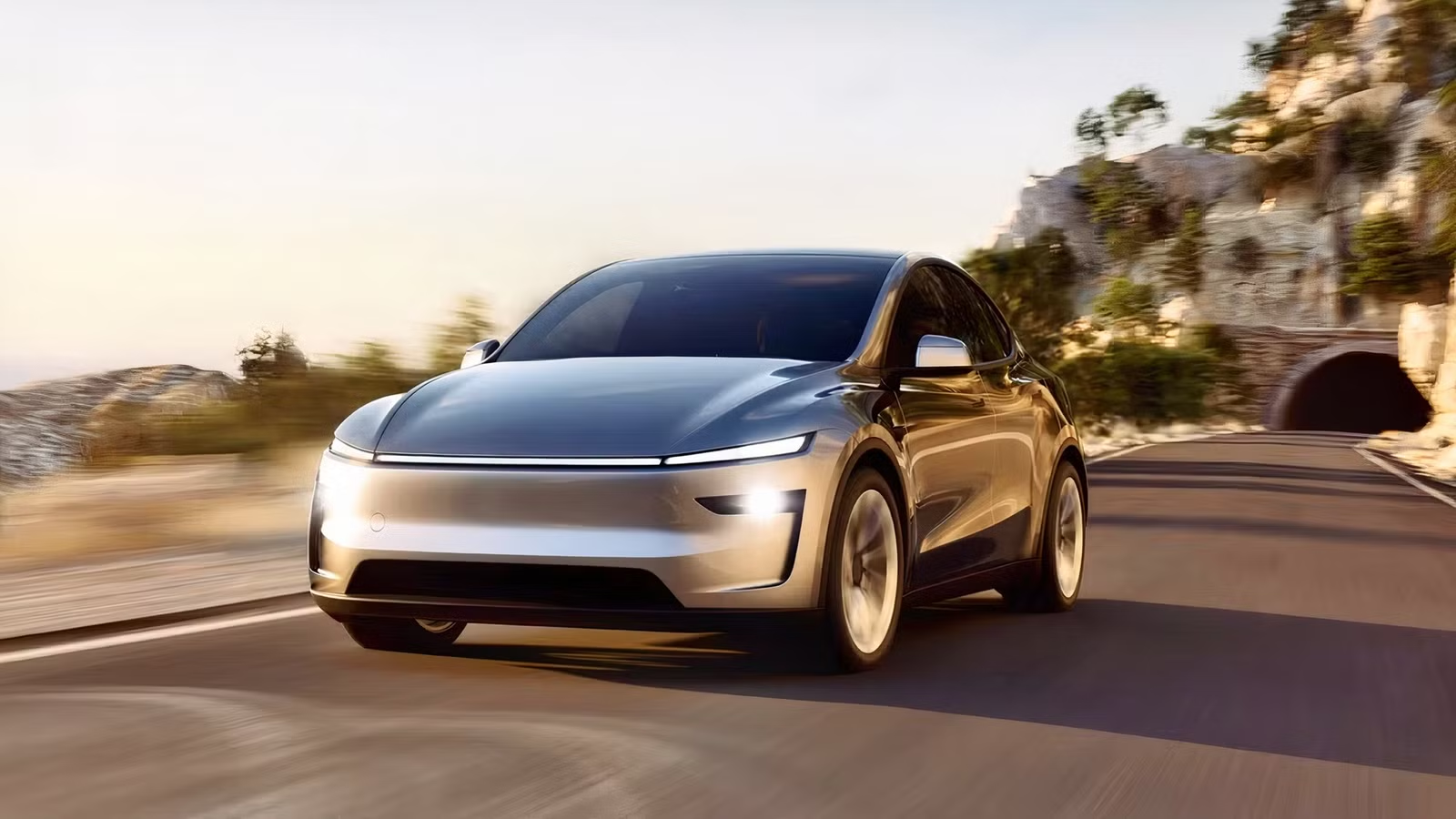
At the 150,000 km mark, the Mercedes-Benz EQA led all models with a median battery state of health of 94.0%, followed closely by the Hyundai Ioniq 5 at 93.8% and the BMW i4 at 93.6%. The Tesla Model Y came in at 90.3%, and the Tesla Model 3 fared worse still at 88.9% — placing both squarely in the bottom half of the table. For buyers weighing long-term ownership costs, those gaps are not trivial.
What the Numbers Actually Mean for Used-EV Buyers
Battery state of health (SoH) is a measure of how much of a pack’s original capacity remains usable. A car sitting at 88.9% SoH after 93,000 miles doesn’t just have less range than it did new — it’s also harder to price accurately on the used market, because buyers and sellers have no standardized way to verify it without independent testing.

AVILOO CEO Marcus Berger put it plainly: “A gap of ten or fifteen percent in state of health is a real difference in range, in what a car is worth, and in what you can rely on it for.” At 150,000 km, the spread between the best and worst individual examples of the same model reached as high as 13.5 percentage points — equivalent to roughly 46 km of real-world range per charge. That’s the difference between a car that completes a long day trip and one that needs an extra charging stop.
The Tesla Model Y showed the highest variation between individual units of any model studied, both in lab testing and observed real-world range. The Nissan Leaf, by contrast, showed the least variation — meaning used Leaf buyers face a more predictable outcome, even if the median SoH is lower. The Ioniq 5 and Volkswagen ID.4 sat between those two extremes.
The Full Rankings Tell a Consistent Story

The pattern held across all three mileage checkpoints, not just the final one. At 50,000 km, the Ioniq 5 led with 97.1% median SoH, followed by the Mercedes-Benz EQA at 96.6%, the Hyundai Kona EV at 96.3%, the Audi Q8 e-tron at 95.7%, and the BMW i4 at 95.6%. The Tesla Model Y posted 94.4% at that same early interval — not a disaster, but already trailing the top performers.
By 150,000 km, the gap had widened. The Volvo XC40 Recharge held 92.8%, the Ford Mustang Mach-E and Polestar 2 both landed at 92.5%, and the Volkswagen ID.4 came in at 90.8%. The Tesla Model 3’s 88.9% placed it alongside the Renault Zoe (87.3%), Mini Cooper SE (87.1%), and Nissan Leaf (86.7%) — models with notably smaller battery packs that AVILOO notes require more frequent charging cycles, accelerating wear.
Climate and charging behavior are significant variables. AVILOO’s methodology sampled vehicles across North and South America, Europe, Australia, and Asia specifically to account for the range of conditions real owners face. Hot and cold climates both affect battery longevity, and the study’s global spread was designed to make the median figures representative rather than regionally skewed.
Why Battery Health Is Now a Pricing Variable

Used EVs are already subject to steeper depreciation than comparable gas-powered vehicles. CarEdge estimates a new Hyundai Ioniq 5 loses around 51% of its value over five years, while a gas-powered Hyundai Tucson retains 57% over the same period. A BMW i4 depreciates roughly 53% in five years against 46% for a gas 4 Series.
Battery health adds another layer of uncertainty on top of that. Unlike a combustion engine, whose condition can be broadly inferred from service history and mileage, an EV battery’s usable capacity can vary significantly between two cars with identical odometer readings — depending on how they were charged, where they lived, and how often they sat at high or low states of charge. AVILOO’s data makes the case that an independent battery health certificate should be treated as a baseline requirement before any used EV changes hands. The study’s own conclusion is direct: before buying a used EV, demand a battery health report.
The good news buried in the data is that EV batteries overall are holding up better than early skeptics predicted. At 50,000 km, the median SoH across all 20 models was 95% — and even the worst performers at 150,000 km remained well above the 70–80% threshold where a pack is typically considered at the end of its useful life. But “better than feared” and “equal across brands” are two different things, and this study makes clear they are not the same.
Source: AVILOO, CarEdge

Related posts




Latest Post


No Comments