
Tesla Adding Grok Puts Real Pressure On Every Other Automaker’s In-Car AI Strategy
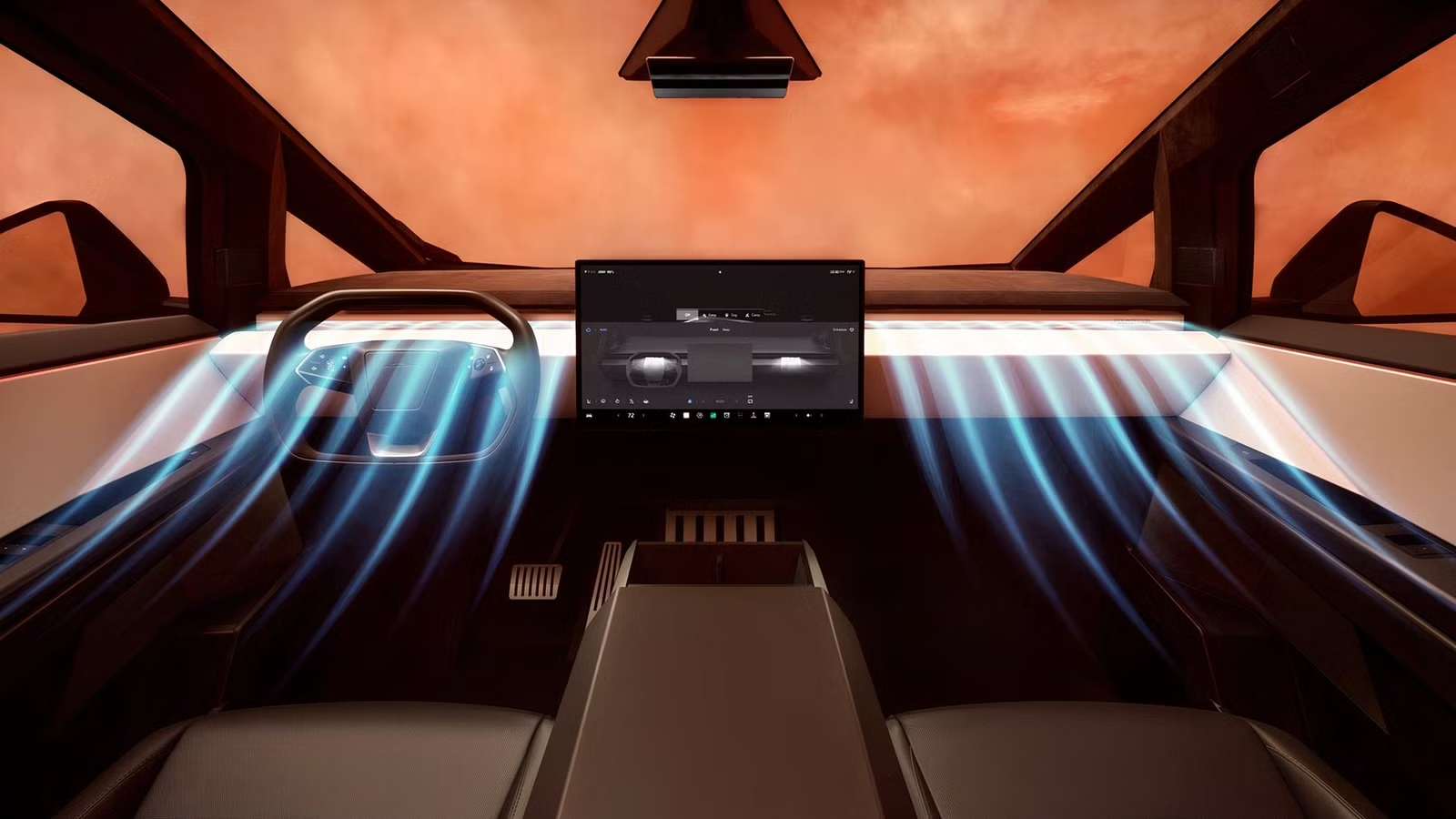
Tesla is moving closer to embedding Grok Bot — xAI’s autonomous agent platform — directly into its vehicle operating system, and the implications stretch well beyond what any in-car voice assistant has attempted before. The signal came this week when Louise Giam, a Grok Voice and Chat engineer at xAI, replied “Stay tuned” to a user asking whether drivers could soon manage Grok Bot agents from behind the wheel. The post was later deleted, but the message landed.

This is a different category of capability than what Grok already does inside Tesla cabins today. The Summer 2026 feature drop gave Grok deeper vehicle control — climate adjustments, Settings menu toggles, natural language navigation — but Grok Bot operates as an always-on AI agent running on a dedicated cloud virtual machine, capable of executing multi-step workflows across external apps and websites. That distinction matters enormously for how automakers think about what their infotainment systems need to become.
What Grok Bot Actually Does That a Voice Assistant Cannot
Standard in-car voice assistants — including the current Grok Chat integration Tesla rolled out with software update 2025.26 in July 2025 — respond to prompts. Ask a question, get an answer. Set a destination, get directions. Grok Bot works differently: it runs continuously in the background on cloud infrastructure, taking on multi-step tasks the way a human assistant would.

A practical example from the sources illustrates this well. A driver could ask Grok Bot to check their calendar, find the meeting address buried in an email chain, and automatically push that destination to the navigation system — all via voice, while Full Self-Driving (Supervised) handles highway driving. That’s not a chatbot interaction. That’s workflow delegation. Grok Bot’s capabilities are also set to expand quickly following xAI’s $60 billion acquisition of Cursor, a move aimed at strengthening the platform’s agent coding infrastructure.
The real-world proof of concept arrived on August 29, when a user shared a screenshot showing Grok Bot had independently placed a Tesla Model Y order on their behalf — with explicit permission and a single-use virtual credit card for security. It’s an early and admittedly niche demonstration, but it confirms the platform can execute high-value, multi-step transactions through live APIs. That’s the architecture Tesla is now looking to bring into the cabin.
Where Rivals Actually Stand on In-Car AI

The brief asked for a direct comparison with BMW, Mercedes, and GM’s OnStar — and it’s worth being honest about what the research bundle can and cannot confirm here. The sources don’t include detailed breakdowns of current rival implementations, so specific capability claims about those systems aren’t available to make without risk of error.
What the bundle does establish clearly is the gap in ambition. Existing in-car AI systems across the industry — including well-regarded implementations from German luxury brands and GM’s connected services — operate primarily as reactive assistants: respond to voice commands, surface information, connect calls, stream music. None have publicly demonstrated the kind of autonomous, multi-step workflow execution that Grok Bot is designed to handle. The closest analogue in the consumer AI space is Amazon’s Alexa, which has long offered voice-activated shopping on its own platform, but no major automaker or AI assistant provider has shown a comparable agentic capability at scale in a vehicle context.
Timeline, Model Availability, and What Remains Unconfirmed

No official rollout timeline or model-specific availability has been confirmed. The only public signal is Giam’s since-deleted “Stay tuned” reply, which suggests something is in development but offers no launch window. Grok Chat’s trajectory — U.S. debut with update 2025.26, then expansion across North America, Europe, and Asia — suggests Tesla would likely roll Grok Bot access out similarly, starting with its existing Grok-capable fleet before broadening availability.
On pricing, the sources don’t confirm whether Grok Bot in-cabin access would require a separate subscription or be bundled with existing Grok access. That’s a meaningful open question for buyers, given Tesla’s history of gating software features behind subscription tiers. Elon Musk has previously confirmed that FSD voice control via Grok is coming, but the sources don’t support specific claims about when or how that integration arrives beyond that general confirmation.
For automakers watching this space, the Grok Bot tease is less about one feature and more about the direction of travel. Tesla has spent the past year systematically deepening Grok’s access to vehicle systems — from navigation to climate to Settings — and is now signaling a move toward cloud-connected agentic AI that treats the cabin as a workstation. That’s a roadmap other manufacturers will need to respond to, whether through their own AI partnerships or by rethinking what their infotainment platforms are actually capable of.

Related posts


Latest Post


No Comments